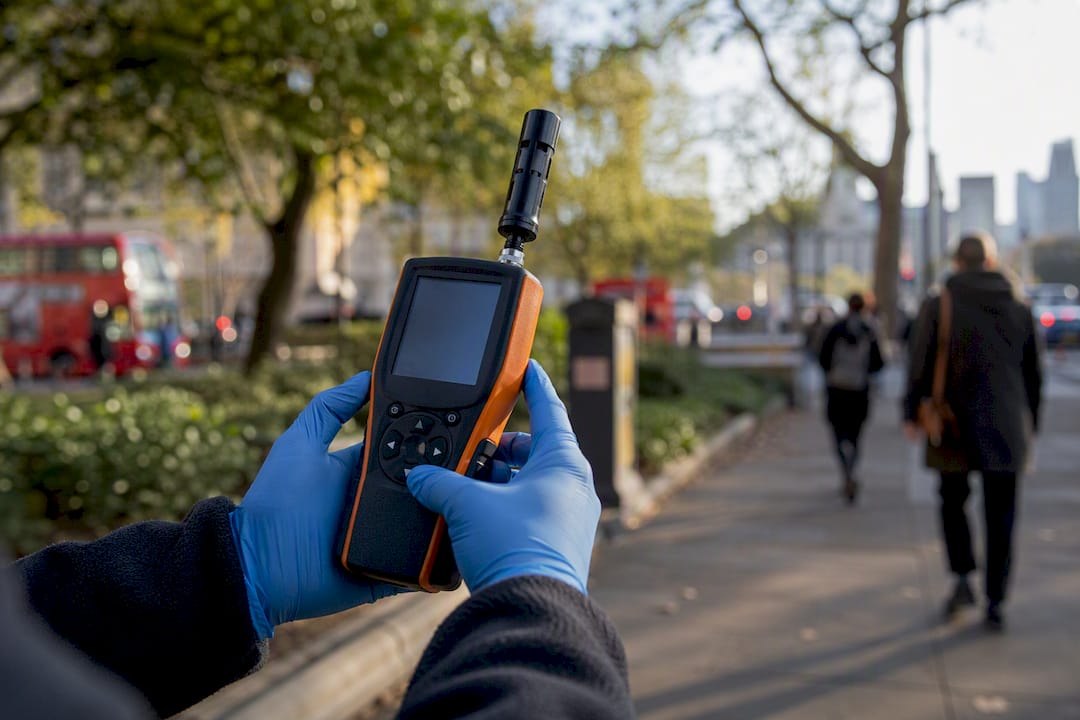
Air Quality Positive: What UK Developers Must Prove
Air Quality Positive requires large-scale, EIA-referable masterplans and applications to demonstrate how the proposal will maximize local air quality benefits and minimize exposure. An AQP Statement, submitted alongside the Environmental Impact Assessment, is the mechanism that shows this to the decision maker.
If your scheme is a masterplan or a phased development referable to the Mayor under EIA regulations, you almost certainly need one. Smaller, single-plot applications typically fall under Air Quality Neutral instead, which works differently.
The statement itself needs to do three things:
- Set out the design decisions and measures that reduce exposure and improve local air quality, mapped against four themes
- Show how each measure will actually get delivered and paid for, not just proposed
- Set a monitoring plan so the local authority can check the promises hold up after occupation
Get an air quality specialist involved at concept design stage, before the massing and layout are locked in. Retrofitting AQP thinking onto a finished scheme is where most rejected statements come from.
Key Takeaways
Air Quality Positive succeeds when design-stage measures are matched to a realistic securing mechanism and a monitoring metric the local authority can actually verify after occupation.
| Point | Details |
|---|---|
| Confirm applicability early | Check whether your scheme is masterplan-scale or EIA-referable before assuming AQP applies. |
| Engage specialists at concept stage | Bring air quality input in before layout and massing are fixed, not after. |
| Build a complete matrix | Populate all seven matrix columns, including securing mechanism and monitoring metric, for every measure. |
| Match securing route to measure type | Use conditions for fixed physical items and Section 106 or 278 for ongoing or highway-related commitments. |
| Work with Fortress Associates | Fortress Associates drafts AQP Statements and matrices against live official data, backed by a 100% planning discharge rate and an amend-or-refund guarantee. |
Table of Contents
- What Does Air Quality Positive Mean in Planning Terms?
- When Do You Need an AQP Statement?
- The Four AQP Themes and What Belongs Under Each
- How Do You Build the AQP Measures Matrix?
- Securing Delivery: Conditions, Section 106, and Monitoring That Holds Up
- How Fortress Associates Supports AQP Compliance
- What Do Successful Air Quality Positive Projects Look Like?
- What Trips Up Applicants on the Way to AQP Status?
- Why Community Engagement Strengthens an AQP Case
- What Technology Is Shaping AQP Measures Now?
- What Are the Real Health and Environmental Benefits?
- How Does London’s Approach Compare Internationally?
- Why Most AQP Advice Misses the Point
- Get Your AQP Statement Right the First Time
- Sources
What Does Air Quality Positive Mean in Planning Terms?
Air Quality Positive is a qualitative, design-led approach. It asks: what has this scheme actually done to make air quality better and reduce exposure for the people who will live, work, or walk through it? There’s no pass/fail number attached.
That’s the crucial distinction from Air Quality Neutral (AQN), which does use numeric benchmarks. AQN checks whether a development’s transport and building emissions stay within calculated limits for its location and use class. It’s a threshold test. Air Quality Neutral under Policy SI1 is largely a compliance exercise: calculate, compare, adjust if you’re over.
AQP has no such ceiling. It’s broader, evidence-based, and judged on the quality of the case you build, not a formula. The guidance itself deliberately avoids strict numeric thresholds for AQP, which shifts the burden onto applicants to prove secured, measurable delivery rather than hit a target.
Key differences worth internalizing:
- AQN = numeric benchmark against emissions from transport and buildings
- AQP = qualitative demonstration of net benefit and exposure reduction
- AQN applies more widely; AQP applies to large-scale and EIA-referable schemes
- Both sit under London Plan Policy SI1, but they ask fundamentally different questions
Confusing the two is the single most common early mistake we see on large sites.
When Do You Need an AQP Statement?
AQP Statements apply to masterplans and large-scale developments that are EIA-referable, meaning they trigger environmental impact assessment under the relevant regulations and are typically referable to the Mayor of London. Consultation materials behind the policy are explicit that AQP is meant for sites where area-wide design and infrastructure changes can make a meaningful difference, which is why it’s aimed at strategic scale rather than single buildings.
Timing matters more than most teams expect:
- Plan-making stage. If you’re preparing a masterplan or opportunity area framework, build AQP thinking into the design brief from day one.
- Planning application stage. Submit a full AQP Statement alongside your Environmental Statement, with the measures matrix populated.
- Reserved matters and phasing. Update the statement as detail resolves; a hybrid application’s outline stage rarely has enough design certainty for firm numbers.
- Discharge of conditions. Revisit the statement again once construction detail is fixed, to confirm what’s actually being delivered matches what was promised.
Treat the document as a living record, not a one off submission you write once and forget.
The Four AQP Themes and What Belongs Under Each
The GLA’s guidance groups measures into four themes, and a credible statement needs content under all four, not just the easy ones.
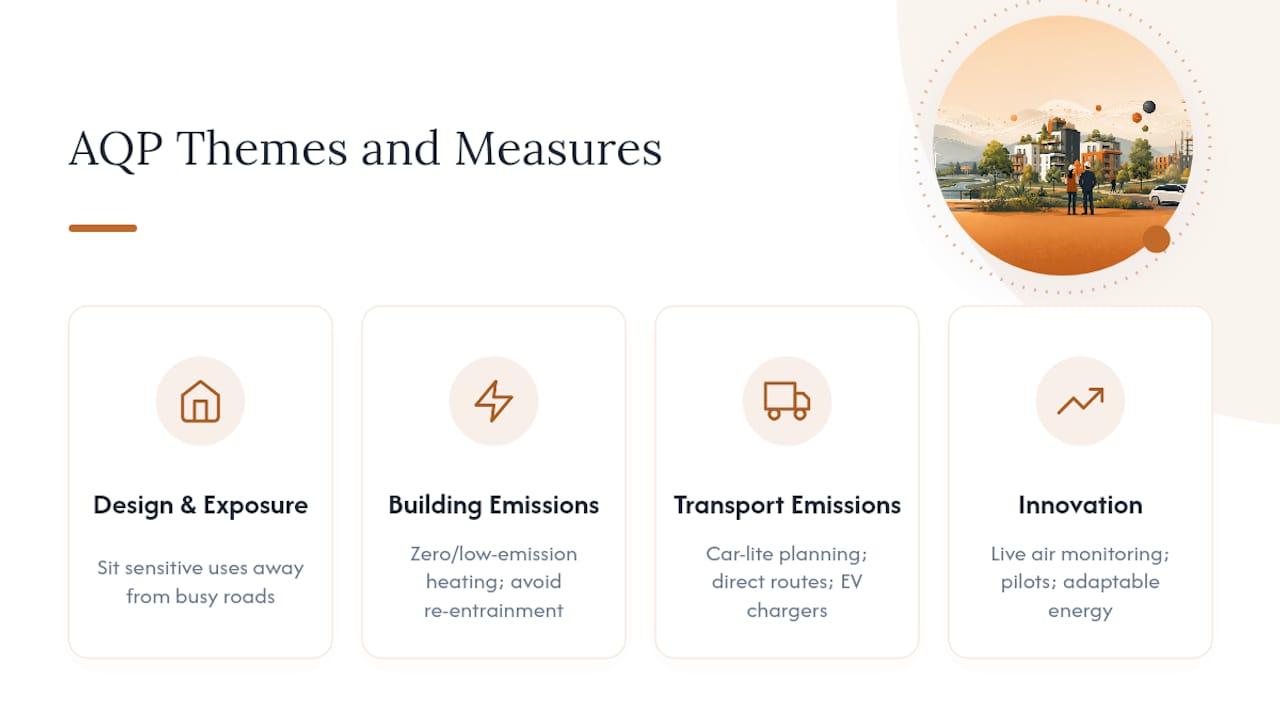
Better design and reducing exposure. This is about layout: keeping sensitive uses like schools, care homes, and residential entrances away from the busiest roads and junctions, orienting courtyards and amenity space to avoid pollution corridors, and specifying mechanical ventilation with filtration where street-level exposure can’t be designed out. Green infrastructure helps but comes with a caveat worth flagging to your design team: poorly placed street trees can trap pollutants in narrow canyon streets rather than disperse them, so planting strategy needs its own evidence, not just good intentions.

Building emissions. Zero and low-emission heating is the baseline expectation now, alongside careful siting of any remaining combustion plant, flue heights that avoid re-entrainment at street level, and a genuine commitment to connect to a local heat network where one exists or is planned.
Transport emissions. Car-free or car-lite masterplanning, priority routes for walking and cycling that are actually direct rather than token, freight consolidation strategies for large mixed-use sites, and EV charging infrastructure sized for realistic uptake rather than the bare policy minimum.
Innovation and future-proofing. This is where schemes differentiate themselves: flexible energy infrastructure that can adapt as heat network technology matures, live air quality monitoring built into the fabric of the scheme, and pilot measures the applicant is willing to trial and report on.
Pro Tip: Don’t spread your best measures thinly across all four themes to look balanced. Planners read straight through padding. Put your strongest, most evidenced measures where they’ll do the most good, and be honest where a theme genuinely has less scope on your site.
How Do You Build the AQP Measures Matrix?
The AQP London Plan Guidance document sets out a matrix template, and populating it properly is where most of the drafting effort should go. A weak matrix is the fastest way to get a statement kicked back for more information.
Each row needs seven pieces of information, at minimum:
- Theme - which of the four AQP themes the measure sits under
- Measure - the specific design or operational commitment
- Justification - why this measure suits this site, not a generic statement
- Evidence source - the modeling, precedent, or technical assessment backing the claim
- Securing mechanism - condition, Section 106, Section 278, or another binding route
- Monitoring metric - the measurable indicator that proves delivery
- Timescale - when the measure gets delivered and monitored
National context helps explain why planners scrutinize this so closely. Government air quality statistics show some urban and roadside monitoring stations recording rising annual mean concentrations of NO2 and PM2.5 against previous years, and that variability is exactly why authorities want secured, monitored commitments rather than aspirational design statements.
Planners consistently check three things: whether the measures show genuine design-stage input rather than bolted-on afterthoughts, whether the securing route is realistic for that specific measure, and whether the monitoring metric is something you could actually go and check five years after occupation. If any of those three is weak, expect a request for further information rather than a straightforward pass.
Securing Delivery: Conditions, Section 106, and Monitoring That Holds Up
A design measure that isn’t secured is just an intention. Planning conditions work well for physical, one-off items checked at a fixed point, like ventilation specifications or plant siting confirmed before occupation. Section 106 agreements suit ongoing obligations that need funding, monitoring, or third-party delivery, such as freight consolidation schemes or long-term air quality monitoring stations. Section 278 agreements come into play where measures touch the public highway, like cycle infrastructure or junction changes.
Three drafting habits separate statements that survive scrutiny from ones that don’t:
- Assign a named responsible party for each measure, not just “the developer” in the abstract.
- Attach a measurable KPI and reporting frequency to every monitored commitment, typically annual for the first five years post-occupation.
- Build in remediation triggers, so if a metric is missed there’s an agreed fallback action rather than silence.
Practical monitoring metrics we see hold up well include NO2 diffusion tube readings near sensitive receptors, EV charge point utilization rates, and heat network connection uptake. Local authority environmental health officers typically sign off the monitoring reports, so write them for that audience.
Pro Tip: Whatever monitoring commitment you write for one measure, check every comparably sensitive measure elsewhere in the statement carries the same rigor. Inconsistent monitoring across the matrix is one of the easiest things for a case officer to flag.
How Fortress Associates Supports AQP Compliance
Fortress Associates prepares the technical backbone of an AQP Statement from the ground up: early-stage air quality input while the masterplan is still fluid, drafting of the statement itself, population of the measures matrix, drafting support for the securing agreements, and the monitoring plans that satisfy local authority officers after occupation.
Every report we produce is built against live official data and checked against current planning standards before it leaves our desk. That’s what sits behind our 100% planning discharge rate.
Three things distinguish how we approach AQP work:
- No advance payment; you review the completed statement before you pay
- An amend-or-refund guarantee if a report gets rejected by the local authority
- Direct integration with your design and planning team so measures reflect what’s actually being built, not a generic template
We work alongside our Building Regulations drawings service for developers who need both the AQP evidence base and the regulatory drawings package moving in parallel, which is common on the large, phased schemes AQP applies to.
What Do Successful Air Quality Positive Projects Look Like?
The strongest AQP submissions share a pattern: air quality thinking shaped the masterplan rather than being added once the layout was fixed. On large opportunity area sites, that has meant pulling sensitive uses like nurseries and residential blocks back from the busiest boundary roads, routing servicing and freight away from pedestrian routes at street level, and committing early to heat network connections rather than leaving heating strategy as a placeholder.
Car-free or heavily car-lite masterplans tend to produce the most convincing transport-emissions sections, because the securing mechanism is straightforward: restrict permits through the Section 106 agreement and the numbers follow. Sites that paired this with genuine freight consolidation, rather than a token line about “considering” it, gave planners something concrete to condition.
On the innovation theme, the schemes that stand out are the ones willing to commit to something measurable and slightly experimental, such as on-site air quality monitoring feeding into a public dashboard, rather than a vague promise to “monitor as appropriate.” That specificity is what separates a matrix row that gets challenged from one that sails through.
What’s notably absent from the strongest examples is padding. They don’t claim benefit under all four themes with equal weight. Where a site genuinely has limited scope for green infrastructure because it sits in a dense, high-rise cluster, the strongest statements say so plainly and lean harder into building emissions and transport measures instead. Honesty about constraints reads as more credible than forced balance.
What Trips Up Applicants on the Way to AQP Status?
The most common failure point isn’t a lack of good ideas. It’s weak evidence behind the ideas that are there. A measure without a named securing mechanism, or with a monitoring metric nobody could actually go and verify, gets flagged for further information almost automatically.
Timing causes the second biggest set of problems. Bringing air quality input in after the masterplan is fixed means the specialist is stuck retrofitting justifications onto decisions that were made for other reasons. Consultancies that work on these schemes consistently advise engaging air quality specialists during concept design, so measures can genuinely shape layout, energy strategy, and transport planning rather than being written up afterward to sound plausible.
A third obstacle is internal: design, sustainability, and transport teams on large schemes often work in parallel without a shared view of what the AQP matrix needs from each of them. That produces gaps, usually in the innovation and future-proofing theme, which tends to get the least attention because it doesn’t map neatly onto any single discipline’s usual deliverables.
The fix for most of this is procedural rather than technical. Commission the air quality input early, hold a single coordination session across disciplines before the matrix gets drafted, and treat the choice of air quality assessment consultant as a decision that affects the whole scheme’s programme, not just one workstream. Statements drafted this way rarely come back with a request for further information on the same issues twice.
Why Community Engagement Strengthens an AQP Case
Local authorities increasingly expect evidence that a scheme’s air quality measures reflect what residents and neighboring occupiers actually raised during consultation, not just what the design team assumed mattered. On large masterplans, that usually surfaces through statutory pre-application consultation, but the strongest AQP Statements go further and log specific concerns, such as a school objecting to a servicing route or a residents’ group flagging a known pollution hotspot, and then show how the matrix responds to each one.
This matters for two reasons beyond box-ticking. First, measures that respond to a named, documented concern are harder for a case officer to dismiss as generic. Second, community input often surfaces hyperlocal detail that formal air quality modeling misses entirely, like a school run that funnels traffic past a specific entrance at a specific time, which a design team sitting in an office three boroughs away would never think to model.
Where schemes get this wrong is treating consultation as something that happens once, early, and separately from the AQP drafting process. The better approach folds consultation feedback directly into the measures matrix as a live evidence source, updated at each iteration of the statement through pre-application, application, and discharge. That gives the local authority a paper trail showing the scheme responded to real input rather than a design team’s assumptions about what the neighborhood wanted.
What Technology Is Shaping AQP Measures Now?
Live monitoring has moved from a nice-to-have to close to an expectation on large schemes. Low-cost sensor networks feeding continuous NO2 and particulate readings into a dashboard, rather than periodic diffusion tube sampling alone, give both the developer and the local authority a far more granular picture of whether committed measures are actually working after occupation.
On the building emissions side, heat pump and heat network technology has matured enough that “zero-emission heating” is now a credible baseline commitment rather than an aspirational one, and flexible energy infrastructure that can connect to a district network later, even if one isn’t available at construction, is increasingly common in the innovation theme.
Transport modeling tools have also improved enough to model freight consolidation and servicing patterns at a granularity that supports specific, defensible commitments in the matrix rather than broad estimates. And on the design side, computational fluid dynamics modeling of pollutant dispersion around building massing is now accessible enough for large schemes to use it routinely, rather than reserving it for the most contentious sites.
None of this replaces good fundamentals. A live dashboard monitoring a poorly sited ventilation intake is still monitoring a poor design decision. But paired with sound design choices, these tools give applicants sharper evidence and give local authorities a clearer basis for signing off a statement with confidence.
What Are the Real Health and Environmental Benefits?
The rationale behind AQP isn’t abstract policy box-ticking. National data shows real variability in pollutant concentrations across the country, with some urban and roadside monitoring stations recording increases in annual mean NO2 and PM2.5 against previous years, and exposure to elevated levels of both pollutants is linked to respiratory and cardiovascular harm, particularly for children, older residents, and people with existing conditions.
Design measures that keep sensitive uses away from the busiest roads, that route freight away from pedestrian areas, and that commit to zero-emission heating aren’t just planning compliance items. They reduce the exposure of the people who will actually occupy the building, day after day, for decades.
There’s a broader environmental case too. Schemes that commit to car-lite masterplanning and genuine cycle and walking priority reduce local emissions beyond their own site boundary, benefiting the wider neighborhood rather than just the development itself. That’s part of why the policy targets large, strategic sites specifically: a single masterplan with the right transport and energy commitments can shift air quality outcomes across an entire district in a way a single building never could.
For developers, there’s a commercial dimension worth naming honestly. Schemes with a credible, secured AQP case tend to face fewer objections during consultation and fewer requests for further information during determination, which shortens the path to approval on projects where programme delays are expensive.
How Does London’s Approach Compare Internationally?
London’s AQP framework is unusual in how deliberately it avoids a single numeric pass mark. Most international air quality planning frameworks, including several European city schemes, lean toward emissions modeling against a fixed benchmark, which is closer to how AQN already works within the London Plan rather than how AQP does.
International comparison data, such as the Environmental Performance Index’s air pollution indicators, gives useful context on how UK urban air quality compares globally, though these datasets measure outcomes rather than planning process and should be read as background rather than a direct comparison of regulatory approach.
What sets London apart procedurally is the requirement for an iterative, evidence-led statement tied to a securing and monitoring framework, rather than a single calculation submitted once. Cities that adopt numeric-only benchmarks tend to produce more consistent, comparable outputs across applicants, but London’s model trades that consistency for flexibility. It lets a scheme make its strongest case on the measures that suit its specific site, rather than forcing every project through the same formula regardless of context. For large, unusual, or highly constrained sites, that flexibility is usually the more useful approach, even if it demands more from the applicant’s evidence base.
Why Most AQP Advice Misses the Point
Most guidance on Air Quality Positive treats it as a documentation exercise: fill in the matrix, cite the four themes, submit alongside the Environmental Statement. That framing gets the sequence right and misses what actually determines whether a statement gets approved on first submission.
The real differentiator is securing, not design ambition. Plenty of AQP Statements propose good measures. Far fewer attach a realistic condition, Section 106 clause, or Section 278 agreement to each one, with a monitoring metric a case officer could genuinely check five years later. That gap between proposing and securing is where most requests for further information originate, and it’s largely avoidable with more disciplined drafting rather than better ideas.
The other overlooked point is timing. Treating AQP as a submission document rather than a live log that evolves from pre-application through discharge means teams keep re-litigating decisions that should have been settled early. Bring air quality expertise in when the masterplan is still fluid, and the matrix practically writes itself later. Bring it in after the fact, and you’re reverse-engineering justifications for choices made on other grounds. Developers who internalize that sequencing lesson consistently move through determination faster than those chasing a perfect-looking matrix built too late to matter.
- Fortress Associates
Get Your AQP Statement Right the First Time
Rejected AQP Statements cost programme time most large developments can’t afford to lose, and a matrix built without proper securing evidence is the most common reason for a request for further information. Fortress Associates prepares AQP Statements, measures matrices, and monitoring plans built against live official data, so the evidence behind every measure holds up to local authority scrutiny the first time.

Unlike a generic planning consultancy juggling AQP alongside dozens of unrelated report types, Fortress Associates specializes specifically in the technical planning documents large-scale schemes need, including air quality studies, energy statements, and Building Regulations drawings, all cross-referenced so your air quality case and your regulatory submissions stay consistent with each other. There’s no advance payment, and every report carries an amend-or-refund guarantee if a local authority rejects it.
If you’re preparing a masterplan or EIA-referable application, get your AQP Statement scoped with Fortress Associates before your next design freeze, while there’s still time for the evidence to shape the layout rather than chase it.
Sources
Recommended
- Air Quality Neutral Explained: London Plan Policy SI 1 for Planning - Fortress Associates
- Population Exposure, Not Just Compliance: Air Quality Assessments in 2026 - Fortress Associates
- WHO Air Quality Guidelines vs UK Objectives: What Planning Uses - Fortress Associates
- Air Quality Assessment Consultants in the UK: How to Choose (2026) - Fortress Associates
Need help with a UK planning project?
Fixed-fee daylight & sunlight reports and Building Regulations drawings - plus flood risk assessments, air quality assessments, energy statements and sustainability statements for planning applications across the UK.
Request a free quote