
BREEAM Pre Assessment for Developers: Practical Guide
A BREEAM pre assessment is an early, evidence-driven review led by a licensed BREEAM Assessor that maps achievable credits, flags design risks, and produces a credit register to guide your project from concept through to certification. Run it at RIBA Stage 2 or 3, before design decisions calcify into expensive problems. The immediate next step: appoint a licensed BREEAM Assessor or log into BREEAM Projects to generate an unverified indicative score as a baseline.
Three things the pre assessment delivers that no other early-stage document does:
- Targeted design decisions - credits are mapped to specific design choices (U-values, fittings specs, ecology strategy) so your team knows exactly what to change and when.
- Cost-risk identification - the risk register surfaces credits that are technically achievable but commercially marginal, letting you drop them before they inflate the cost plan.
- Planning-ready evidence - local planning authorities increasingly require a BREEAM credit pathway statement; the pre assessment report provides exactly that.
Pro Tip: Treat the pre assessment as a living document. Schedule at least one follow-up update at RIBA Stage 4 to capture design changes and re-score any credits that have shifted since the original workshop.
Clockfortress (trading as Fortress Associates) runs fixed-fee, assessor-led pre assessments for developers, architects, and sustainability consultants across the UK, with an amend-or-refund guarantee on every report.
Table of Contents
- What Is BREEAM and What Do the Rating Benchmarks Mean?
- Where Does the Pre Assessment Fit in the BREEAM Assessment Stages?
- What Does a BREEAM Pre Assessment Actually Include?
- Who Should Run the Pre Assessment and What Evidence Do You Need?
- What Does a Pre Assessment Typically Cost and How Long Does It Take?
- What Should a BREEAM Pre Assessment Report Actually Contain?
- How to Integrate the Pre Assessment Into Your RIBA Workflow
- How Does a Pre Assessment Differ From Formal BREEAM Registration and Certification?
- How Fortress Associates Runs BREEAM Pre Assessments
- Key Takeaways
- Why the Pre Assessment Is a Strategic Tool, Not a Checkbox
- Fortress Associates: Fixed-Fee Pre Assessments With a Guarantee
- Useful Sources and Official BREEAM Resources
What Is BREEAM and What Do the Rating Benchmarks Mean?
BREEAM (Building Research Establishment Environmental Assessment Method) is the UK’s primary framework for measuring the sustainability performance of buildings. It is owned and administered by BRE Global, which handles independent quality assurance (QA), scheme licensing, and the registration of assessments. When a project achieves a certified BREEAM rating, BRE Global has independently verified the evidence submitted by a licensed Assessor.
The most commonly used scheme for new UK construction is BREEAM New Construction, which covers both the Design Stage (DS) and Post Construction Review (PCR). Developers targeting planning conditions or investor requirements will almost always be working within this scheme.
The rating benchmarks are:
| Rating | Typical Score Band | Common Commercial Trigger |
|---|---|---|
| Pass | meets the minimum planning condition | |
| Good | typically meets some local authority requirements | |
| Very Good | commonly accepted for commercial schemes | |
| Excellent | often required by investors or ESG covenants | |
| Outstanding | recognized as exemplar or public sector flagship |
Statistic callout: Via BREEAM Projects, any project team can generate a free unverified pre assessment score before formal registration - giving developers a working credit target without committing to the full certification process.
The distinction between an unverified score and a certified rating matters commercially. Lenders and planning authorities accept certified ratings as evidence; an unverified pre assessment score is a planning and design tool, not a deliverable you can submit as proof of compliance.
Where Does the Pre Assessment Fit in the BREEAM Assessment Stages?
Understanding the sequence prevents the most common mistake teams make: registering too late and discovering that several credits are no longer achievable because the design is already fixed.
The main stages, in order:
- Pre assessment - indicative credit mapping, gap analysis, risk register. Unverified. Runs at RIBA Stage 2–3.
- Registration - only licensed assessors can register a project on BREEAM Projects; registrations are non-refundable once a registration number is issued, and the building type cannot be changed after registration.
- Design Stage (DS) assessment - formal evidence collection and submission by the licensed Assessor, typically spanning RIBA Stages 3–4.
- Post Construction Review (PCR) - evidence updated to reflect the as-built condition, submitted after practical completion.
- Certification and BRE Global QA - BRE Global independently reviews the Assessor’s submission and issues the certified rating.
The activity split matters. The project team (architect, M&E engineer, ecologist) gathers and produces evidence. The licensed Assessor interprets that evidence against BREEAM’s evidentiary rules, scores credits, and submits to BRE Global. BRE Global does not advise the design team; it audits the Assessor’s work.
Key handoffs and decision points to lock into your programme:
- RIBA Stage 2: Run the pre assessment. Confirm target rating. Identify credits that require early specialist input (ecology, transport, energy modelling).
- RIBA Stage 3: Update the pre assessment after developed design. Confirm which credits are still achievable and which have been lost.
- RIBA Stage 4: Register the project. Assessor begins formal evidence collection. Confirm assessor has completed any required V7 training modules before registration.
- Post completion: PCR evidence compiled and submitted. BRE Global QA turnaround typically several weeks.
What Does a BREEAM Pre Assessment Actually Include?
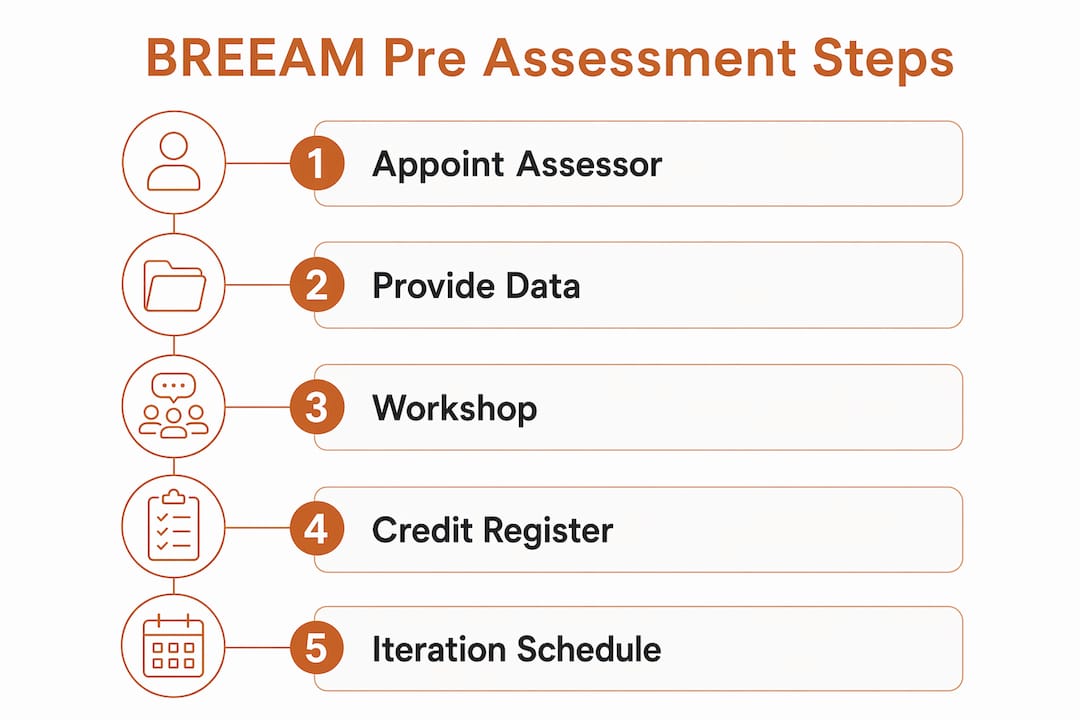
The pre assessment process follows a clear sequence. Here is what each step involves and what your team needs to prepare.
Step 1: Appoint a licensed BREEAM Assessor
Check that the assessor holds a current licence for the relevant BREEAM scheme (e.g., New Construction V7). Confirm they have completed any mandatory academy training modules - some assessors cannot register V7 projects without them. Ask for their BRE licence number and verify it on the BRE website before signing a scope of work.

Step 2: Provide drawings and data
The assessor cannot score credits accurately without real design information. Minimum inputs at RIBA Stage 2–3 typically include:
| Credit Theme | Minimum Evidence Input |
|---|---|
| Energy | Outline energy strategy or SAP/SBEM model file |
| Water | Sanitary fittings schedule or specification |
| Ecology | Preliminary Ecological Appraisal (PEA) or desk study |
| Materials | Outline specification or materials strategy |
| Health & Wellbeing | Architectural drawings showing daylighting, ventilation strategy |
| Pollution | Site drainage strategy, surface water management plan |
| Transport | Site location plan, public transport accessibility data |
Step 3: Assessor-led workshop and gap analysis
The assessor reviews the evidence, scores each credit against BREEAM’s criteria, and identifies dependencies - credits that require input from a discipline not yet appointed, or credits where the current design falls short. This workshop is where the gap analysis happens: the assessor flags which credits are achievable as-designed, which require a design change, and which are realistically out of reach given the site constraints.

Step 4: Credit register, risk register, and recommendations
The assessor produces the credit register (indicative scores by category), a risk register listing credits at risk of being lost, and a set of recommended specification or design changes. This is the core deliverable.
Step 5: Iteration schedule
A single pre assessment is not enough. Plan for at least one update at RIBA Stage 3 and a final check before registration at RIBA Stage 4. Each update should re-score credits that have changed and remove credits that are no longer feasible.
Pro Tip: The BREEAM Projects pre assessment tools now align with the Scoring and Reporting tools, so new pre assessments match the scoring logic used in formal submissions. But the tool cannot apply professional judgment to your specific design evidence - only a licensed assessor can do that, which is why over-claiming credits using the online tool alone is a real risk.
Who Should Run the Pre Assessment and What Evidence Do You Need?
The licensed BREEAM Assessor leads the pre assessment. Every other member of the design team is a supplier of evidence.
Roles in practice:
- Licensed BREEAM Assessor: Scores credits, runs the workshop, produces the credit register, risk register, and report. Advises the team on evidence gaps.
- Architect: Provides drawings, daylighting strategy, ventilation approach, materials specification.
- M&E Engineer: Provides energy strategy, plant schedules, fittings specification, controls strategy.
- Ecologist: Provides Preliminary Ecological Appraisal, biodiversity net gain (BNG) data, habitat survey results.
- Landscape Architect: Provides external works drawings, planting schedules, surface water strategy.
- Client / Developer: Confirms target rating, provides site history, confirms any planning conditions that specify a BREEAM rating.
Evidence checklist by credit theme:
- Energy: SAP or SBEM model, energy strategy report, plant schedule with efficiency ratings
- Water: Sanitary fittings schedule, rainwater harvesting strategy (if applicable), sub-metering plan
- Materials: Outline specification, responsible sourcing certificates (FSC/PEFC for timber), lifecycle assessment data where available
- Ecology: Preliminary Ecological Appraisal, BNG metric calculation, habitat management plan
- Health & Wellbeing: Daylight calculations or daylight and sunlight assessment, ventilation strategy, acoustic report
- Pollution: Surface water drainage strategy, NOx emission data for boilers/plant, light pollution strategy
- Transport: Public transport accessibility level (PTAL) data, cycle storage drawings, EV charging strategy
On quality: verifiable evidence means a document that a licensed Assessor can cite in a formal submission. An indicative estimate (e.g., “we intend to use low-flow taps”) is useful for the pre assessment but will not survive BRE Global QA without a specification or product data sheet behind it. The pre assessment should flag which credits are based on indicative estimates so the design team knows where to harden the evidence before formal submission.
Coordinating multiple specialist inputs into a single evidence pack is where projects often lose time. A sustainability statement consultant can manage that coordination and reduce the risk of gaps appearing at the design stage submission.
What Does a Pre Assessment Typically Cost and How Long Does It Take?
There is no single published fee for a BREEAM pre assessment in the UK because cost scales with project complexity, target rating, and the number of iterative updates required.
Typical schedule ranges:
- Simple residential scheme (10–20 units, Pass or Good target): Pre assessment workshop and report in 5–10 working days from receipt of drawings.
- Mid-size commercial or mixed-use scheme (Excellent target): 2–4 weeks, including specialist input coordination and a follow-up update.
- Large or complex scheme (Outstanding target, multiple buildings): 4–8 weeks for the initial pre assessment, with iterative updates at each RIBA stage.
Cost drivers to understand before you commission:
- Project size and complexity: More buildings, more uses, more credits to score.
- Target rating: Excellent and Outstanding require deeper evidence review and more specialist inputs.
- Number of follow-up updates: Each update is a separate scope item; confirm how many are included in the fee.
- Specialist inputs: If an ecology report or detailed energy model does not yet exist, those are additional costs outside the assessor’s fee.
- Geographic complexity: Sites in flood zones, AQMAs, or areas with complex planning history require more evidence gathering. Free site constraint tools can reduce this overhead before the assessor is appointed.
Procurement tips to control cost:
- Bundle the pre assessment with related planning reports (energy statement, air quality, flood risk) to reduce coordination overhead and overall fees.
- Specify deliverables in the scope of work before signing: credit register, evidence log template, risk register, executive summary, and number of follow-up updates.
- Confirm the assessor’s licence and training status before appointment to avoid delays caused by ineligibility to register under the current scheme version.
- Use free UK planning tools to gather site constraint data before the assessor starts, reducing billable research time.
Pro Tip: A short, focused pre assessment (workshop plus credit register, no follow-up updates) is sufficient when you need a planning condition response or a quick feasibility check. Commission a comprehensive iterative contract when you are targeting Excellent or Outstanding and the design will evolve significantly across RIBA Stages 3 and 4.
What Should a BREEAM Pre Assessment Report Actually Contain?
Standard pre assessment outputs include a credit register with indicative scores, an evidence log template, a risk register with mitigation actions, recommended specification changes, and a short executive summary. If your report does not contain all five, ask for the missing elements before accepting it.
A sample report structure to request from your assessor:
- Cover and scope - project name, scheme version, target rating, date, assessor licence number
- Methodology - how credits were scored, what evidence was reviewed, what assumptions were made
- Credit register - all credits listed by category, with indicative score (achieved / not achieved / at risk), evidence reviewed, and evidence gaps
- Evidence checklist - what document or data type is needed to confirm each credit at design stage submission
- Risk register - credits at risk, reason for risk, recommended mitigation action, and responsible party
- Specification recommendations - specific changes to drawings, specs, or plant schedules that would secure at-risk credits
- Executive summary - one-page summary of indicative score, target rating gap, and top three priority actions for the client and planning authority
- Appendices - copies of evidence reviewed, tool screenshots, ecology or energy data
How to use each deliverable:
- Credit register: Feed directly into the design team’s specification and procurement schedule. Credits that require a specific product or system should trigger a procurement action before RIBA Stage 4.
- Evidence log: Assign ownership. Each evidence item should have a named responsible party and a deadline tied to the RIBA programme.
- Risk register: Merge into the project’s main risk register. Credits at risk are project risks with a cost implication; treat them that way.
- Executive summary: Use in planning submissions and sustainability statements. Planning officers want to see a clear pathway to the required rating, not a full technical report.
Submission-readiness checklist:
- Assessor licence number is stated in the report
- Scheme version is confirmed (e.g., BREEAM New Construction V7)
- All credits are scored with evidence reviewed or evidence gap noted
- Risk register includes a mitigation action for every at-risk credit
- Executive summary is written in plain English suitable for a planning officer
How to Integrate the Pre Assessment Into Your RIBA Workflow
The pre assessment only earns its fee if the outputs change what the design team does next. A report that sits in a folder and is never referenced again is a wasted investment.
RIBA stage touchpoints:
- RIBA Stage 2 (Concept Design): Run the initial pre assessment. Confirm target rating with the client. Identify credits that require early specialist appointment (ecology, transport, energy modelling). Feed credit register into the project brief.
- RIBA Stage 3 (Developed Design): Update the pre assessment. Re-score credits that have changed. Confirm which credits are now locked in and which remain at risk. Update the risk register and feed into the cost plan.
- RIBA Stage 4 (Technical Design): Final pre assessment update before registration. Confirm all evidence is in place or has a clear procurement route. Register the project with BRE Global via a licensed Assessor.
Practical steps to embed outputs:
- Update the outline specification after each pre assessment iteration to reflect recommended changes (U-values, fittings, materials).
- Revise contractor briefs to include BREEAM evidence requirements - contractors need to know they must provide responsible sourcing certificates, waste management data, and commissioning records.
- Include the executive summary and credit register in the planning sustainability statement. Many local authorities require a BREEAM credit pathway as part of the planning submission, and the pre assessment report provides exactly that.
For more on what councils require, the BREEAM in planning overview covers local policy triggers in detail.
Common design changes that follow a pre assessment:
- Improved building fabric U-values to secure energy credits that were marginal in the initial design
- M&E plant specification changes (higher-efficiency boilers, heat pumps, PV arrays) to close the gap to the target rating
- Biodiversity and landscaping adjustments to meet ecology credits, particularly on brownfield sites where habitat baseline is low
Pro Tip: Align pre assessment recommendations with the cost plan at RIBA Stage 3, not after. A specification change that costs £5,000 at Stage 3 can cost £50,000 at Stage 5 if it requires a contractor variation. Construction cost benchmarking methods can help you quantify the cost impact of each credit recommendation before committing to the design.
How Does a Pre Assessment Differ From Formal BREEAM Registration and Certification?
The short answer: a pre assessment produces an indicative, unverified score. Certification requires registration with BRE Global, formal evidence submission by a licensed Assessor, and independent QA by BRE Global. These are not interchangeable.
Registration steps and who can act:
- Only a licensed BREEAM Assessor can register a project on BREEAM Projects. Developers and architects cannot self-register.
- Registration is non-refundable once a registration number is issued.
- The building type selected at registration cannot be changed afterward, so the assessor must confirm the correct scheme and building type before submitting.
- Documentation needed for QA includes all credit evidence, the assessor’s scoring rationale, and any specialist reports referenced in the submission.
The role of BREEAM Projects tools in this distinction matters. The pre assessment tools now match the scoring logic used in formal submissions, which improves their accuracy. But the tool generates an unverified score - it does not constitute a registered assessment, and BRE Global has not reviewed it. Only a licensed Assessor’s formal submission, followed by BRE Global QA, produces a certified rating.
Timeline from registration to certification:
- Registration: triggered at RIBA Stage 4 by the licensed Assessor.
- Design Stage submission: typically submitted after RIBA Stage 4, once technical design evidence is assembled.
- Post Construction Review: submitted after practical completion, with as-built evidence.
- BRE Global QA: turnaround varies by scheme and submission quality; allow several weeks in the programme.
How Fortress Associates Runs BREEAM Pre Assessments
Fortress Associates delivers fixed-fee, assessor-led BREEAM pre assessments for developers, architects, and sustainability consultants across the UK. The process is scoped upfront, with no hidden costs and a clear deliverables list agreed before work starts.
What the Fortress Associates pre assessment scope includes:
- Assessor-led workshop with the design team (remote or on-site)
- Full credit register with indicative scores, evidence reviewed, and evidence gaps
- Evidence log template with named responsible parties and RIBA stage deadlines
- Risk register with mitigation actions for every at-risk credit
- Suggested specification notes for credits requiring design changes
- Executive summary suitable for planning submissions and client reporting
- One follow-up update included in the fixed fee (additional updates available)
Scope checklist:
- Credit register (all categories, indicative scores, evidence gaps)
- Evidence log template (assignable, RIBA-stage aligned)
- Risk register (at-risk credits, mitigation actions, responsible party)
- Specification recommendations (specific product or design changes)
- Executive summary (planning-ready, plain English)
- One follow-up update at RIBA Stage 3 or 4
Every report is cross-referenced against live official BREEAM data and current scheme requirements. If a report is rejected or requires amendment due to an error on Fortress Associates’ part, the report is amended or refunded. That guarantee applies to every report, not just pre assessments.
To commission a scoped pre assessment or request a scope of work, visit the Fortress Associates services page. Typical turnaround for an initial pre assessment report is 5–10 working days from receipt of drawings and design information, depending on project complexity.
Key Takeaways
A BREEAM pre assessment, run at RIBA Stage 2–3 by a licensed Assessor, is the single most cost-effective action a development team can take to protect its target rating and avoid late-stage redesign costs.
| Point | Details |
|---|---|
| Run it early | Commission the pre assessment at RIBA Stage 2 or 3, before design decisions are fixed. |
| Appoint a licensed Assessor | Only a BRE-licensed BREEAM Assessor can produce a credible credit register and register the project formally. |
| Demand five deliverables | Require a credit register, evidence log, risk register, specification recommendations, and executive summary. |
| Treat it as iterative | Update the pre assessment at RIBA Stage 3 and again before registration at Stage 4. |
| Clockfortress delivers it | Fortress Associates provides fixed-fee, assessor-led pre assessments with an amend-or-refund guarantee across the UK. |
Why the Pre Assessment Is a Strategic Tool, Not a Checkbox
Most teams commission a BREEAM pre assessment because a planning condition requires it. That framing is the wrong one, and it costs money.
The projects that consistently hit Excellent and Outstanding ratings treat the pre assessment as a design management tool. The credit register becomes a live specification tracker. The risk register feeds the project risk log. The evidence log becomes a procurement checklist. When the pre assessment is embedded that way, early integration of BREEAM at concept design delivers the most cost-effective sustainable performance - because the design team is making decisions with full knowledge of their credit implications, not retrofitting compliance after the fact.
The argument for treating it as a one-off deliverable is usually about cost. But a single pre assessment that is never updated is almost always less accurate than the design it was meant to guide. Designs change. Credits that were achievable at Stage 2 become unachievable at Stage 4 if no one has tracked the drift. The iterative model costs more upfront and saves significantly more at construction.
There is also a subtler point. Experts consistently advise against box-ticking approaches to BREEAM - a formal pre assessment functions best as a strategic tool linking environmental goals to operational cost savings and occupant well-being. The credit register is not just a score; it is a map of where the building performs well and where it does not. Used properly, it shapes procurement, informs contractor briefs, and gives the client a building that actually performs as designed.
Fortress Associates: Fixed-Fee Pre Assessments With a Guarantee
Developers and architects who need a BREEAM pre assessment report that is planning-ready, evidence-backed, and delivered on a fixed fee will find Fortress Associates a direct fit. The service covers the full pre assessment scope: assessor-led workshop, credit register, evidence log, risk register, specification recommendations, and an executive summary written for planning officers and clients alike.

Fortress Associates also prepares the specialist planning reports that feed directly into BREEAM evidence: energy statements, air quality assessments, flood risk evaluations, daylight and sunlight reports, and sustainability statements. Bundling these with a pre assessment reduces coordination time and overall cost, and every report in the bundle carries the same amend-or-refund guarantee. There are no advance payments; you review the completed documents before paying.
To commission a pre assessment or a bundled report package, visit the Fortress Associates services page or use the free planning tools to run a quick site constraint check before you call.
Useful Sources and Official BREEAM Resources
- BREEAM Projects pre assessment tool - Free login for unverified pre assessment scoring; licensed assessors access additional tools through the same portal.
- Prepare to register your first project (BRE) - Official BRE guidance on registration rules, assessor training requirements, and the difference between unverified and certified scores.
- Improvements to pre assessment tools (BREEAM Knowledge Base) - Explains how updated pre assessment tools now align with scoring and reporting logic, and how legacy pre assessments are flagged.
- Registrations (BREEAM Knowledge Base) - Covers registration rules: who can register, non-refundable registration fees, and building type selection.
- BREEAM assessment process explained (Tunley Environmental) - Practitioner-level walkthrough of the pre assessment process, workshop structure, and standard deliverables.
- How BREEAM works (BRE) - Overview of BREEAM’s strategic purpose and the case against box-ticking approaches.
- BREEAM in planning (Fortress Associates) - Practical guide to when and why local planning authorities require BREEAM ratings and what the rating bands mean for planning submissions.
- Sustainability statement consultants (Fortress Associates) - Guidance on coordinating specialist inputs into a unified pre assessment evidence pack.
Recommended
- BREEAM in Planning: When Councils Require It and What the Ratings Mean - Fortress Associates
- Free UK Planning Tools: Flood Zone, AQMA, Daylight, Carbon, BNG - Fortress Associates
- 21 Free UK Planning Tools - Constraints, Flood, Fees, Daylight | Fortress Associates
- Site Constraints Checker: Instant Planning Appraisal by Postcode - Fortress Associates
Need help with a UK planning project?
Fixed-fee daylight & sunlight reports and Building Regulations drawings - plus flood risk assessments, air quality assessments, energy statements and sustainability statements for planning applications across the UK.
Request a free quote