
Combined Planning Reports: A UK Commissioning Guide
Combined planning reports are a coordinated bundle of technical planning and building-control documents assembled to match a specific site and a specific Local Planning Authority’s validation requirements. The moment you know a scheme is going in, the next move is simple: check the LPA’s local validation list and confirm the mandatory documents against the Planning Portal before you commission anything.
That order matters more than most project teams admit. Validation lists dictate scope, and scope dictates which specialists you need on the job, whether that’s a daylight and sunlight consultant working to BRE 2022 or an ecologist producing a biodiversity metric. Skip the checklist stage and you risk paying for reports the LPA never asked for, or worse, submitting without one it did.
Two things to do right now:
- Pull the local validation checklist for your specific LPA and cross-reference it against the National Planning Policy Framework to see which requirements are locally added versus nationally mandated.
- Use a site constraints checker or equivalent screening tool to flag flood zone status, conservation area overlap, and other triggers before you brief consultants like Fortress Associates.
Key Takeaways
Combined planning reports succeed when they’re scoped against the LPA’s own validation list first, sequenced around site constraints, and cross-referenced so every document tells the same story.
| Point | Details |
|---|---|
| Check the LPA list first | Confirm requirements against the current local validation checklist, not a generic national template. |
| Sequence constraints before design | Screen flood, heritage, and ecology triggers before finalizing scheme design to avoid costly redesigns. |
| Assign one point of contact | Use a single coordinator to cross-reference reports and keep drawing revisions consistent. |
| Require BRE 2022 statements | Ask for a written compliance statement on every daylight and sunlight assessment. |
| Confirm live data provenance | Check that reports cite official datasets with retrieval dates, not outdated desk studies. |
| Consider a fixed-fee bundle | Fortress Associates offers cross-referenced, fixed-fee report bundles with an amend-or-refund guarantee. |
Table of Contents
- What Goes Into a Combined Planning-Report Bundle?
- When Do You Actually Need Each Report?
- How Do You Commission a Bundle Correctly?
- What Does a Combined Bundle Cost and How Long Does It Take?
- How Do You Prepare for Validation and Submission?
- What Separates a Trustworthy Report From a Risky One?
- Common Mistakes That Delay Validation
- How Fortress Associates Packages Combined Planning Reports
- Get a Combined Planning-Report Quote Without the Guesswork
- Sources
What Goes Into a Combined Planning-Report Bundle?
Most bundles for a medium-sized residential or mixed-use scheme in the UK draw from a fairly consistent shortlist, even though the exact combination shifts with site and scale. A representative validation checklist from Milton Keynes Council shows daylight and sunlight assessments, biodiversity metrics, energy and climate statements, transport assessments, and flood risk assessments all appearing as standard local list items.
Here’s what each report typically does and why an officer would ask for it:
- Daylight & sunlight assessment: tests whether neighboring windows and gardens retain adequate light, following BRE 2022 methodology. Triggered by proximity to existing residential windows.
- Flood risk assessment (FRA): required in Flood Zones 2 and 3, or for sites over one hectare in Zone 1.
- Ecology report: covers protected species and habitat impact, usually triggered by site type (woodland, brownfield with vegetation, watercourses nearby).
- Arboriculture report: needed where trees, especially those under a Tree Preservation Order, sit on or near the site.
- Transport assessment or statement: scales with dwelling count or floorspace and proximity to the road network.
- Heritage impact assessment: triggered by listed buildings, conservation areas, or scheduled monuments nearby.
- Energy and sustainability statement: increasingly standard for major applications under local climate policies.
- Air quality assessment: required inside or near an Air Quality Management Area (AQMA).
- Noise assessment: common near busy roads, rail lines, or industrial uses.
- Land contamination report: standard for former industrial sites or where historic land use raises red flags.
- Planning statement and Design and Access Statement (DAS): the narrative documents that tie the technical evidence back to policy.
- Biodiversity metric: quantifies net gain, now a fixture on most local validation lists.
When Do You Actually Need Each Report?
Most invalid applications trace back to one thing: someone guessed at the trigger instead of checking it. LPAs publish specific thresholds, and a scheme that sits just over a boundary, ten dwellings instead of nine, for instance, can suddenly need a full transport assessment it wouldn’t have needed otherwise.
A quick trigger-to-report mapping looks like this:
- 10+ dwellings or 1,000m² floorspace: transport assessment, often energy and sustainability statement.
- Flood Zone 2 or 3, or over 1 hectare in Zone 1: flood risk assessment.
- Inside an AQMA: air quality assessment.
- Listed building, conservation area, or scheduled monument nearby: heritage impact assessment.
- Trees under a TPO on or adjacent to site: arboriculture report.
- Adjacent residential windows within typical BRE assessment distances: daylight and sunlight assessment.
- Site near major road, rail corridor, or industrial use: noise assessment.
- Former industrial, agricultural with pesticide history, or landfill-adjacent land: land contamination report.
Local lists vary in how they express these thresholds, and government policy explicitly pushes LPAs to keep information requirements proportionate rather than demanding everything by default. That’s good news for smaller schemes but it also means two neighboring boroughs can genuinely ask for different things on similar sites.
Pro Tip: If a trigger is ambiguous, don’t guess. Book a pre-application meeting with the LPA and get the required document list confirmed in writing before you commission anything. It’s a small fee against the cost of a rejected validation.
How Do You Commission a Bundle Correctly?
Commissioning works best as a sequence, not a shopping list. Constraints get checked first, design responds to them, and only then do you lock the scope of reports.
- Brief: send site address, red line boundary, coordinate datum (usually OSGB36), existing drawings, and a description of the proposed use.
- Constraints check: screen the site against flood, heritage, ecology, and air quality datasets.
- Scope confirmation: match findings against the LPA local validation list.
- Procurement: instruct consultants with a single point of contact managing cross-referencing.
- Delivery and QA: check every report references the others correctly and cites the same baseline data.
A workable brief template includes: site address and postcode, coordinate reference system, existing and proposed drawings (with revision numbers), access arrangements for site surveys, survey window availability (especially for ecology, which is season-dependent), programme milestones, and one named point of contact who owns coordination across all consultants.
The Planning Statement should reference each technical report by exact appendix and page number rather than a vague “see attached ecology survey.” That level of signposting, recommended in government guidance on major applications, avoids duplication and makes an officer’s life considerably easier.
What Does a Combined Bundle Cost and How Long Does It Take?
Desktop-based reports (energy statements, planning statements, most heritage assessments) typically turn around in one to two weeks. Reports requiring field surveys, ecology in particular, can stretch to several weeks or months if the survey season has already closed for the year. Flood risk assessments with hydraulic modeling and full transport assessments with junction modeling sit somewhere in between, often three to six weeks depending on data availability.
Cost drivers worth flagging before you request a quote:
- Site constraints (contaminated land history, watercourses, protected species habitat) add specialist survey time.
- Seasonally-dependent ecology surveys can force a report into a holding pattern until spring or summer.
- Hydraulic flood modeling costs more than a desktop flood zone check.
- Large-scale traffic studies with multiple junction assessments scale cost with junction count.
- Biodiversity net gain calculations add a distinct scope item now that most LPAs require them.
When comparing quotes, ask for: a fixed price with clearly stated exclusions, the assumptions behind the price (site access, existing survey data availability), a full deliverables list, and the revision policy if a report needs amending after LPA feedback.
How Do You Prepare for Validation and Submission?
Every application needs national mandatory documents (application form, location plan, ownership certificate) plus whatever the LPA’s local list adds on top. The Planning Portal draws that distinction clearly, and its online submission tool can prompt you for the required supporting documents when you apply electronically, which cuts down on guesswork at the point of submission.
Local lists aren’t static. OPDC’s draft 2026 validation checklist shows how LPAs tie their requirements back to the NPPF and revise them periodically, so a checklist you used on a project eighteen months ago may no longer be current.
The pitfalls that trip up otherwise solid applications tend to be procedural rather than technical. A missing ownership certificate or agricultural land declaration halts validation immediately, no matter how good the daylight report is. A location plan drawn to the wrong scale, or missing the required north point and site boundary in red, gets bounced back just as fast. And appendices referenced in the body text but not actually attached, or GIS files missing their coordinate reference system metadata, cause the kind of back-and-forth that adds weeks to a timeline that should have taken days.
What Separates a Trustworthy Report From a Risky One?
Ask suppliers for a handful of specific things before you commission: a written BRE 2022 compliance statement for any daylight and sunlight report, named author qualifications, the retrieval date for any official dataset used (flood maps, air quality data, ecology records), evidence of internal QA or peer review, and a clear policy on what happens if the LPA rejects the report.
A few checks worth running on every deliverable before it goes anywhere near a submission:
- Confirm version control, every report should carry a revision number matching the drawings it references.
- Check the figure list matches the figures actually included.
- Verify cited data sources include retrieval dates, not just source names.
- Confirm GIS shapefiles carry the correct CRS and accompanying metadata file.
Reports that reference each other by exact appendix, and that tie back explicitly to the LPA validation list and relevant NPPF policy, read as far more credible to a planning officer than a stack of standalone PDFs that happen to share a project name.
Common Mistakes That Delay Validation
The recurring offenders are almost always avoidable. Missing local list items happen when a team works from a national checklist alone and never pulls the LPA’s own document. The fix: request the current local validation list directly from the LPA’s planning portal page, not from a template someone used on a previous job.
Inconsistent drawings and datum errors show up when different consultants use different coordinate reference systems or revision numbers that don’t match across reports. The fix: specify OSGB36 (or the LPA’s preferred datum) and a single drawing revision schedule in the brief, and check it before final QA.
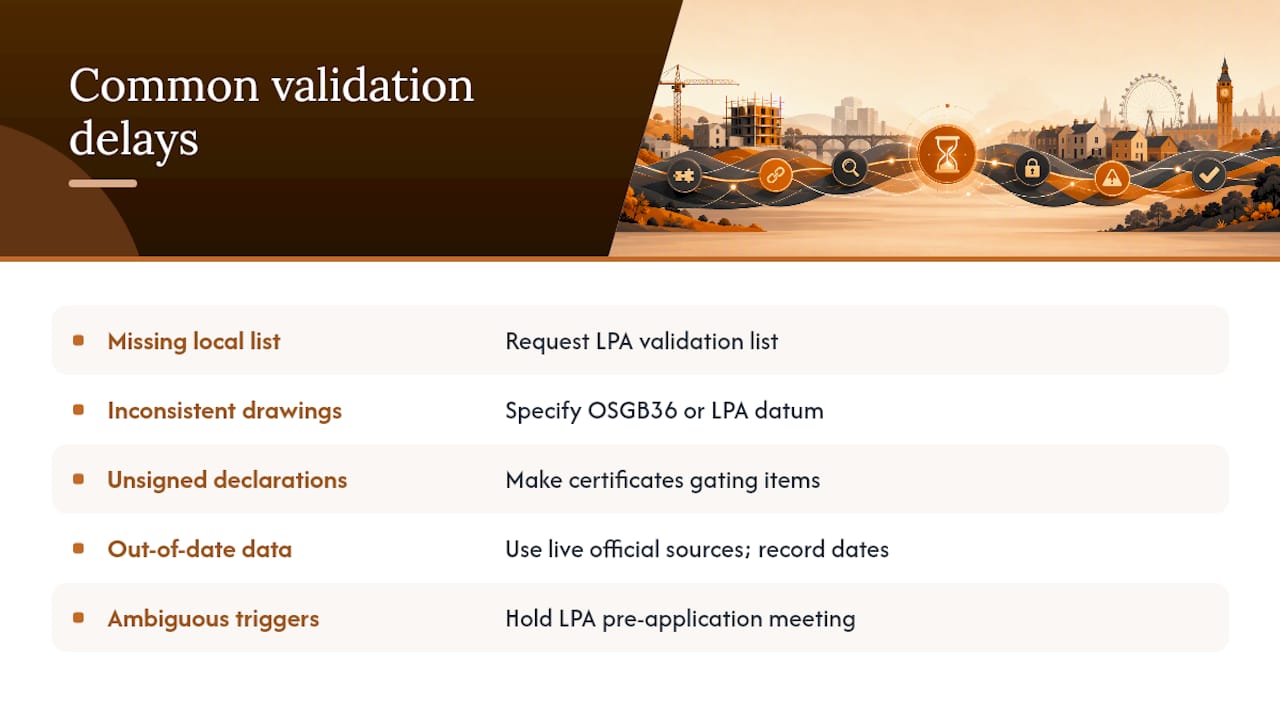
Unsigned ownership or agricultural declarations are a simple administrative miss that stalls validation instantly. The fix: build a submission checklist that treats these certificates as gating items, not afterthoughts.
Out-of-date baseline data, an old flood map, a superseded air quality dataset, undermines a report’s credibility even when the analysis itself is sound. The fix: use live official data sources and record retrieval dates in every report.
Where any of these triggers feels ambiguous, a pre-application conversation with the LPA is worth the fee. It clears up scope questions before you’ve paid for reports you didn’t need, or missed one you did.
How Fortress Associates Packages Combined Planning Reports
Fortress Associates prepares combined planning report bundles from a single point of contact, so daylight, flood risk, air quality, energy, and sustainability reports arrive cross-referenced and consistent, rather than as separate documents from separate consultants that don’t quite line up. Every bundle includes versioned PDFs, figure sets, and GIS exports where the report type calls for them.
What clients can expect:
- Fixed-fee bundles with no advance payment, you review the completed reports before paying.
- Daylight and sunlight assessments prepared to BRE 2022 methodology.
- Reports built from live official data, with retrieval dates recorded rather than static desk-study snapshots.
- An amend-or-refund guarantee on any report an LPA rejects.
- A track record Fortress Associates describes as a 100% planning discharge rate across delivered reports.
To request a scoped quote for your project, get in touch through Fortress Associates’ planning and compliance services with your site address and scheme details.
A Practitioner’s View on Bundled Submissions
Three things consistently separate a smooth validation from a stalled one. First, sequence constraints before design, not after. A scheme redesigned around a flood zone boundary discovered late costs far more than one designed around it from day one. Second, insist on a single coordinate datum and drawing revision schedule across every consultant on the job, mismatched datums cause more validation delays than any single technical error. Third, schedule season-sensitive surveys, especially ecology, as early as the brief allows, because a missed survey window can push a submission back by months regardless of how ready everything else is.
When these three things are handled correctly, the pattern is consistent: fewer planning conditions attached to approval, and validation that goes through on the first attempt rather than bouncing back for missing items. That’s not a guarantee. It’s what coordinated bundles tend to produce compared with ad hoc, piecemeal commissioning.
*- Fortress Associates
Get a Combined Planning-Report Quote Without the Guesswork
Fortress Associates prepares combined planning-report bundles for architects, developers, and contractors who need daylight and sunlight, flood risk, air quality, energy, and sustainability reports delivered as one coordinated package rather than five separate consultant relationships to manage.
A standard bundle for a small-to-medium residential scheme typically turns around within a few weeks of a confirmed brief, and every report comes with three things built in: BRE 2022 compliance on daylight and sunlight work, live official data with recorded retrieval dates rather than stale desk studies, and a fixed fee agreed before work starts, with no advance payment required. If an LPA rejects a report, Fortress Associates amends it or refunds it.
If you have a scheme that needs Building Regulations drawings alongside your planning reports, Fortress Associates handles full plans submissions too, so both sides of the application can come from one coordinated team. To get a scoped quote, send your site address, scheme details, and target submission date and Fortress Associates will confirm which reports your LPA’s validation list actually requires.
Sources
For confirming what a specific application needs and how to submit it, these sources are worth bookmarking:
- What to submit - How to apply - Planning Portal
- MKC Planning Application Validation Requirements v2.3 ADOPTED
- Streamlining information requirements for planning applications - impact assessment
- Draft Validation Checklist 2026 - OPDC committee report
- Nationally significant infrastructure projects: advice on the preparation and submission of application documents
Recommended
- Planning & Compliance Reports - Fortress Associates
- UK Planning Reports - Daylight, Flood Risk, Air Quality, Energy | Fortress Associates
- The 2026 EPUK/IAQM Air Quality Planning Guidance Update Explained - Fortress Associates
- Free UK Planning Tools: Flood Zone, AQMA, Daylight, Carbon, BNG - Fortress Associates
Need help with a UK planning project?
Fixed-fee daylight & sunlight reports and Building Regulations drawings - plus flood risk assessments, air quality assessments, energy statements and sustainability statements for planning applications across the UK.
Request a free quote