
Stop LPA Delays: 5 UK Checks for Cross Referencing Planning Documents
Use minimal, purposeful cross-references paired with strict document naming, unique reference numbers, and a Guide to the Application, so planning officers and Inspectors can trace evidence without hunting through a submission. That standard is drawn from Planning Inspectorate and Planning Advisory Service (PAS) guidance, and it’s the same discipline Fortress Associates applies to every report bundle before a client signs off.
TL;DR:
- Proper document naming with unique reference numbers, development names, and revision notes prevents delays and ensures easy identification during processing.
- Cross-references should be limited to precise locations and only where claims depend on other data, avoiding assumptions of hierarchy or importance.
- A standalone Guide to the Application, combined with a contents page and key evidence index, significantly reduces navigation issues in large submissions.
- Citing stable external sources like GOV.UK and embedding PDFs with full metadata enhances evidence integrity over time.
- Maintaining a live, shared reference table for codes, versions, and citations prevents common errors and supports consistent cross-referencing across multiple authors.
Table of Contents
- Document naming and identifiers for planning document verification
- When should you cross-reference between planning documents?
- How do you structure a Guide to the Application for large submissions?
- Which external sources should you cite in planning evidence?
- Version control that gives Inspectors a clear audit trail
- Do you need to check the LPA validation list before submitting?
- A step-by-step workflow for assembling cross-referenced submissions
- Methods for linking cross-references across multiple documents
- Tools for managing cross references without losing track
- Common cross-referencing errors and how to avoid them
- What are the legal and compliance risks of poor cross-referencing?
- What does effective cross-referencing look like in practice?
- Fortress Associates’ approach to filing and cross-referencing that passes validation
- Get your submission validation-ready before you file
- Sources
Document naming and identifiers for planning document verification
Every document you submit needs an identity that survives being downloaded, printed, or read out of order. National guidance on preparing application documents is specific about this: each file needs the development name, a document title, a unique reference number, a production date, and a chronological note of revisions. Skip any of these and you risk exactly the kind of registration delay that Planning Inspectorate guidance warns against.
A workable convention combines a project prefix, a document type code, and a version marker: something like PROJ001-FRA-v1.2 for the second flood risk assessment revision on a project coded PROJ001. Keep it short enough to fit a file name without truncation.
- Development name (matches the application form exactly)
- Document title (plain English, no internal jargon)
- Unique reference number (consistent across the whole submission)
- Production date
- Chronological revision note
Case officers process dozens of applications at once. A document that doesn’t identify itself gets set aside, and that pause is often where validation clocks start slipping.
When should you cross-reference between planning documents?
Not as often as most authors assume. PAS guidance on Local Plans specifically warns against constant internal cross-referencing, because linking one policy or paragraph to another creates an unintended hierarchy that wasn’t there in the original drafting. A reader starts assuming the referenced clause takes precedence, even when that was never the intent. The same risk applies to planning statements, environmental statements, and technical reports: cross-reference too liberally and you’ve built an accidental order of priority among documents that are meant to sit alongside each other.
A tighter approach works better:
- Cross-reference only where a claim in one document depends on data proven in another (a planning statement citing a specific figure in the flood risk assessment, for example).
- Reference exact locations, not whole documents. “See Flood Risk Assessment, Section 4.2, Figure 7” tells an Inspector precisely where to look; “see the flood risk assessment” does not.
- Where two documents cover overlapping ground, restructure one of them rather than patching the gap with a cross-reference.
Pro Tip: Before adding a cross-reference, ask whether a reader could find the same information faster through the contents page or the Guide to the Application. If yes, cut the cross-reference.
Structural clarity beats connective tissue. Chapter headings, a working contents page, and a standalone Guide to the Application usually solve the navigation problem that authors try to fix with cross-references.
How do you structure a Guide to the Application for large submissions?
Any submission running to multiple technical reports benefits from a standalone Guide to the Application, a short document that sits outside the individual reports and tells the reader where everything lives. PAS guidance on plan-making treats this kind of navigational aid as central to reducing an Inspector’s reliance on cross-references scattered through the evidence base.
At minimum, the guide needs:
- A document map listing every submitted file with its reference number and one line on its purpose
- An index of key evidence, pointing to specific figures, tables, or appendices rather than whole documents
- A note on where relevant policy extracts appear, so the reader isn’t hunting the local plan separately
Pair the guide with a single central contents page and a short executive summary at the front of the main planning statement. Together, these three elements do most of the navigational work that scattered internal references would otherwise have to carry. For NSIP-scale submissions specifically, the Planning Act 2008 guidance on application contents requires that any prescribed document included within another be signposted by exact page, paragraph, and appendix number, not a general pointer.
Which external sources should you cite in planning evidence?
External evidence needs to survive scrutiny months, sometimes years, after submission. That means choosing hosts that won’t move, rename, or delete the page you’re pointing to. Planning Inspectorate guidance flags transient links to personal or commercial cloud storage as a genuine integrity risk during inspection.
- Prefer GOV.UK, the Planning Inspectorate, the Environment Agency, and Historic England over third-party summaries or news coverage
- Embed a PDF copy when the source data feeds a technical conclusion directly (flood maps, air quality datasets); link to the live page when you’re citing general policy or guidance
- Include full citation metadata (publisher, title, date accessed) so a broken link doesn’t strand the reader without a way to trace the original
- Where permitted, keep a local archived copy with citation metadata noted in the document map
A reference that only works today isn’t a reference. It’s a placeholder waiting to fail during examination.
Version control that gives Inspectors a clear audit trail
Never overwrite a document once it’s been submitted. That’s not a style preference, it’s the operating principle behind Planning Inspectorate guidance for major projects, which requires each revision to go up as a new file so the Examining Authority retains a full audit trail.
- Use a consistent versioning pattern:
v1,v1.1,v2, or a letter suffix like(A),(B)for NSIP-style examination libraries. - Place a chronological revision log inside the document itself, usually on the second page, recording what changed and why.
- Upload the new version as a distinct file; leave the earlier version in place rather than replacing it.
A revision note might read: “v1.1, March 3, 2026: updated Table 6 following amended drainage calculations; no change to overall conclusion.” That single line tells a reader exactly what moved and what didn’t.
Pro Tip: Log revisions at the point of change, not at submission. Reconstructing a revision history from memory two weeks later is where most inconsistencies creep in.
Do you need to check the LPA validation list before submitting?
Yes, every time, even on a project type you’ve submitted a dozen times before. National minimum requirements set the floor, but each local planning authority layers its own local list on top, and those local triggers are where most under-specified submissions fail. Validation lists get updated roughly every two to three years, so a saved copy from a previous project can be quietly out of date.
Westminster City Council publishes one of the more detailed examples: a dedicated file-naming specification that sets out exactly how documents should be titled before they reach the case officer’s queue.
Before you submit, run through five checks:
- Confirm the current file-naming format for that specific LPA
- Cross-check which technical reports are locally triggered, not just nationally required
- Verify file size limits against the authority’s portal restrictions
- Confirm spatial data and plan formats meet local specifications
- Check that contact and agent details match across every document
A step-by-step workflow for assembling cross-referenced submissions
Treat this as a sequence, not a checklist you tick in random order. Each step depends on the one before it.
- Evidence audit. List every technical report your project triggers before you write a word of cross-reference text.
- Choose your naming convention. Lock the project prefix and document codes before drafting starts, not after.
- Build the Guide to the Application. Draft the document map and evidence index once you know your final file list.
- Apply links and citations. Add cross-references and external citations last, once structure is fixed and won’t shift underneath them.
- Run a version check. Confirm every file carries a correct reference number, date, and revision note.
- LPA validation check. Match your final document set against the current local validation list.
Pro Tip: Do the evidence audit before you name a single file. Renaming a document mid-project after discovering a missing trigger report is how naming conventions fall apart.
A high-level revision-log template looks like this: version number, date, section changed, one-line reason. Fortress Associates built its Planning Application Checklist Generator around exactly this sequence, letting authors confirm they haven’t skipped a step before the portfolio goes to the LPA.
Methods for linking cross-references across multiple documents
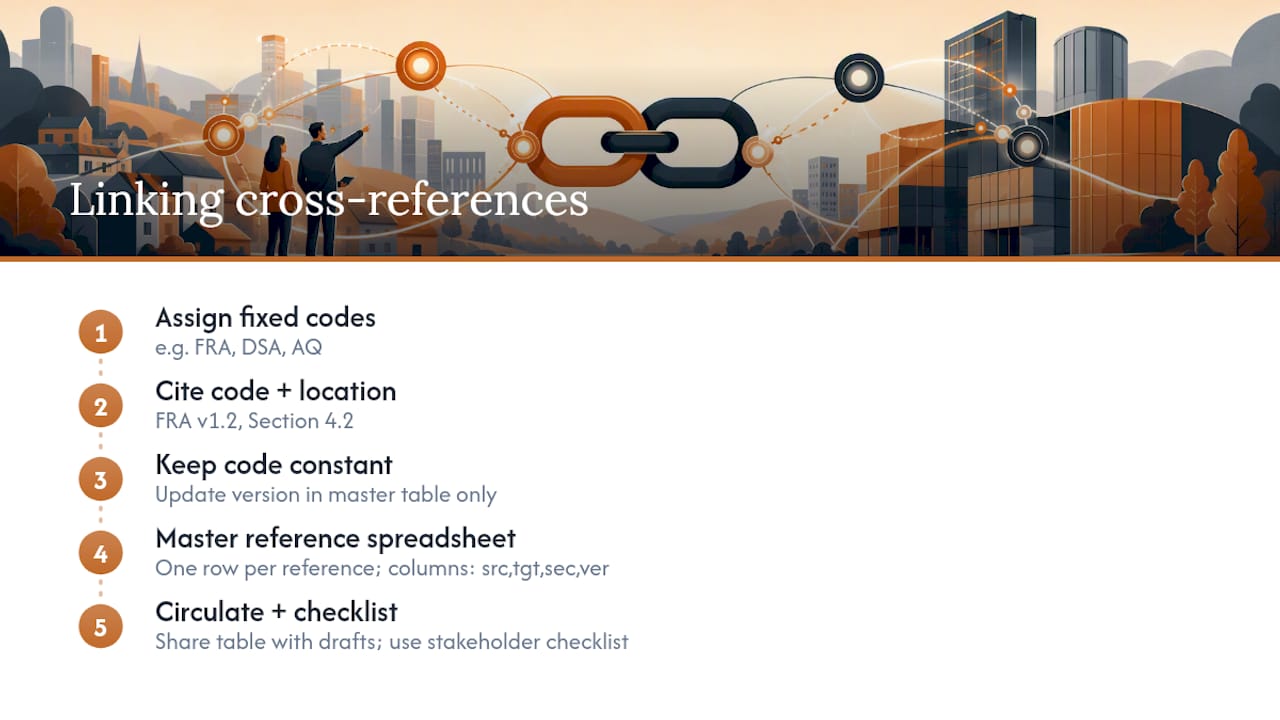
Traceability breaks down when a reference in one document doesn’t match the reality of another. The fix is a shared reference key, not cleverer prose. Assign every technical report a fixed short code (FRA for flood risk, DSA for daylight and sunlight, AQ for air quality) and use that code consistently in every other document that touches it.
A cross-reference then reads as a code plus a location: “FRA v1.2, Section 4.2” rather than a loose phrase like “see the flood report.” That format survives version updates cleanly, because updating the FRA to v1.3 doesn’t force you to hunt down every prose mention across five other documents. You update one entry in your master reference table, and the code itself stays constant.
Some larger consultancies maintain that master reference table as a standalone spreadsheet: one row per cross-reference, columns for source document, target document, section, and current version. It’s unglamorous, but it turns a traceability problem into a five-minute audit before submission rather than a forensic exercise after an Inspector flags an inconsistency. For multi-author submissions, a shared table also stops two authors from citing the same evidence at slightly different section numbers, which happens more often than most teams expect when reports are drafted in parallel.
Circulating that table alongside draft chapters, rather than after them, catches most mismatches before they reach a final PDF. A stakeholder alignment checklist built for multi-author consultancy work covers similar ground and is worth adapting if your submission involves more than two or three contributing authors.
Tools for managing cross references without losing track
Most planning teams start with what they already have: Microsoft Word’s cross-reference field, which updates section numbers automatically if you insert new content earlier in a document. That solves numbering drift inside a single file, but it does nothing across separate documents, which is where most cross-referencing actually happens in a planning submission.
For that, a shared reference spreadsheet (the master table described above) remains the most reliable low-tech option, because it’s visible to every author and doesn’t depend on proprietary software licenses across a consultant team. Some larger practices use document management platforms with built-in version control and audit logging, which automatically timestamp changes and prevent accidental overwrites, directly supporting the never-overwrite principle Planning Inspectorate guidance requires for major projects.
Whatever tool you choose, the requirement is the same: a single source of truth for reference codes, version numbers, and document status that every author checks before adding a new cross-reference. A tool like Fortress Associates’ checklist generator can’t replace that internal system, but it does catch the downstream symptom, a missing report or an inconsistent file name, before it reaches a case officer.
Common cross-referencing errors and how to avoid them
The same handful of mistakes show up across most rejected or delayed submissions.
Referencing whole documents instead of specific locations. “See the transport assessment” forces a reader to search an entire report for one figure. Cite the section, paragraph, or figure number every time.
Letting cross-references imply a policy hierarchy. PAS guidance flags this directly: cross-referencing one policy from another can make a reader assume the referenced one takes precedence, even when no such hierarchy was intended.
Overwriting a submitted file instead of issuing a new version. This destroys the audit trail Examining Authorities rely on and is explicitly against Planning Inspectorate practice for major projects.
Inconsistent naming between the document and its cross-references. If a file is renamed mid-project but references to it elsewhere aren’t updated, every citation pointing to the old name breaks silently.
Linking to unstable external hosts. A citation to a personal cloud drive or a page that gets restructured later leaves an Inspector unable to verify the underlying evidence.
Most of these share a root cause: cross-references get added late, under time pressure, without anyone checking them against the final document set. Building the reference table early, and treating it as a live document through drafting rather than a final polish step, removes most of this risk before it becomes a validation problem.
What are the legal and compliance risks of poor cross-referencing?
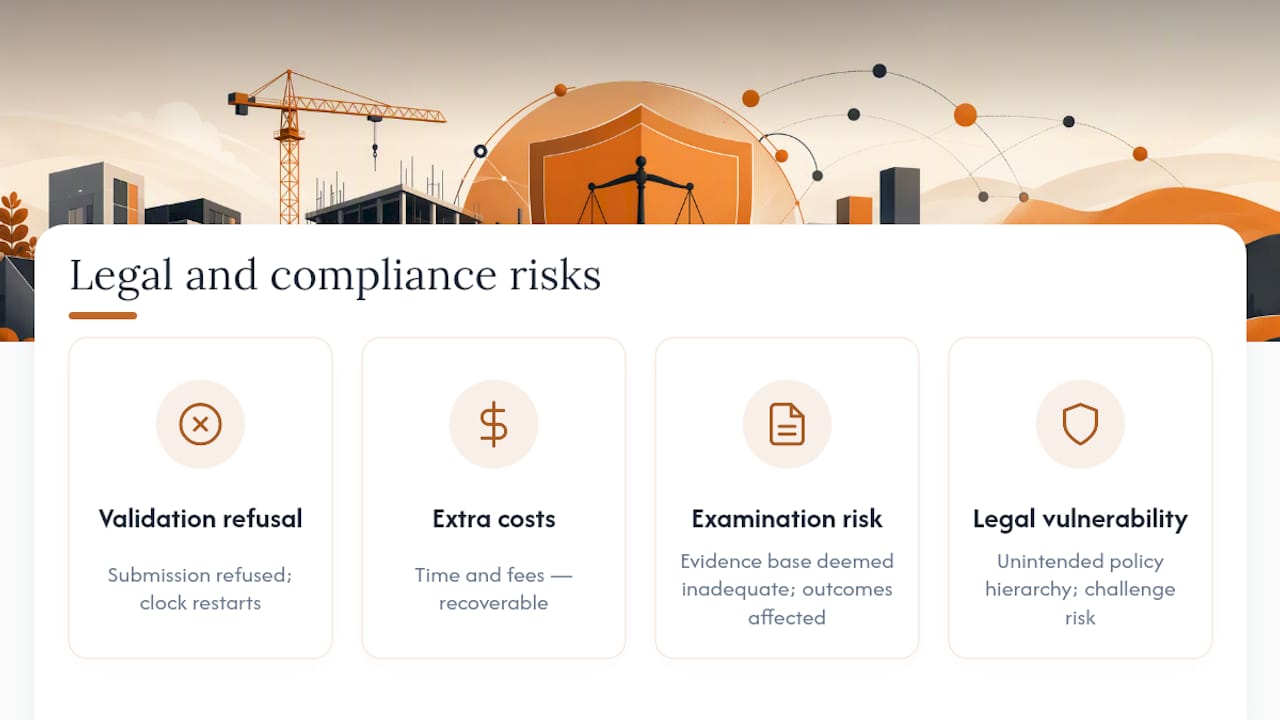
Cross-referencing errors aren’t just cosmetic. Under Planning Act 2008 guidance for major projects, prescribed documents referenced within another submission must be signposted with exact page, paragraph, and appendix numbers, and vague or broken cross-references can be treated as a failure to meet that requirement outright, not a minor drafting slip.
At the LPA level, the consequence is usually procedural rather than legal: an incomplete or inconsistent submission gets refused validation, restarting the clock on your application. That’s a cost in time and, often, in professional fees, but it’s recoverable. At examination stage for major and nationally significant projects, the stakes are higher. An Examining Authority working from a submission where cross-references don’t reliably lead to the evidence they claim to cite may treat the underlying evidence base as inadequately demonstrated, which can affect the outcome of the examination itself.
There’s also a quieter risk: cross-references that create an unintended policy hierarchy, the exact failure mode PAS guidance warns against, can be challenged later as having altered the intended meaning or weight of a policy. That’s a legal vulnerability baked into the document’s structure, not just an inspection headache. Getting the naming, versioning, and referencing right isn’t only about smoothing the path to registration. It’s part of making sure the submission means what its authors intended it to mean, and can be shown to mean that, months or years after it was drafted.
What does effective cross-referencing look like in practice?
A well-cross-referenced flood risk assessment doesn’t say “refer to the drainage strategy.” It says “Drainage Strategy DS v1.1, Section 3.4, Figure 9,” giving the reader a document code, a version, a section, and a specific figure in one line. That single habit, repeated consistently across a submission, is the difference between a document set an Inspector can navigate in an afternoon and one that takes a week of cross-checking.
Effective submissions also tend to share a structural trait: the Guide to the Application does the heavy navigational lifting, while cross-references inside individual reports stay sparse and specific. A planning statement might cross-reference the flood risk assessment twice, once to confirm a site classification and once to cite a specific mitigation measure, rather than scattering a dozen loose references to “the flood report” throughout the text.
Revision logs that read clearly matter just as much. “v2, June 12, 2026: revised Section 5.1 following LPA comment on cumulative air quality impact; conclusions unchanged” tells a case officer exactly what to check without reopening the whole document. Compare that to a bare “updated,” which forces the reader to compare two full documents side by side to find what actually moved.
None of this requires unusual effort. It requires deciding on a naming and reference system before drafting starts, and holding every author to it through to submission.
Fortress Associates’ approach to filing and cross-referencing that passes validation
Every report Fortress Associates prepares gets checked against live official data, not cached guidance, before naming conventions, revision logs, and cross-references go through a bundled review ahead of client sign-off. Readers can run the same check themselves using the Planning Application Checklist Generator before a submission goes to the LPA.
- Fortress Associates
Get your submission validation-ready before you file
Fortress Associates is the alternative to piecing a submission together report by report: one team handles the daylight and sunlight assessment, the flood risk evaluation, the air quality study, and the Building Regulations drawings as a single cross-referenced bundle that is checked against current standards before you ever see an invoice.

That matters because most of the errors covered above (mismatched naming, inconsistent revision logs, cross-references that point to the wrong version) happen when different reports are commissioned separately and never reconciled against each other. Fortress Associates builds each bundle against live official data, with no advance payment and no hidden costs, and backs every report with an amend-or-refund guarantee if an LPA rejects it. If you’re assembling Building Regulations drawings alongside a wider submission, the Full Plans drawing service follows the same naming and validation discipline covered here. Start by running your document set through the Planning Application Checklist Generator to see which reports and cross-references your project still needs before you file.
Sources
Amendments are where cross-referencing systems either hold up or fall apart. The rule from Planning Inspectorate guidance is unambiguous: submit the amended document as a new version, don’t touch the original file, and update every cross-reference that points to the changed section, not just the document that changed.
That last part gets missed constantly. A team revises a flood risk assessment, uploads FRA v1.2, and forgets that three other documents cite “FRA, Section 4.2” by page number rather than by the fixed reference code described earlier. If the amendment shifted that section from page 12 to page 14, every one of those citations is now silently wrong.
This is the strongest argument for coding cross-references by section number and document version rather than page number. Page numbers move every time a document is edited. Section numbers, if the document is structured consistently, tend to survive most amendments intact. When they don’t survive, the master reference table flags exactly which cross-references need a manual check, rather than leaving that discovery to whoever reads the document next.
Build in a fixed checkpoint: any time a document goes to a new version, run a search across the reference table for every other file that cites it, and confirm each citation still points to the right location. It takes minutes on a well-maintained table and hours of rework if it’s skipped and an Inspector catches the mismatch first.
- Nationally significant infrastructure projects: advice on the preparation and submission of application documents
- Local Plan route mapper and toolkit (PAS)
- Westminster City Council planning application document naming conventions
Recommended
Need help with a UK planning project?
Fixed-fee daylight & sunlight reports and Building Regulations drawings - plus flood risk assessments, air quality assessments, energy statements and sustainability statements for planning applications across the UK.
Request a free quote