
Discharge of Planning Conditions: Guide for Developers
Yes, you must formally discharge any planning condition that requires LPA approval before the element it controls can lawfully proceed. Start on site without that written confirmation and your works may be unlawful, regardless of whether you hold planning permission.
- Who applies: The planning permission holder, their agent, or any person with a legal interest in the land.
- Immediate next step: Read your decision notice now, list every pre-commencement condition, and submit your details to your LPA via the Planning Portal or your council’s own portal.
- Where to check fees: GOV.UK fees guidance publishes the current fee schedule; as of April 2026, householder applications cost £89 and all other discharge requests cost £309.
The statutory decision period is 8 weeks from valid application. Build 12–16 weeks into your programme. Clockfortress prepares the specialist reports most commonly required for discharge, including Flood Risk Assessments, Daylight and Sunlight reports, and Energy Statements, with an amend-or-refund guarantee.
Table of Contents
- What planning conditions are and why they matter legally
- Who should apply to discharge conditions and when
- What documents LPAs expect with your application
- How to submit a discharge application step by step
- How long decisions take and what they cost
- Risks of starting work without formal discharge
- Practical steps to get discharge approved faster
- Specialist reports that commonly support discharge applications
- Key Takeaways
- The part of discharge most applicants underestimate
- Clockfortress handles the reports that hold up your discharge
- Useful sources and official guidance
What planning conditions are and why they matter legally
A planning condition is a requirement attached to a planning permission by the local planning authority. LPAs use them to control how, when, and in what form development takes place, typically to mitigate impacts that would otherwise make the proposal unacceptable.
Common types you will encounter:
- Pre-commencement conditions: Must be discharged before any work starts on site. These are the highest-risk category. Starting work without formal written discharge makes the commencement unlawful under the Town and Country Planning Act 1990.
- Pre-occupation conditions: Must be satisfied before a building is occupied or used. Common for drainage strategies, landscaping, and access arrangements.
- Compliance or submission-of-details conditions: Require the applicant to submit specific drawings, reports, or material samples for LPA approval at a defined stage of the project.
The formal legal framework sits in articles 27–30 of the Town and Country Planning (Development Management Procedure) (England) Order 2015 and section 74A of the Town and Country Planning Act 1990. GOV.UK guidance is explicit: failure to discharge a pre-commencement condition before starting work can make that start unlawful, which carries real enforcement consequences.
Who should apply to discharge conditions and when
Anyone with a legal interest in the land can apply. That includes:
- The original planning permission holder
- Their planning agent or architect
- A developer or contractor who has acquired the site
- A future purchaser, provided they have a legal interest
Timing is where most projects go wrong. Pre-commencement conditions must be discharged before a single spade goes in the ground. Other conditions tied to specific construction stages need to be resolved before that stage begins, not after. Waiting until you are ready to start on site and then submitting a discharge application is a common and expensive mistake. Industry practice recommends reading the decision notice the day permission is granted and beginning discharge preparation immediately.
Pro Tip: An informal “clearance” from a planning officer by email or phone call does not constitute a formal discharge. Local authorities can confirm some conditions informally, but that confirmation will not satisfy a solicitor on a property sale or a mortgage lender’s due-diligence requirements. Always get the written decision notice.
Agreeing a timetable with the LPA in writing is worth doing on complex schemes. If the LPA needs more time and you agree it in writing, the statutory clock pauses. That agreement also protects you if you later need to trigger the deemed-discharge procedure.
What documents LPAs expect with your application
Submitting an incomplete package is the single most common cause of delay. LPAs may refuse or invalidate an application if details are missing, and in most cases the fee is not refunded on resubmission.
Standard documents for most discharge applications:
- The original decision notice reference and the specific condition numbers you are addressing
- Scaled plans and drawings referenced to the condition wording
- Specification documents or material schedules
- A signed application form (the article 27 form, available on the Planning Portal)
- The correct fee
Beyond the standard pack, many conditions require specialist technical reports. The table below shows the most common ones.
| Report | When typically required | What it demonstrates |
|---|---|---|
| Flood Risk Assessment | Sites in Flood Zones 2 or 3, or where drainage is conditioned | Safe development and no increase in flood risk |
| Daylight and Sunlight Assessment | Residential schemes near existing buildings | Compliance with BRE 2022 daylight standards |
| Air Quality Assessment | Sites near Air Quality Management Areas | Acceptable air quality impact during and after construction |
| Construction Management Plan | Most urban or constrained sites | Safe, managed construction process |
| SuDS / Surface Water Drainage Strategy | Where drainage is conditioned | Sustainable drainage design meeting local standards |
| Energy Statement | Schemes with energy or carbon conditions | Compliance with Part L or local energy policy |
| Building Regulations Drawings | Where compliance with Building Regulations is conditioned | Technical compliance with Approved Documents |
Callout: Local authority validation checklists vary significantly. Always download your specific LPA’s checklist before submitting. Use the Find My Council tool to locate your LPA’s portal and validation requirements.
Some councils require material samples to be physically installed on site for inspection rather than delivered to the planning office. Check this before you book a courier.
How to submit a discharge application step by step
-
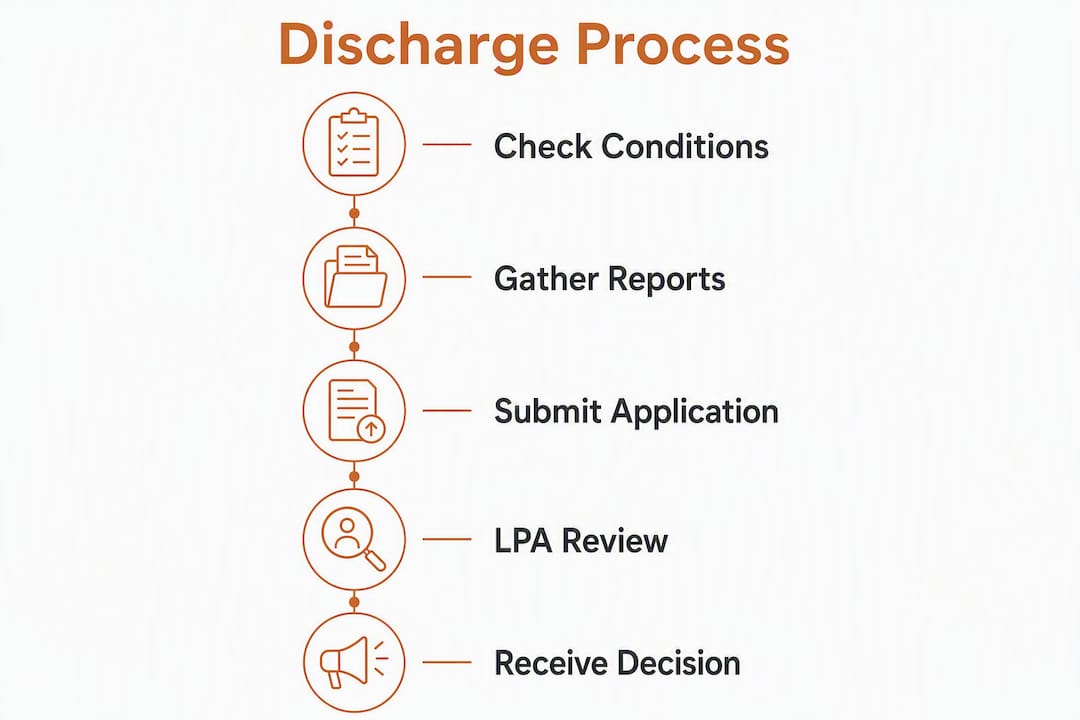
Read the decision notice and list every condition. Separate pre-commencement from pre-occupation and compliance conditions. Use a simple spreadsheet: condition number, trigger point, documents required, status.
-
Commission or prepare the required documents. For specialist reports, allow enough lead time. A Flood Risk Assessment or Daylight and Sunlight report typically takes one to three weeks to prepare properly.
-
Complete the article 27 application form. This is the standard form for approval of details reserved by condition. It is available directly through the Planning Portal. Some LPAs also accept submissions through their own portals.
-
Upload documents and pay the fee. Confirm the fee amount on GOV.UK fees guidance before submitting. As of April 2026, the fee is £89 for householder development and £309 for all other cases. Keep your payment confirmation.
-
Respond promptly to validation queries. The 8-week clock does not start until the LPA accepts the application as valid. If the validation team requests additional information, respond within their stated window or the application may lapse.
-
Arrange site inspections if required. Some conditions, particularly those relating to materials or landscaping, require a site visit before discharge is confirmed. Coordinate access early.
-
Receive and file the written decision notice. Once the LPA issues written confirmation of discharge, keep it with the original planning permission. You will need it for building control sign-off, mortgage purposes, and any future property sale.
Pro Tip: Put the planning permission reference number and the specific condition numbers on every page of every document you submit. Case officers handle multiple applications simultaneously. Making it effortless to match your documents to the right conditions reduces the chance of a validation query and speeds up the officer’s review.
If the LPA refuses discharge or fails to decide within the statutory period, you have two options: appeal the refusal, or trigger the deemed-discharge procedure under articles 27–30 of the 2015 Order if the condition is eligible. Deemed discharge is not automatic. You must actively serve a deemed-discharge notice after the minimum waiting period, and many technical conditions are excluded entirely.

How long decisions take and what they cost
The LPA must decide within 8 weeks of accepting your application as valid. If the LPA fails to issue written confirmation within 12 weeks of a valid application, the fee must be refunded for written confirmation requests.
In practice, treat 8 weeks as the statutory floor, not a delivery promise. Industry guidance recommends building 12–16 weeks into your programme, because discharge applications typically sit lower on planning team workloads than live planning applications. Use a planning deadline calculator to map these dates against your construction programme.
Possible decision outcomes:
- Fully discharged: The LPA confirms the condition is satisfied. Works controlled by that condition may proceed.
- Partially discharged: Some elements are approved, others are not. You may need to resubmit for the outstanding elements before proceeding.
- Refused: The submitted details do not satisfy the condition. You can revise and resubmit or appeal.
- No decision within statutory period: You may be entitled to a fee refund and, where eligible, can trigger deemed discharge.
Current fees vary by application type; householder developments attract a lower fee than most other discharge requests. Check the GOV.UK fees schedule for the exact current amounts, as these are subject to annual indexation. Some LPAs will confirm straightforward conditions informally without a fee, but that informal confirmation carries no legal certainty and will not satisfy a solicitor.
Risks of starting work without formal discharge
Starting work before a pre-commencement condition is formally discharged is not a grey area. The works are unlawful. That has specific, concrete consequences.
Legal risks:
- The commencement is not a lawful start, meaning the permission may not be made extant and could lapse.
- The LPA can issue an enforcement notice requiring works to stop or be removed.
- Retrospective approval is not guaranteed and may be refused.
Commercial and contractual risks:
- Mortgage lenders and their solicitors will require written discharge notices as part of due diligence on any sale or refinancing.
- Buildings insurance may be affected if works were carried out unlawfully.
- Contractor handover and practical completion can be delayed if discharge is outstanding at the end of the build.
- Buyers’ solicitors will flag missing discharge notices during conveyancing, which can delay or kill a sale.
The mitigation is simple: do not start any work controlled by a pre-commencement condition until the formal written discharge notice is on file. An email from a planning officer is not enough.
Practical steps to get discharge approved faster
The biggest delays in discharge applications are self-inflicted. Incomplete submissions, poorly referenced documents, and last-minute preparation are the main culprits. These tactics address all three.
- Start at permission stage, not build stage. Read the decision notice immediately and begin preparing discharge documents before the project programme demands it.
- Use pre-application advice. GOV.UK guidance actively encourages pre-application engagement because early dialogue with the LPA clarifies validation requirements and can reduce the number of conditions you need to discharge.
- Bundle related conditions into one application. Where the fee regime and LPA guidance allow, submitting multiple conditions in a single application saves time and reduces administrative back-and-forth.
- Submit a complete validation pack. Check the LPA’s validation checklist before you submit, not after you receive a query.
- Include a covering letter with a document index. Map each submitted document to its condition number and the precise test the condition sets. Best practice from specialist providers is a simple table: condition number, condition wording summary, document submitted, page reference.
- Negotiate fewer conditions during the main application. LexisNexis guidance recommends pushing back on unnecessary post-consent conditions at the planning application stage. Fewer conditions means less discharge work later.
Pro Tip: If a condition requires approval of materials, arrange for sample panels to be installed on site before you submit the application. A case officer who can inspect samples in context during a single site visit is far more likely to discharge the condition promptly than one who has to schedule a separate visit after reviewing office samples.
For chasing decisions, a polite email to the case officer at week six is reasonable. Reference the application number, the validation date, and the statutory 8-week deadline. If you are approaching week ten with no decision, ask in writing whether the LPA is willing to agree an extended determination period or whether deemed discharge may be appropriate.
Specialist reports that commonly support discharge applications
Most discharge applications for anything beyond a simple householder extension will require at least one specialist technical report. Getting these right first time is where projects save the most time.
- Flood Risk Assessment: Required where a condition relates to flood risk or drainage. Must demonstrate that the development is safe and does not increase flood risk to others. Clockfortress prepares these using live Environment Agency flood data.
- Daylight and Sunlight Assessment: Required for residential schemes near existing buildings or where a condition references BRE 2022 daylight standards. Clockfortress’s daylight and sunlight reports are BRE 2022 compliant and prepared for planning discharge.
- Air Quality Assessment: Required near Air Quality Management Areas or where construction impact is conditioned. Must show acceptable dust and emissions management.
- SuDS / Surface Water Drainage Strategy: Required where a sustainable drainage condition is attached. Must meet the Lead Local Flood Authority’s standards.
- Construction Management Plan: Required on most urban or constrained sites. Covers delivery routes, working hours, site hoarding, and waste management.
- Energy Statement: Required where a carbon or energy condition is attached, typically on larger residential or commercial schemes.
- Building Regulations Drawings: Required where a condition cross-references Building Regulations compliance. Clockfortress produces full plans submissions that satisfy both planning conditions and Building Regulations approval simultaneously.
Clockfortress bundles related reports into a single coordinated submission, cross-referencing each document to the exact condition wording. Every report is validated against current standards before delivery, and the amend-or-refund guarantee means that if a report is rejected, Clockfortress revises it at no additional cost.
Key Takeaways
Discharging planning conditions requires formal written LPA approval before works proceed; informal clearances carry no legal weight and will not survive conveyancing due diligence.
| Point | Details |
|---|---|
| Pre-commencement conditions are critical | Discharge these before any work starts on site or the commencement is unlawful. |
| Statutory decision period is 8 weeks | LPAs must decide discharge applications within 8 weeks of a valid submission; fees are refunded if written confirmation is not issued within 12 weeks. Industry guidance recommends building 12–16 weeks into your programme as a realistic schedule. |
| Fees from April 2026 | £89 for householder development; £309 for all other discharge applications. |
| Incomplete submissions cost money | Resubmission fees are generally non-refundable; submit a complete validation pack the first time. |
| Clockfortress for specialist reports | Clockfortress prepares bundled, cross-referenced planning reports with an amend-or-refund guarantee for discharge applications. |
The part of discharge most applicants underestimate
Most people treat discharge of planning conditions as an administrative formality. It is not. It is a second planning process with its own validation rules, its own fee structure, and its own statutory timeline. The difference is that nobody sends you a reminder.
The projects that run into trouble are almost always the ones where the developer or homeowner read the permission notice once, filed it, and assumed the conditions would sort themselves out closer to the build date. By the time they realize a pre-commencement condition needs a Flood Risk Assessment or a detailed drainage strategy, the contractor is already booked and the programme has no slack.
What actually works is treating the decision notice as a project management document the day it arrives. List every condition, assign a trigger point to each, and start commissioning specialist reports immediately for anything pre-commencement. The 8-week statutory period sounds reasonable until you factor in validation queries, site inspection scheduling, and the reality that discharge applications sit at the bottom of most planning teams’ workloads.
The deemed-discharge procedure exists as a backstop, but it is procedurally strict, excludes a long list of technical conditions (flood risk, contaminated land, environmental impact, SSSIs, archaeological matters, and highways), and does not apply to permissions granted before April 15, 2015. Relying on it as a primary strategy is a gamble most projects cannot afford.
The practical answer is preparation: start early, submit complete packs, and get specialist reports from a provider who understands what case officers actually need to see.
Clockfortress handles the reports that hold up your discharge
Getting discharge applications right the first time comes down to the quality of the specialist reports you submit. A poorly scoped Flood Risk Assessment or a daylight report that misses the BRE 2022 methodology will generate a refusal or a request for further information, costing you weeks and a non-refundable resubmission fee.

Clockfortress prepares the full range of technical reports most commonly required for planning condition discharge: Flood Risk Assessments, Daylight and Sunlight Assessments, Air Quality studies, Energy Statements, SuDS strategies, and Building Regulations drawings. Every report is prepared using live official data, validated against current LPA and national standards before delivery, and cross-referenced to the exact condition wording in your decision notice. Reports are bundled where the fee regime allows, with a covering letter mapping each document to its condition number.
The amend-or-refund guarantee means that if a report is rejected, Clockfortress revises it at no additional cost. No advance payment is required; you review the completed document before paying.
Get a scoped report bundle for your discharge application at clockfortress.com/services, or check the free planning tools to prepare your submission checklist before you commission reports.
Useful sources and official guidance
- GOV.UK: Use of planning conditions - primary guidance on when conditions are used, the discharge process, deemed discharge eligibility, and the statutory 8-week decision period.
- GOV.UK: Fees for planning applications - current fee schedule for discharge applications, refund rules, and the annual indexation updates.
- Planning Portal: Approval (Discharge) of Conditions - the submission portal and guidance on completing the article 27 application form.
- The Town and Country Planning (Development Management Procedure) (England) Order 2015, Part 5 - the statutory instrument governing discharge applications and the deemed-discharge procedure (articles 27–30).
Local validation rules vary between LPAs. Before submitting, download your specific council’s validation checklist from their planning portal. Use the Find My Council tool to locate your LPA’s page directly. Deemed discharge is available in limited circumstances only; many technical conditions are excluded, and it does not apply to permissions granted before April 15, 2015.
Recommended
- Do I Need Planning Permission for an Extension? Free PD Checker - Fortress Associates
- Site Constraints Checker: Instant Planning Appraisal by Postcode - Fortress Associates
- Do Heat Pumps Need Planning Permission? 2026 PD Checker Tool - Fortress Associates
- Daylight Reports for Permitted Development and Prior Approval (2026) - Fortress Associates
Need help with a UK planning project?
Fixed-fee daylight & sunlight reports and Building Regulations drawings - plus flood risk assessments, air quality assessments, energy statements and sustainability statements for planning applications across the UK.
Request a free quote