Environment Agency Consultation for Planning in England
If your site sits in Flood Zone 2 or 3, falls within 20 metres of a main river, involves a discharge to controlled waters, or triggers an environmental permit under the Environmental Permitting (England and Wales) Regulations, you must consult the Environment Agency before submitting your planning application. The fastest route to a compliant response: check Flood Map for Planning first, apply national flood risk standing advice where it covers your case, and for anything more complex, use the EA’s pre-application advice service and submit a complete Statement of Environmental Effects workflow with your LPA consultation.
When to escalate beyond standing advice:
- Main river within 20 metres of the proposed development footprint
- Development in Flood Zone 2 or 3 (any vulnerability class above water-compatible)
- Proposed wastewater discharges or abstractions requiring an environmental permit
- EIA development with significant water quality or flood risk effects
- Sites adjacent to or within a permitted facility boundary
- Habitats Regulations Assessment (HRA) scope triggered by proximity to a European protected site
Key Takeaways
Consulting the Environment Agency correctly from the start is the single most effective way to keep a planning application on programme. The triggers are specific, the documents are known, and the process is manageable with the right preparation.
| Point | Details |
|---|---|
| Check Flood Map for Planning first | Run the official screening tool to confirm Flood Zone and main river proximity before any other step. |
| Use standing advice where it applies | Many lower-risk cases are covered by national flood risk standing advice, removing the need for direct EA consultation. |
| Submit a complete FRA and drainage strategy | Incomplete submissions are the primary cause of EA information requests and programme delay. |
| Use EA pre-application advice for complex cases | The chargeable service, with a 15-working-day eligibility check target, resolves technical issues before formal submission. |
| Fortress Associates delivers EA-ready reports | Flood risk assessments, drainage strategies, and pre-application bundles prepared to current EA standards, with an amend-or-refund guarantee. |
Table of Contents
- When does the Environment Agency need to be consulted on a planning application?
- What documents should you send with an EA planning consultation?
- Who does what: EA, LLFA, LPA, and Natural England
- How does environmental permitting relate to planning, and when do you need pre-permit advice?
- What are the EA’s consultation timelines and response standards?
- What are the most common EA objections and how do you avoid them?
- How do you use the EA’s pre-application advice service effectively?
- A practical submission checklist for EA planning consultations
- What should you do if the EA objects to your planning application?
- What technical standards does the EA expect for FRAs and hydraulic modelling?
- Why early EA engagement is the only strategy that consistently works
- Fortress Associates prepares the technical reports that get EA consultations right
- Sources
When does the Environment Agency need to be consulted on a planning application?
The statutory triggers for Environment Agency consultation planning sit primarily in the Town and Country Planning (Development Management Procedure) Order 2015 (DMPO) and the Environmental Impact Assessment Regulations 2017. The EA must be consulted on:
- Flood risk: Development in Flood Zones 2 and 3, and certain Flood Zone 1 sites where surface water risk is significant
- Main river proximity: Any development within 20 metres of a main river or 8 metres of a tidal main river (or their flood defences)
- EIA development: Where the Environmental Statement addresses water quality, flood risk, or impacts on the water environment
- Environmental permitting: Proposals that involve activities regulated under EPR (waste operations, industrial discharges, water/wastewater activities)
- Strategic plans: Local Plans and Spatial Development Strategies where EA input on flood risk policy and water quality is required
The distinction between direct EA consultation and standing advice matters enormously for LPA officers and applicants. National flood risk standing advice sets out the screening rules: if a development falls within a Flood Zone and vulnerability classification combination that the standing advice covers, the LPA can apply that advice directly without consulting the EA. This removes a layer of process for lower-risk cases and speeds up decisions.
The Lead Local Flood Authority (LLFA) handles surface water drainage for major development. If your concern is solely about surface water runoff and SuDS design, the LLFA is the right consultee, not the EA. The EA steps in when the receiving watercourse is a main river, when flood risk from rivers or the sea is in scope, or when permitting issues arise.
Quick screening checklist:
- Run Flood Map for Planning and note the Flood Zone and main river proximity
- Check the vulnerability classification of the proposed use against the NPPF/PPG flood risk tables
- Confirm whether any proposed activity (discharge, abstraction, waste) needs an environmental permit
- Identify whether the LLFA or EA is the appropriate drainage consultee for the scale of development
What documents should you send with an EA planning consultation?
The EA cannot assess flood risk or permitting implications from a site location plan and a planning statement alone. Incomplete submissions are the single biggest driver of repeat information requests, which push applications past statutory decision windows. Send the following from day one.
Core documents:
- Flood Risk Assessment (FRA): Site-specific, prepared to EA standing advice methodology, covering all relevant flood sources, climate change allowances (using EA’s updated allowances), and a clear vulnerability classification and justification
- Drainage strategy or SuDS design: Including pre- and post-development runoff rates, attenuation volumes, and an outline operation and maintenance plan
- Site plans: Clearly annotated to show the distance from the development footprint to the nearest main river bank and any flood defence
- Hydraulic modelling outputs: Model summary, input data, calibration/validation notes, and flood extent maps at the 1-in-100-year (plus climate change) return period
- Environmental Statement excerpts: Where EIA applies, the water environment chapter and any relevant appendices
- HRA screening or appropriate assessment: Where the site is near a European protected site and nutrient or hydrological impacts are in scope
File formatting matters. Label modelling files with the software version, run date, and scenario name. Put the key conclusions and summary tables on page one of the FRA, not buried in an appendix. EA reviewers work to tight turnaround windows; a document that makes them hunt for the critical figure will generate a holding response.
Pro Tip: Attach a one-page cover note to every EA consultation that lists: (1) what documents are included, (2) what the EA is specifically being asked to review, and (3) who to contact for technical clarifications. This alone can cut review time significantly because it removes ambiguity about the scope of the EA’s role on that application.
A short document checklist to attach to the LPA consultation:
- [ ] Flood Map for Planning screenshot (date-stamped)
- [ ] FRA (version number and date on cover)
- [ ] Drainage strategy / SuDS design
- [ ] Hydraulic modelling summary and outputs
- [ ] Environmental Statement water chapter (if EIA)
- [ ] HRA screening opinion or appropriate assessment (if applicable)
- [ ] Permit feasibility note (if EPR-regulated activity proposed)
- [ ] Cover note with specific EA questions and contact details
Who does what: EA, LLFA, LPA, and Natural England
Overlapping remits between statutory consultees cause more delays than almost any technical shortfall. Routing the wrong question to the wrong body wastes weeks.
Environment Agency: Statutory consultee for flood risk from rivers and the sea, main river management, environmental permitting (EPR), water quality, and the Water Framework Directive. The EA advises the LPA but does not make the planning decision. LPAs are required to take EA responses into account, and a sustained EA objection will almost always block approval in practice.
Lead Local Flood Authority (LLFA): Responsible for surface water drainage management. For major development (10 or more dwellings, or commercial development over 1,000 m²), the LLFA is the statutory consultee for SuDS and surface water drainage design. The LLFA is not the right body for main river flood risk questions.
Local Planning Authority (LPA): The decision-maker. The LPA coordinates consultations, weighs responses, and issues the planning decision. It is the LPA’s job to consult the EA and LLFA at the right time; applicants should not bypass the LPA to consult the EA directly during a live application, though pre-application engagement with the EA is both permitted and encouraged.
Natural England: Statutory nature conservation adviser. Consult Natural England where the development may affect a Site of Special Scientific Interest (SSSI), a European protected site, or where an HRA is required. Nutrient neutrality issues (particularly in catchments subject to Habitats Regulations obligations) often involve both Natural England and the EA.
Practical routing:
- Surface water runoff from a new housing estate with no main river nearby: LLFA
- Proposed culverting or works within 8 metres of a tidal main river: EA
- Discharge of treated effluent to a watercourse: EA (permitting) and LPA (planning)
- Development near a Special Area of Conservation with potential nutrient loading: Natural England and EA
The EA’s role as adviser rather than decision-maker is worth keeping front of mind. A well-evidenced FRA that addresses the EA’s technical concerns gives the LPA the basis to approve even where the EA has raised initial questions, provided those questions are resolved before the decision is made.
How does environmental permitting relate to planning, and when do you need pre-permit advice?
Planning permission and an environmental permit are separate legal consents. Planning permission addresses land use and the acceptability of development in principle. An environmental permit, issued under the Environmental Permitting (England and Wales) Regulations, controls how an operation is run and what pollution controls apply. You can have one without the other, and the EA administers permits independently of the planning system.
Activities that commonly require an environmental permit alongside planning permission:
- Waste processing or transfer operations
- Industrial discharges to controlled waters or sewer
- Abstraction of water above threshold volumes
- Certain water/wastewater treatment activities
- Operations on or near a permitted site (landfill, industrial installation)
During a planning consultation, the EA will flag if a proposed activity appears to require a permit and may recommend that the applicant seek pre-permit advice or pursue parallel tracking of the permit and planning applications. This is not a refusal of the planning application; it is a signal that permitting feasibility needs to be established before the LPA can be confident the development is deliverable.
EA guidance on permit consultations confirms that once a permit application is duly made, the EA aims to start the public consultation within 30 working days, with the consultation window typically open for 20 working days. Running the permit application in parallel with the planning application, rather than sequentially, is standard practice for complex schemes and avoids the scenario where planning is granted but the permit is refused or significantly conditioned.
What are the EA’s consultation timelines and response standards?
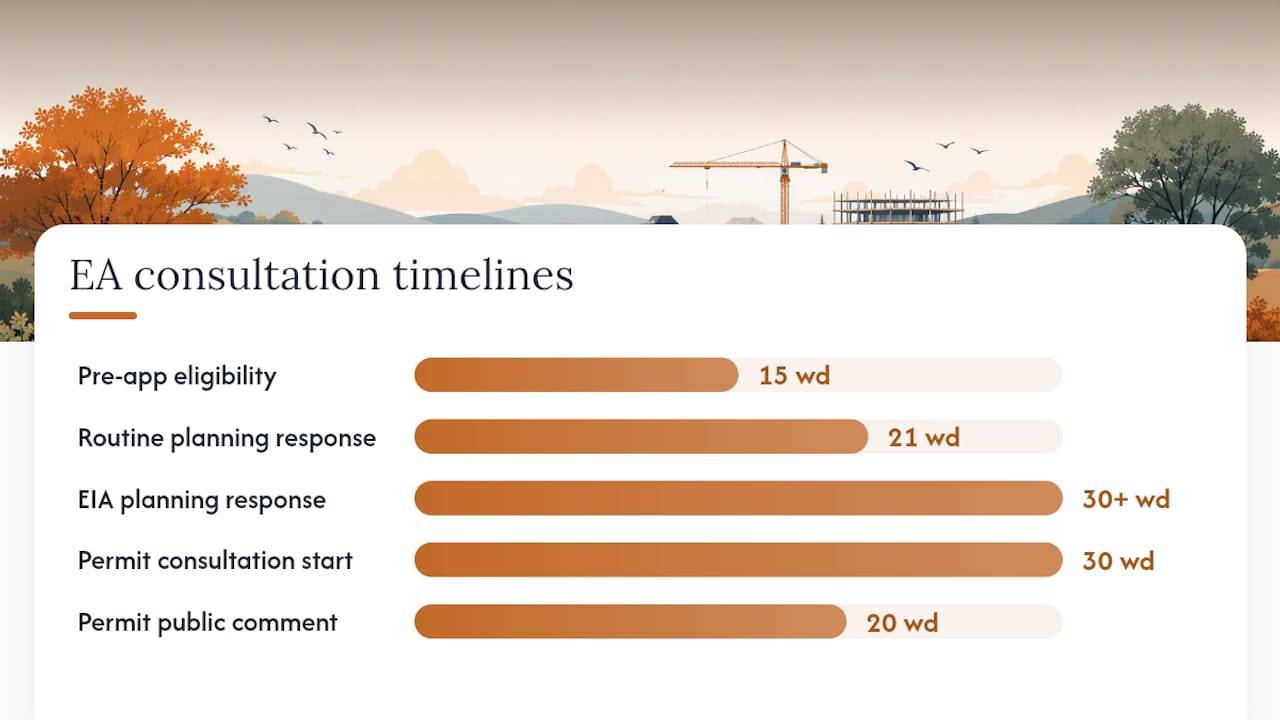
The GOV.UK guidance for local planning authorities sets out typical response time expectations. For most planning consultations, the EA aims to respond within 21 working days. EIA cases and plan-stage consultations typically attract longer windows. The EA’s published timeliness data shows that complex flood risk modelling reviews can run beyond the standard window, which is why early engagement matters for high-risk schemes.
| Stage | Typical EA target |
|---|---|
| Pre-application eligibility check | 15 working days |
| Routine planning consultation response | 21 working days |
| EIA planning consultation response | 30+ working days |
| Permit consultation start (post duly made) | 30 working days |
| Permit public comment window | 20 working days |
“Duly made” means the permit application is complete and valid. The EA will not start the consultation clock until the application meets this threshold. Missing information, incorrect fees, or absent supporting documents will delay the duly-made determination and push back the entire permit timeline.
High public interest cases, such as those involving significant community concern or major environmental risk, may attract extended consultation periods and wider publicity requirements. The EA has discretion to extend consultation windows in these circumstances.
For planning consultations, the 21-day window runs from the date the LPA formally notifies the EA. Applicants cannot control this date directly, but submitting a complete application to the LPA with all EA-relevant documents included from day one prevents the LPA from having to re-consult after additional information is requested.
What are the most common EA objections and how do you avoid them?
Most EA objections are preventable. They cluster around a small number of recurring technical shortfalls.
Incomplete or low-quality FRA. The FRA does not cover all relevant flood sources, uses outdated climate change allowances, or fails to demonstrate that the development passes the sequential and exception tests. Fix: use the EA’s current climate change allowances, address all flood sources (fluvial, tidal, surface water, groundwater where relevant), and include a clear sequential test narrative.
Inadequate surface water drainage or SuDS. The drainage strategy does not demonstrate that post-development runoff rates match or improve on the greenfield rate, or the SuDS design lacks an operation and maintenance plan. Fix: provide pre- and post-development runoff calculations, attenuation volume justification, and a draft O&M plan with named responsible parties.
Unassessed wastewater discharges. The application proposes a discharge to a watercourse or sewer without addressing permit feasibility or demonstrating that receiving water quality can accommodate the load. Fix: include a permit feasibility note and, where necessary, a pre-permit advice request to the EA before submission.
Unacceptable impacts on permitted sites. The development is adjacent to a permitted facility (landfill, industrial installation) and the application does not assess the interaction. Fix: identify all permitted sites within the study area and include a brief assessment of potential interactions.
Nutrient and nature conservation issues. In catchments subject to Habitats Regulations obligations, the application does not include a nutrient budget or mitigation strategy. Fix: engage Natural England and the EA early, prepare a nutrient budget using the relevant catchment calculator, and identify mitigation credits if the budget shows a net increase.

Insufficient modelling or O&M detail. Hydraulic models are submitted without calibration notes, input data, or scenario summaries, making it impossible for the EA to verify the outputs. Fix: follow the EA’s modelling guidance and provide a model summary document alongside the raw outputs.
Pro Tip: Log every piece of EA correspondence, including pre-application emails and meeting notes, in a dated project file. When the EA raises an objection, you can demonstrate to the LPA exactly what was discussed, what was agreed, and what technical steps were taken in response. This record is also valuable evidence if the application goes to appeal.
How do you use the EA’s pre-application advice service effectively?
The EA offers a discretionary, chargeable pre-application advice service for non-NSIP developments. It can cover draft FRA review, hydraulic modelling checks, environmental statement sections, and permitting feasibility. The EA aims to confirm eligibility for a request within 15 working days of submission.
Step-by-step process:
- Screen the project using Flood Map for Planning and standing advice to confirm whether pre-application advice is needed or whether standing advice resolves the issue.
- Prepare a project summary covering site location, proposed use, flood zone, proximity to main rivers, and any proposed regulated activities.
- Submit the pre-application request via the EA’s online service (accessible through GOV.UK), including the project summary, draft FRA or modelling outputs where available, and a list of specific questions for the EA.
- Await eligibility confirmation (target: 15 working days). The EA will confirm whether the request is accepted and provide a fee estimate for the review.
- Receive EA pre-application response and use it to refine the FRA, modelling, and drainage strategy before formal LPA submission.
- Submit the complete package to the LPA, referencing the EA pre-application response in the cover note.
The chargeable service is most valuable for: sites in Flood Zone 3, developments requiring complex hydraulic modelling, projects with permitting implications, and EIA development where the water environment chapter is a significant element of the Environmental Statement.
Best-practice workflow:
- Early screening (Flood Map for Planning + standing advice check)
- EA pre-application advice for complex or permit-linked items
- Refine FRA, drainage strategy, and modelling based on EA response
- Submit complete package to LPA with EA pre-application response attached
Pro Tip: *When requesting pre-application advice, ask the EA specific, answerable questions rather than open-ended ones.
Sample email structure for a preliminary EA opinion:
- Subject: Pre-application flood risk advice request - [Site address] - [LPA reference if known]
- Para 1: Site description, proposed use, Flood Zone, main river proximity
- Para 2: Summary of flood risk issues and specific questions for the EA
- Para 3: List of attachments (draft FRA, site plan, modelling summary)
- Para 4: Contact details and preferred response format
A practical submission checklist for EA planning consultations
Use this checklist before submitting to the LPA to confirm that everything the EA needs is included from day one.
Mapping and screening:
- Run Flood Map for Planning and save a date-stamped screenshot
- Confirm Flood Zone and main river proximity (measure to the bank, not the flood extent)
- Check standing advice applicability using the national flood risk standing advice screening rules
- Identify any EPR-regulated activities and confirm permit feasibility status
Technical documents:
- [ ] FRA (version-controlled, date on cover, EA climate change allowances used)
- [ ] Drainage strategy with pre/post runoff calculations and SuDS design
- [ ] Hydraulic modelling summary (inputs, calibration notes, flood extents)
- [ ] Environmental Statement water chapter (EIA only)
- [ ] HRA screening or appropriate assessment (if applicable)
- [ ] Permit feasibility note (if EPR activity proposed)
Cover note contents:
- Project name, address, LPA reference, and application type
- Flood Zone, main river distance, and vulnerability classification
- Specific questions for the EA (numbered, answerable)
- Full list of attachments with version numbers
- Named technical contact for clarifications
PDF mark-up advice: Bookmark the FRA to take the reader directly to the executive summary, the flood zone map, and the climate change assessment. Highlight the key conclusions table on page one. EA reviewers handling multiple consultations simultaneously will prioritise documents that surface the critical information immediately.
Suggested subject line for LPA consultations: EA Consultation - [Site Address] - FRA v[X] + Drainage Strategy - [Date]
What should you do if the EA objects to your planning application?
An EA objection is not the end of the road, but it does require a structured response. Ignoring it or waiting for the LPA to resolve it rarely works.
- Read the objection carefully and identify the specific grounds. EA objection letters typically list technical deficiencies by category. Separate the flood risk grounds from any permitting grounds - they may need different responses.
- Request a meeting with the EA case officer. Most EA teams will agree to a short technical meeting to clarify what evidence would satisfy the objection. Get the meeting confirmed in writing and circulate an agenda in advance.
- Prioritise technical fixes. Prepare amended documents (revised FRA, updated modelling, drainage strategy revision) that directly address each ground of objection. Do not resubmit the same document with minor edits.
- If the objection is permitting-related, request pre-permit advice. Where the EA’s concern is about whether a permit is feasible, a pre-permit advice request to the EA’s permitting team will establish whether the activity can be permitted and on what terms.
- Submit amended documents to the LPA with a schedule of changes that maps each EA objection to the specific amendment made. This makes it straightforward for the LPA to re-consult the EA on the revised material.
- If the EA maintains its objection after amendments, ask the EA in writing to confirm the specific residual grounds. This creates a clear record for the LPA and, if necessary, for a planning inspector.
EA objections are usually withdrawn after a well-targeted amended submission. Persistent objections typically involve sites where the fundamental flood risk is unresolvable (development in the functional floodplain without adequate justification) or where permitting feasibility is genuinely in doubt.
On appeals: Where a planning application is refused partly on EA grounds, the EA will submit evidence to the planning inspector. Assembling a complete record of all EA correspondence, pre-application advice, meeting notes, and agreed action logs before lodging the appeal is not optional. Inspectors will want to understand what was discussed, what was agreed, and why the objection was not resolved before the decision.
Pro Tip: After any technical meeting with the EA, send a follow-up email within 24 hours summarising what was discussed and what was agreed. Ask the EA officer to confirm or correct the summary. This creates a contemporaneous record that is far more reliable than notes taken weeks later, and it demonstrates good faith to both the LPA and any future inspector.
What technical standards does the EA expect for FRAs and hydraulic modelling?
The EA’s expectations for technical quality are not arbitrary. They reflect the minimum standard of evidence needed to assess flood risk reliably.
FRA methodology:
- Use the current EA climate change allowances (Higher Central and Upper End scenarios for most development types)
- Apply the correct vulnerability classification from the NPPF/PPG flood risk tables and justify it explicitly
- Address all relevant flood sources: fluvial, tidal, surface water, groundwater, sewer flooding where appropriate
- Demonstrate that the sequential test has been applied and, where required, that the exception test is passed
- Include a residual risk assessment and flood warning/evacuation plan for vulnerable uses
Hydraulic modelling:
- Provide model inputs (topographic data, roughness values, boundary conditions) in a summary document
- Include calibration and validation notes showing how the model performs against observed flood events
- Submit flood extent maps at the 1-in-100-year and 1-in-100-year plus climate change return periods
- Use EA-approved model software where specified and confirm the software version used
SuDS and drainage:
- Demonstrate that post-development runoff rates do not exceed the greenfield rate (or the existing rate for brownfield sites, where the greenfield rate is not achievable)
- Provide attenuation volume calculations and a drainage layout plan
- Include an O&M plan with named responsible parties and maintenance schedules
- Assign responsibility for long-term SuDS maintenance in a legal agreement or planning condition
Key reference standards: EA standing advice on flood risk, the EA’s hydraulic modelling guidance, NPPF Chapter 14 and the accompanying PPG on flood risk and coastal change, and the CIRIA SuDS Manual (C753) for drainage design.
For sites near rivers and watercourses, the FRA requirements go beyond the basics: modelling must account for the interaction between the development and the watercourse, including any culverting, bridging, or realignment proposed.
| Technical element | EA minimum expectation |
|---|---|
| Climate change allowances | Higher Central + Upper End scenarios |
| Flood sources addressed | All relevant (fluvial, tidal, surface water, groundwater) |
| Modelling calibration | Calibration/validation notes with observed data |
| SuDS runoff rate | At or below greenfield rate |
| O&M plan | Named responsible parties and maintenance schedule |
Why early EA engagement is the only strategy that consistently works
The planning system treats the EA as an adviser, not a gatekeeper. But in practice, a sustained EA objection on flood risk or permitting grounds will stop most applications. LPAs rarely override a maintained EA objection on technical flood risk matters, and planning inspectors give EA evidence significant weight at appeal.
The pattern that Fortress Associates sees repeatedly is this: applicants who engage the EA early, use the pre-application advice service for complex cases, and submit a complete technical package from day one rarely face formal objections. Those who treat the EA consultation as a formality to be managed after submission spend months in a cycle of information requests, amended submissions, and re-consultations.
There is a subtler point worth making. The EA’s pre-application advice is chargeable, and some applicants resist paying for it on the grounds that they will “deal with any issues when they arise.” The cost of a pre-application review is almost always less than the cost of a single round of amended submissions, re-consultation, and the programme delay that follows. For schemes in Flood Zone 3 or with permitting implications, skipping pre-application advice is a false economy.
The other underestimated factor is documentation discipline. Every email, every meeting note, every agreed action from an EA conversation should be logged and filed. Not because the EA is adversarial, but because planning applications are long processes with multiple decision-makers, and the record of what was agreed six months ago is what protects the applicant when a new EA officer picks up the file.
Fortress Associates prepares the technical reports that get EA consultations right
Fortress Associates prepares flood risk assessments, drainage strategies, and hydraulic modelling outputs built specifically to meet EA expectations on planning consultations. Every report is validated against current EA standards and NPPF/PPG requirements before delivery, and the amend-or-refund guarantee means that if a report is rejected on technical grounds, Fortress Associates fixes it at no additional cost.
For developers and planning consultants working on sites in Flood Zone 2 or 3, near main rivers, or with permitting implications, Fortress Associates offers pre-application bundles that combine the FRA, drainage strategy, and a permit feasibility note into a single coordinated package. This is the format EA reviewers find easiest to work with, and it is the format most likely to produce a clean consultation response. Reports are prepared using live official data, with no hidden costs and no advance payment required.
To commission a flood risk assessment or pre-application bundle, visit the Fortress Associates services page or get in touch directly for a scoping conversation about your project.
Sources
These are the primary references for environment agency consultation planning in England. Open them in this order: screening first, then submission guidance, then permitting.
This article is general information, not a substitute for advice from a qualified lawyer. Consult a qualified legal professional about your own circumstances before acting on anything here.
Recommended
- Daylight Requirements in Fenland - Fortress Associates
- Free UK Planning Tools: Flood Zone, AQMA, Daylight, Carbon, BNG - Fortress Associates
- The 2026 EPUK/IAQM Air Quality Planning Guidance Update Explained - Fortress Associates
- 21 Free UK Planning Tools - Constraints, Flood, Fees, Daylight | Fortress Associates
Need help with a UK planning project?
Fixed-fee daylight & sunlight reports and Building Regulations drawings - plus flood risk assessments, air quality assessments, energy statements and sustainability statements for planning applications across the UK.
Request a free quote