Planning Approval Timeline UK: What to Expect and When
England’s statutory decision periods are fixed by law: 8 weeks for non-major applications, 13 weeks for major development, and 16 weeks where an Environmental Impact Assessment applies. These figures come straight from Article 34 of the Development Management Procedure Order, and they’re measured from the date your application is validated, not the date you hit submit.
Here’s the catch. Statutory doesn’t mean guaranteed. Validation snags, statutory consultees dragging their feet, committee referrals, and Section 106 haggling routinely push real determination times well past the legal clock, especially on anything classed as major.
- Non-major applications: 8 weeks
- Major development: 13 weeks
- Applications requiring EIA: 16 weeks
Gov confirms these are the baseline expectations, but plan for slippage on anything complex.
Key Takeaways
Statutory planning decision periods in England are 8, 13, and 16 weeks, but validation quality and consultee responses determine whether you actually get a decision within that window.
| Point | Details |
|---|---|
| Know your statutory window | Non-major applications get 8 weeks, major development 13 weeks, and EIA schemes 16 weeks from validation. |
| Plan for major-scheme slippage | Median major application decisions run around 28 weeks in practice, well past the 13-week target. |
| Fix validation before submitting | Missing or inconsistent specialist reports are the most common cause of delay before the clock even starts. |
| Negotiate before you appeal | An agreed extension of time is almost always faster than a non-determination appeal. |
| Commission a validated report bundle | Fortress Associates delivers cross-referenced daylight, flood, air quality, and energy reports with an amend-or-refund guarantee to prevent validation bounce-backs. |
Table of Contents
- How Does the Planning Approval Timeline Uk Clock Actually Start?
- How Long Does UK Planning Approval Really Take?
- Why Do Planning Applications Overrun the Statutory Target?
- What Can You Do to Speed Up a Planning Decision?
- How Long Does Planning Permission Last Once Granted?
- What If Your Council Is Late or Refuses Your Application?
- What Do Specialist Planning Reports Actually Fix During Validation?
- The Biggest Preventable Cause of Delay
- Get Your Planning Reports Right the First Time
- Sources
How Does the Planning Approval Timeline Uk Clock Actually Start?
The clock doesn’t start when you post your application. It starts when your local planning authority (LPA) formally validates it, meaning every required form, plan, and supporting document has been checked and accepted. Get validation wrong and you’ve lost days, sometimes weeks, before the statutory period even begins.
Planning Portal guidance puts typical validation turnaround at 3 to 5 working days for minor applications and around 10 working days for major schemes, assuming everything’s correctly documented the first time. Miss a required report and that timer effectively resets while the LPA writes back asking for it.
Once validated, the LPA consults statutory bodies (highways, the Environment Agency, heritage officers, and others depending on your site). Their responses, or lack of them, can stretch the practical timeline considerably even though the legal clock keeps ticking.
- Validation confirms the application is complete and starts the statutory clock.
- Statutory consultees can request further information, adding real-world delay.
- Extension of time agreements let the LPA and applicant formally agree to a longer period rather than the council missing the deadline outright.
Our planning application checklist generator flags the documents that most often trip up validation before you submit.
Pro Tip: The single most common validation pitfall is submitting a daylight or flood risk report that doesn’t reference the actual submitted drawings. Cross-check every specialist report against your final plan set before you send anything.
How Long Does UK Planning Approval Really Take?
The statutory figures (8, 13, and 16 weeks) are the legal ceiling for most cases, with the higher figures applying to major schemes and EIA development. But those numbers describe the legal deadline, not the average outcome.
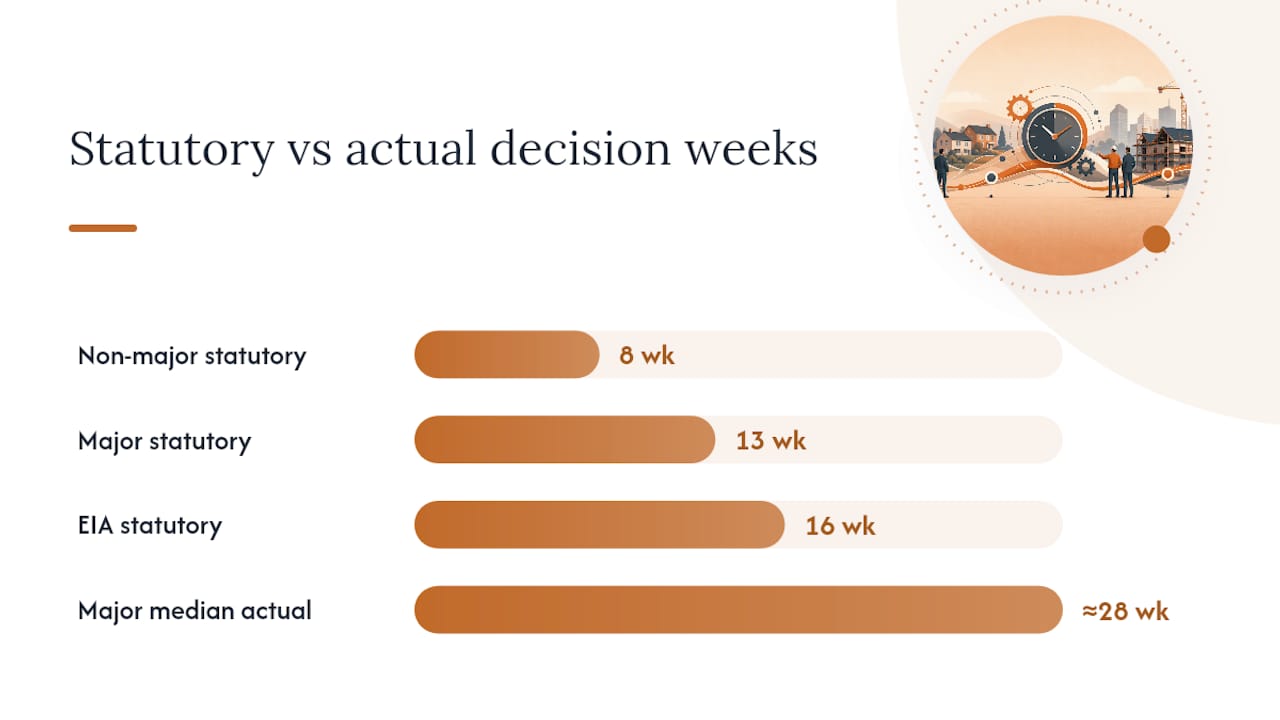
Government consultation data shows median determination time for major applications running around 28 weeks in a recent period, more than double the 13 week statutory target. That gap is exactly why the government has proposed an Accelerated Planning Service offering a 10-week decision route for certain major commercial applications, with fee refunds if the LPA misses it.
For homeowners and small developers, non-major applications tend to track closer to the 8-week statutory figure, especially when the LPA doesn’t need to consult widely. Complex sites, listed buildings, or anything needing committee sign-off change that picture fast.
- Non-major applications often approach the 8-week statutory target on straightforward sites.
- Major development decisions frequently take substantially longer than the 13-week legal limit in practice.
- EIA-related schemes have a 16-week statutory time limit but real times can be longer due to additional procedures.
Why Do Planning Applications Overrun the Statutory Target?
Four causes account for most delays beyond the statutory window. Missing or inadequate specialist reports, most commonly daylight and sunlight, flood risk, or heritage assessments, top the list because they trigger validation bounce-backs before the clock even starts properly.
Statutory consultees are the second big one. Highways authorities and the Environment Agency, in particular, can take weeks to respond, and the LPA has limited power to hurry them along. Committee referrals add another layer: if a ward councillor calls in an application, or it meets a council’s committee threshold, you lose the officer’s discretion to decide quickly. Finally, Section 106 negotiations and EIA scoping disputes can stall a technically ready application for months while lawyers and planners argue over contributions.
- Missing or poor-quality specialist reports
- Slow statutory consultee responses
- Committee call-ins and political referral
- Section 106/CIL negotiation or EIA scoping disagreements
Pro Tip: Ask your case officer early which statutory consultees will be notified. If highways or the Environment Agency is involved, that’s usually your biggest schedule risk, not the LPA itself.
What Can You Do to Speed Up a Planning Decision?
Most delay is preventable, and the fix starts before you submit, not after.
- Book pre-application advice with the LPA. It surfaces objections and missing documents while you can still fix them cheaply.
- Submit a complete validation package: full plans, correct forms, and every specialist report the LPA’s local list requires, from daylight and flood risk to air quality and energy statements.
- Consider a paid fast-track service where your council offers one. Kensington and Chelsea’s fast-track service and Stevenage’s equivalent both promise faster decisions, but only for non-contentious applications that avoid committee referral.
- Negotiate an extension of time rather than letting the statutory deadline lapse unresolved. It’s almost always faster than the alternative.
- Pre-application advice reduces first-round objections.
- A complete, cross-referenced document set avoids repeat information requests.
- Fast-track fees only pay off when committee referral is unlikely.
Pro Tip: Bundle your specialist reports so they reference each other, daylight assessment citing the same window schedule as your energy statement, for instance. LPAs flag inconsistencies between reports far more often than errors within a single report.
How Long Does Planning Permission Last Once Granted?
Approval isn’t the finish line. Under Section 91 of the Town and Country Planning Act 1990, you generally have three years from the decision date to begin development in England, unless the permission states a different period.
Conditions attached to your approval need discharging before or during construction, depending on their wording, and that’s a separate application with its own processing time. Outline permission works differently again: you’ll need to submit reserved matters within the timeframe set on the outline consent, then start work within the standard period after that approval.
- Standard start-by period: 3 years from decision date (England).
- Conditions must be formally discharged, often via a separate application.
- Outline permissions carry their own reserved matters deadlines.
If your project needs Building Regulations sign-off once planning is secured, our Building Regulations drawings service covers full plans submissions alongside your planning approval.
What If Your Council Is Late or Refuses Your Application?
If the statutory period lapses without an agreed extension, you have the legal right to appeal for non-determination to the Planning Inspectorate. In practice, most planning professionals treat that as a last resort. Appeals are adversarial, add months, and rarely beat negotiating directly with your case officer.
Refusal is a different fork. Sometimes an appeal to the Planning Inspectorate is the right call, particularly where the refusal reasons are policy disagreements you can argue on planning merit. Other times, amending the scheme and resubmitting locally, addressing the specific objection with a stronger report, gets you a faster result than an 8+ month appeal.
- Non-determination appeal: available, but usually slower than negotiating an extension.
- Refusal appeal: worth it when the disagreement is genuinely about planning policy interpretation.
- Amend and resubmit: often faster when the refusal turned on a fixable technical issue.
Our planning deadline and appeal calculator helps you work out where you stand before choosing a route.
Pro Tip: Before appealing anything, ask whether a revised specialist report could resolve the officer’s specific objection. It’s almost always cheaper and faster than either appeal route.
What Do Specialist Planning Reports Actually Fix During Validation?
Daylight and sunlight assessments, flood risk evaluations, air quality studies, and energy statements exist because LPAs require evidence, not assertions, that a scheme meets local standards. A report that’s technically accurate but formatted wrong, or that doesn’t cross-reference the submitted drawings, gets bounced at validation just as often as one that’s missing entirely.
Planning Portal guidance makes the point directly: bundled reports that reference each other and the application drawings cut down on repeat information requests during both validation and determination.
A validated report bundle where the daylight assessment, flood risk evaluation, and energy statement all cite the same drawing references gives the case officer nothing to query. That consistency is often the difference between a clean validation and three weeks of back-and-forth over paperwork.
Fortress Associates builds every report against live official data and validates it before delivery, backed by an amend-or-refund guarantee if an LPA rejects it on technical grounds.
The Biggest Preventable Cause of Delay
The most common validation delay isn’t a missing report. It’s an inconsistent one, a daylight assessment that cites an older drawing revision than the one actually submitted.

Pro Tip: Always date-stamp and cross-reference every specialist report against your final drawing set before submission, not before you commission the reports.
Commissioning your specialist reports as a coordinated bundle early, rather than piecemeal as objections arrive, avoids that trap entirely.
Get Your Planning Reports Right the First Time
Fortress Associates removes the biggest controllable variable in your planning approval timeline UK: report quality and consistency at submission. Every daylight and sunlight assessment, flood risk evaluation, air quality study, and energy statement is built from live official data, cross-referenced against your drawings, and validated before it reaches your desk, with no advance payment required.
If your scheme involves overshadowing concerns, a watercourse nearby, or an EIA screening question, our daylight and sunlight reports and companion assessments are built to answer the exact queries that stall validation. Every report carries our amend-or-refund guarantee, so a rejected report gets fixed or your money back, not another round of billable revisions. Once you’re through planning, our Building Regulations drawings service covers full plans submission for the construction stage. Get a quote on your report bundle before you submit, and cut the queries out of your timeline before they start.
Sources
For the statutory rules themselves, go straight to the primary sources rather than secondary summaries.
This article is general information, not a substitute for advice from a qualified lawyer. Consult a qualified legal professional about your own circumstances before acting on anything here.
Recommended
Need help with a UK planning project?
Fixed-fee daylight & sunlight reports and Building Regulations drawings - plus flood risk assessments, air quality assessments, energy statements and sustainability statements for planning applications across the UK.
Request a free quote