
Prior Approval vs Permission: Which Route Do You Need?
Prior approval is a narrow, GPDO-governed check on specific impacts only; full planning permission is the local planning authority’s (LPA’s) complete merits-based decision against policy and all material considerations. The practical rule: if your project sits clearly within a permitted development class and the LPA only needs to assess a short, defined list of matters, prior approval is your route. If the scheme falls outside those limits, or if design, heritage, or wider amenity arguments need to be made, you need a full planning application.
Quick decisions:
- Homeowners adding a single-storey rear extension beyond standard PD limits but within the larger-home-extension parameters: prior approval under Part 1, Class A.
- Developers converting offices to residential under Part 3, Class MA: prior approval, with highways, contamination, flood risk, and noise as the assessable matters.
- Planners dealing with listed buildings, conservation areas, or schemes that exceed PD thresholds entirely: full planning permission, no shortcut available.
Table of Contents
- What Is Prior Approval and Where Does It Come From?
- What Does Full Planning Permission Actually Cover?
- Prior Approval vs Planning Permission: Side-by-Side
- When Should You Use Prior Approval and When Should You Not?
- How Each Process Works: Steps, Timings, and What Happens When Things Go Wrong
- What Are the Risks of Getting the Route Wrong?
- How to Decide Between the Two Routes: A Practical Checklist
- What Technical Evidence Do You Actually Need?
- Key Takeaways
- The Mistake Most Applicants Make Before They Even Submit
- Fortress Associates Prepares the Reports That Make Submissions Stick
- Useful Sources and Where to Read the Original Guidance
What Is Prior Approval and Where Does It Come From?
Prior approval is not a planning permission. That distinction matters more than most applicants realize. The Town and Country Planning (General Permitted Development) (England) Order 2015 (GPDO) grants a national planning permission for certain categories of development. Prior approval is a condition attached to some of those classes: before you start, you must notify the LPA and give it the chance to assess a defined, limited set of matters. If the LPA is satisfied, or if it fails to decide within the statutory period, development may proceed.
GOV.UK confirms that some permitted development rights require prior approval from the LPA before the development can be carried out. The permission itself comes from the GPDO; the LPA’s prior approval decision only discharges the condition. As Local Government Lawyer notes, a prior approval decision does not validate development that otherwise fails the GPDO’s own requirements. You can hold a prior approval and still be in breach of planning control if the underlying development exceeds the class limits.
What the LPA can and cannot assess
The LPA’s scope under prior approval is strictly confined to the matters the specific GPDO class lists. Common assessable matters include:
- Flood risk - (where the site is in a flood zone)
The LPA cannot use a prior approval application to assess general design quality, wider neighbourhood character, or local plan policy compliance. Those are full planning permission considerations.
What Does Full Planning Permission Actually Cover?
Full planning permission is the LPA’s decision under the Town and Country Planning Act 1990, assessed against the development plan (local plan, neighbourhood plan) and any other material considerations, including the National Planning Policy Framework (NPPF). Unlike prior approval, there is no pre-set list of what the LPA can consider. Everything material is fair game.
What an LPA can assess in a full application:
- Design, appearance, and scale
- Compliance with local plan policies (housing, employment, retail, heritage)
- Impact on listed buildings and conservation areas
- Ecology and protected species
- Transport and highways
- Flood risk and drainage
- Noise and air quality
- Daylight, sunlight, and overshadowing of neighbouring properties
- Cumulative impacts and precedent
- Section 106 obligations (affordable housing, infrastructure contributions)
The procedural differences are significant. A full application triggers statutory consultation with neighbours and statutory consultees (Highways England, Environment Agency, Historic England where relevant). The LPA can impose bespoke conditions. For householder applications, the statutory determination period is 8 weeks. Major applications (10 or more dwellings, or over 1,000m² of commercial floorspace) have a 13-week period. Both can be extended by agreement.
When full planning permission is the right route:
- The scheme exceeds PD limits or does not fit any GPDO class
- The site involves a listed building or is in a conservation area (where PD rights are often restricted or removed)
- The proposal requires a design or heritage argument to be made on its merits
- The development involves new build on a greenfield or brownfield site without an applicable PD class
- The applicant wants conditions negotiated or a s.106 agreement to unlock a policy trade-off
One important nuance: even where a PD class technically applies, some applicants choose a full planning application deliberately. A full permission creates a more defensible record, allows design arguments to be made, and avoids the risk of a deemed approval with thin evidence.
Prior Approval vs Planning Permission: Side-by-Side
| Dimension | Prior Approval | Full Planning Permission |
|---|---|---|
| Legal basis | GPDO (national permission); prior approval discharges a GPDO condition | Town and Country Planning Act 1990; LPA decision against development plan and NPPF |
| Scope of what’s authorized | Specific GPDO class only; all class limits must still be met | Any development the LPA approves; conditions and s.106 can shape scope |
| Matters LPA can assess | Only those listed in the specific GPDO class (e.g., siting, highways, noise, flood risk, contamination) | All material considerations: design, amenity, heritage, ecology, transport, flood risk, noise, daylight, policy compliance |
| Typical uses | Larger rear extensions, office-to-residential conversions, upward extensions, demolition, agricultural buildings, telecoms | New builds, extensions outside PD limits, listed building works, change of use outside PD classes, major schemes |
| Decision period | Commonly 42 or 56 days depending on class; some classes 28 days | 8 weeks (householder/minor); 13 weeks (major); extendable by agreement |
| Deemed approval | Yes: if LPA fails to decide within the statutory period, development may proceed (with caveats) | No deemed approval; non-determination triggers a right of appeal |
| Appeal route | Appeal to the Planning Inspectorate against refusal or conditions; non-determination may trigger deemed approval | Appeal to the Planning Inspectorate against refusal, conditions, or non-determination |
| Retrospective | Not available retrospectively | Retrospective applications possible under s.73A (though not advisable) |
| Risks | Prior approval does not validate non-GPDO-compliant development; Article 3(5) can remove PD rights; enforcement remains possible | Conditions, s.106 costs, longer timescales, neighbour objections can influence outcome |
| Evidence commonly required | Flood risk assessment, transport/highways statement, contamination report, noise assessment, daylight report (class-dependent) | All of the above plus design and access statement, heritage statement, ecology survey, energy statement, air quality assessment |
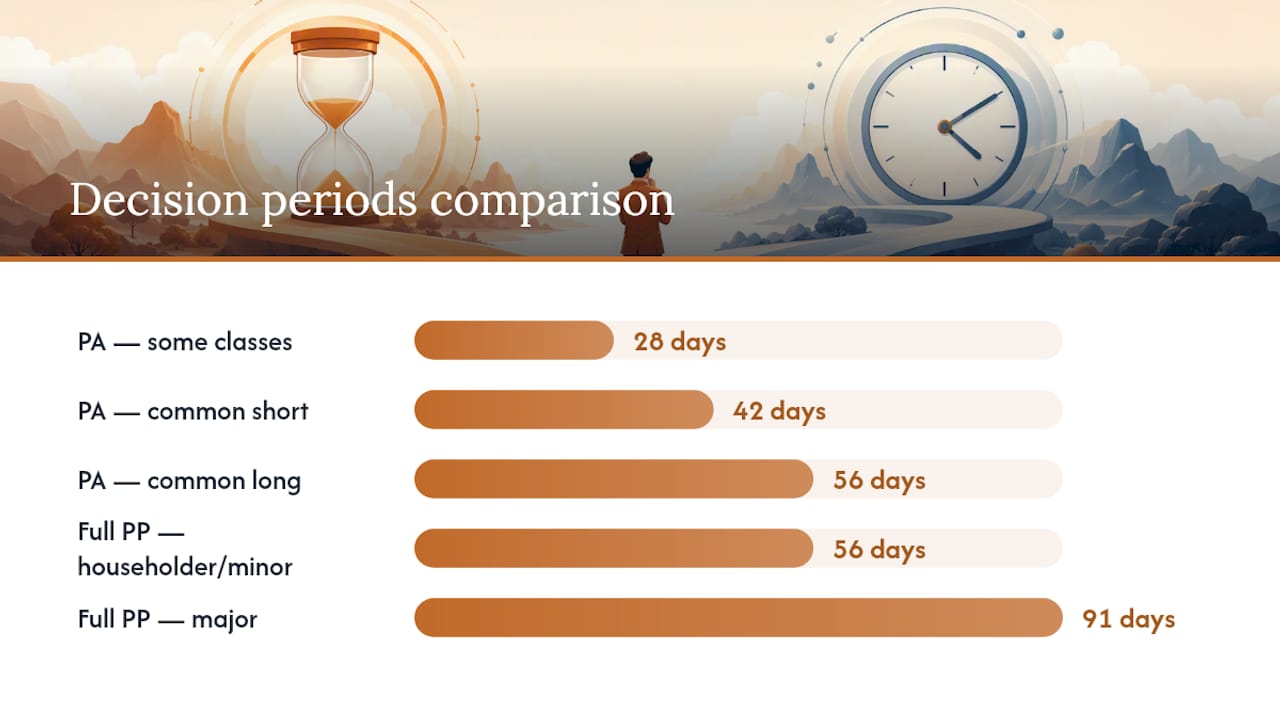
The practical summary: prior approval is faster and cheaper when the class fits, but it only works if every GPDO limit is met and the assessable matters can be addressed with solid evidence. Full planning permission takes longer and costs more, but it gives you a complete, defensible consent.
When Should You Use Prior Approval and When Should You Not?
Prior approval suits projects where the GPDO class is unambiguous, the site has no special designations, and the assessable matters are straightforward to address. It does not suit projects where the underlying PD right is uncertain or where the site carries constraints that remove or restrict PD rights.
Scenarios that commonly fit prior approval
A homeowner with a detached house in a standard residential area wants a 6m single-storey rear extension. The Part 1, Class A larger-extension route applies. The LPA assesses only the impact on adjoining properties’ amenity. A brief supporting note addressing overlooking and overshadowing is usually sufficient.
A developer holds a vacant office building in a town centre. Converting it to 20 flats under Part 3, Class MA requires prior approval. The LPA will assess highways impact, contamination risk, flood risk, noise from nearby commercial uses, and whether habitable rooms will receive adequate natural light. Each of those matters needs a scoped technical report. The Planning Portal’s prior approval guidance sets out the information requirements in detail.
A telecoms operator installing a new mast under Part 16 must notify the LPA and obtain prior approval for siting and appearance. The class is narrow; the LPA cannot refuse on general amenity grounds outside those two matters.
Where prior approval will fail
Prior approval is a two-limb test, not one. The first question is whether the PD class applies at all. The second is whether the listed matters are acceptable. Many applicants jump straight to the second limb and never properly check the first. If the building was constructed without permission, if the site is in a National Park, or if a previous Article 4 Direction has removed the relevant PD right, the class does not apply and no amount of technical evidence will rescue the application.
Conservation areas and listed buildings are the most common trap. Permitted development rights for householders are significantly restricted in conservation areas. Extensions to the side elevation, for example, are not permitted development in a conservation area. Listed buildings require listed building consent for any works affecting their character, regardless of whether PD rights exist. Neither prior approval nor a standard PD claim will substitute for that.
Article 3(5) of the GPDO is the other major risk. It provides that PD rights do not apply to development that creates or changes a use that is itself unlawful. If the building has an unlawful use or was built without permission, the PD right falls away. As Landmark Chambers explains, prior approval consents discharge a condition but do not determine whether the development actually falls within the PD class.
When to get a Lawful Development Certificate instead: If there is any doubt about whether PD rights apply, a Lawful Development Certificate (LDC) under s.191 or s.192 of the Town and Country Planning Act 1990 is the safer route. An LDC gives a formal, legally binding determination that the development is lawful. It is not the same as prior approval, but it removes the uncertainty that prior approval leaves unresolved. Use the site constraints checker to identify designations before you decide which route to take.
How Each Process Works: Steps, Timings, and What Happens When Things Go Wrong
Prior approval: the process
- Submit to the LPA - Applications are submitted via the Planning Portal or directly to the LPA. The fee is generally lower than a full planning application fee.
Statutory timings at a glance
| Route | Statutory Decision Period | Deemed Approval? | Appeal Route |
|---|---|---|---|
| Prior approval (Part 1, Class A) | 42 days | Yes, if LPA fails to decide | Planning Inspectorate |
| Prior approval (Part 3, Class MA) | 56 days | Yes, if LPA fails to decide | Planning Inspectorate |
| Prior approval (Part 6, agriculture) | 28 days (some classes) | Yes | Planning Inspectorate |
| Householder planning application | 8 weeks | No | Appeal |
| Minor planning application | 8 weeks | No | Appeal |
| Major planning application | 13 weeks | No | Appeal |
Deemed approval: useful but risky
Deemed approval sounds like a free pass, but practitioners treat it with caution. Gluck v Secretary of State for Housing, Communities and Local Government clarified the consequences when councils miss statutory deadlines, including the remedies available and the limits of what a deemed approval actually decides. A deemed approval does not mean the development is lawful in all respects. It means the LPA’s prior approval condition is treated as discharged. If the development still fails the GPDO’s own limits, enforcement remains possible.
Agreeing an extension of time with the LPA is almost always preferable to relying on deemed approval. It keeps the process clean, gives the LPA time to respond to any information request, and avoids the ambiguity that deemed approval creates. If the LPA issues an information request under the class-specific provisions, respond promptly and completely. An incomplete response can restart the clock or leave the application in limbo.
Pro Tip: Bundle all required technical reports at the point of submission rather than responding piecemeal to LPA information requests. A complete submission on day one reduces the risk of the clock being paused and shortens the overall determination period.
What Are the Risks of Getting the Route Wrong?
Getting the route wrong is not just an administrative inconvenience. It can result in enforcement action, costly retrospective applications, and in the worst cases, a requirement to demolish or undo completed works.
Case law that shapes the limits
Keenan v Woking Borough Council is the leading authority on what an LPA can and cannot decide under prior approval provisions. The court confirmed that the LPA’s role is limited to assessing the matters the GPDO class specifies. It cannot use a prior approval application to determine whether the development falls within the PD class at all. That question remains open and can be tested later, including by enforcement action. The practical implication: a prior approval decision is not a clean bill of health for the whole project.
Murrell v Secretary of State for Communities and Local Government addressed the process of determination and confirmed that procedural compliance with the GPDO’s requirements is not optional. Where an LPA fails to follow the correct procedure, the decision can be challenged.
As Local Government Lawyer’s analysis puts it, prior approval discharges a GPDO condition but does not validate development that otherwise fails the Order’s requirements. That is the core risk in one sentence.
Retrospective remedies
Full planning permission can be applied for retrospectively under s.73A of the Town and Country Planning Act 1990. Prior approval cannot. If you have carried out development that needed prior approval without obtaining it, you cannot apply retrospectively. Your options are limited to a Lawful Development Certificate (if the development is lawful on other grounds or the limitation period has passed) or a full planning application if the development would have been acceptable on its merits. Neither is as straightforward as getting it right before you start.
How to Decide Between the Two Routes: A Practical Checklist
Work through these steps in order before submitting anything. Skipping a step is where most problems start.
- Identify the proposed development type. What exactly are you building or changing? Be specific about dimensions, use class, and location.
- Check whether a GPDO class covers it. Search Schedule 2 of the GPDO for the relevant Part and Class. Read the class wording carefully, including all conditions and limitations. Use the householder PD checker for extensions.
- Verify all GPDO limits are met. Check dimensions, floor area, height, setbacks, and any use-specific conditions. If any limit is exceeded, the PD right does not apply and you need full planning permission.
- Check Article 3(5) and site-specific constraints. Is the building lawfully constructed and in a lawful use? Is the site in a conservation area, National Park, Area of Outstanding Natural Beauty, or SSSI? Is there an Article 4 Direction removing the relevant PD right? Is the building listed? A “yes” to any of these almost certainly means the PD route is unavailable or restricted.
- Identify the assessable matters for the class. Read the class wording again and list the specific matters the LPA is entitled to assess. These are the only grounds on which it can refuse.
- Decide whether you need full merits assessment. If the scheme involves design arguments, heritage considerations, or policy trade-offs that go beyond the listed matters, full planning permission is the appropriate route.
- Gather supporting technical reports. Match each assessable matter to the report that addresses it. Flood risk? Commission a Flood Risk Assessment. Noise? A noise impact assessment. Daylight to habitable rooms? A daylight and sunlight report.
- Consider a pre-application enquiry. For anything other than a straightforward householder extension, a pre-app discussion with the LPA is worth the fee. Ask which matters the LPA will assess, what evidence it expects, who the statutory consultees are, and what conditions it is likely to impose.
- Consider an LDC if PD status is uncertain. If there is any doubt about whether the PD class applies, a Lawful Development Certificate resolves it formally before you commit to construction.
- Submit a complete application. Include all required documents and technical reports from day one. Incomplete submissions waste time and can trigger information requests that pause the statutory clock.
Key pre-application questions to ask the LPA:
- Which specific matters will you assess for this class?
- What is the statutory determination period for this class?
- What technical evidence do you require?
- Who are the statutory consultees and what is your standard consultation period?
- What conditions are you likely to impose if you approve?
Documents for a prior approval pack vs a full planning application:
| Document | Prior Approval | Full Planning Application |
|---|---|---|
| Application form | Required | Required |
| Location plan | Required | Required |
| Site plan | Required | Required |
| Floor plans and elevations | Required | Required |
| Design and access statement | Not usually required | Required (most applications) |
| Flood Risk Assessment | Where site is in flood zone | Where site is in flood zone |
| Transport/highways statement | Where class requires it | Where highways impact is material |
| Contamination report | Where class requires it (e.g., Part 3) | Where contamination risk exists |
| Noise impact assessment | Where class requires it | Where noise is a material consideration |
| Daylight and sunlight report | Where habitable rooms are affected (e.g., Part 3, MA) | Where daylight/overshadowing is material |
| Heritage statement | Not applicable | Where listed building or conservation area |
| Ecology survey | Not applicable | Where protected species risk exists |
| Energy statement | Not applicable | Where local plan requires it |
| Air quality assessment | Not applicable | Where air quality is a material consideration |
What Technical Evidence Do You Actually Need?
The reports you need depend entirely on which matters the GPDO class allows the LPA to assess. Scoping a report to the wrong matters, or submitting a report that does not address the class wording directly, is one of the most common reasons prior approval applications attract information requests or refusals.
Common reports and when they apply
Daylight and sunlight assessments are required wherever habitable rooms in the proposed development or in neighbouring properties may be affected. For Part 3, Class MA (office-to-residential), the GPDO requires that the development provides adequate natural light to habitable rooms. A BRE 2022-compliant daylight report maps each room against the Vertical Sky Component and Average Daylight Factor targets. Without it, the LPA has no basis to be satisfied on this matter and will either refuse or issue an information request.
Flood Risk Assessments (FRAs) are needed wherever the site is in Flood Zone 2 or 3, or in Flood Zone 1 above 1 hectare. For prior approval applications, the FRA needs to address the specific flood risk matters the class lists, not the full sequential and exception test that a full planning application would require. Scoping it correctly saves time and avoids over-engineering the report. See the Flood Zone 3 planning guidance for the specific thresholds.
Transport and highways statements are required where the class lists highways as an assessable matter. For Part 3 conversions, the LPA will want to know about parking provision, access, and trip generation. A transport statement does not need to be a full Transport Assessment unless the scale warrants it.
Noise impact assessments are particularly important for residential conversions near commercial or industrial uses. The LPA needs to be satisfied that future occupiers will not be exposed to unacceptable noise levels. BS 8233:2014 is the standard reference for internal noise levels in residential buildings.
Contamination reports are required for Part 3 changes of use where the site has a history of industrial or commercial use. A Phase 1 Desk Study is usually the starting point; a Phase 2 Site Investigation follows if the Phase 1 identifies a risk.
Structural and engineering inputs are needed for Part 20 upward extensions, where the LPA assesses structural integrity as a listed matter. An engineer’s report confirming the existing structure can support the additional storeys is standard.
Energy statements and sustainability assessments are not typically required for prior approval applications but are commonly needed for full planning applications where the local plan has energy or sustainability policies.
Air quality assessments are required for full planning applications near Air Quality Management Areas or where the development will generate significant traffic.
Bundling reports for a successful submission
PlanningGeek’s prior approval guidance emphasizes the two-limb nature of the prior approval test and the importance of addressing each assessable matter with evidence that maps directly to the class wording. A report that addresses “flood risk” generically is less useful than one that addresses “whether the site is at risk of flooding” in the specific terms the class uses.
Fortress Associates prepares each report with the GPDO class wording in front of it. The flood risk section references the specific flood risk matter in the class. The daylight section references the adequate natural light requirement. Cross-referencing between reports (for example, where a transport statement and a noise assessment both reference the same access point) reduces the risk of the LPA finding gaps between documents. The amend-or-refund guarantee means that if a report is rejected, it is revised at no additional cost.
Pro Tip: When submitting a prior approval application for a Part 3 change of use, include a short cover letter that maps each assessable matter in the class to the specific report or document that addresses it. LPA case officers deal with high volumes; a clear signpost reduces the chance of an information request and keeps the statutory clock running.
Key Takeaways
Prior approval and full planning permission are legally distinct routes: prior approval discharges a GPDO condition on a narrow set of matters, while planning permission is the LPA’s full merits-based decision, and choosing the wrong route can result in enforcement action even after works are complete.
| Point | Details |
|---|---|
| Prior approval is not planning permission | It discharges a GPDO condition only; all class limits must still be met for development to be lawful. |
| LPA scope is strictly limited | Under prior approval, the LPA can only assess the matters the specific GPDO class lists, not general design or policy compliance. |
| Statutory timelines differ | Prior approval periods are commonly 42 or 56 days (class-dependent); full applications run 8 weeks for householder, 13 weeks for major schemes. |
| Site constraints can remove PD rights | Conservation areas, listed buildings, Article 4 Directions, and Article 3(5) issues can make prior approval unavailable regardless of class. |
| Fortress Associates | Prepares scoped technical reports (daylight, flood risk, transport, noise, contamination) mapped to GPDO class wording, with an amend-or-refund guarantee. |
The Mistake Most Applicants Make Before They Even Submit
The most common error seen in prior approval submissions is treating the process as a formality rather than a two-part legal test. Applicants confirm the class exists, submit the forms, and assume the LPA will handle the rest. They skip the first limb entirely: does the PD right actually apply to this building, on this site, in its current lawful state?
Article 3(5) catches more projects than any other single provision. A building extended without permission years ago, a change of use that was never formally authorized, a condition on an old planning permission that restricted PD rights: any of these can mean the class never applied. The prior approval is obtained, works start, and then an enforcement notice arrives. At that point, the options are expensive and the timescales are tight.
The second common mistake is submitting thin technical evidence and relying on deemed approval if the LPA fails to decide. Deemed approval with inadequate evidence is not a safe outcome. It leaves the development exposed to third-party challenge and future enforcement. A formal decision backed by a complete evidence pack is worth waiting for.
Fortress Associates Prepares the Reports That Make Submissions Stick
Getting the route right is only half the job. The other half is submitting evidence that actually addresses the assessable matters in the GPDO class wording, not just evidence that looks comprehensive.

Fortress Associates prepares daylight and sunlight assessments, Flood Risk Assessments, transport statements, noise impact assessments, contamination reports, energy statements, and Building Regulations drawings for prior approval and full planning applications across the UK. Every report is scoped to the specific class or policy requirement, cross-referenced where multiple reports are needed, and validated against current standards before delivery. There are no advance payments: you review the completed report before paying. If a report is rejected by the LPA, Fortress Associates amends it at no additional cost.
For a prior approval application, the right starting point is a pre-submission review of the class wording, the site constraints, and the assessable matters. From there, Fortress Associates identifies which reports are needed and delivers them as a coordinated pack. Visit clockfortress.com/services to see the full range of reports or to request a quote for your specific project.
Useful Sources and Where to Read the Original Guidance
The sources below are the primary references for everything covered in this article. For anything involving enforcement risk, case law, or a complex site, read the original before relying on any summary.
-
When is permission required? - GOV.UK: The official starting point. Explains when development requires planning permission, when PD rights apply, and when prior approval is needed. Updated regularly; always check the current version.
-
Prior approval - Consent types - Planning Portal: Practical guidance on the prior approval process, information requirements, decision periods, and the non-retrospective rule. Useful for applicants preparing submissions.
-
The Town and Country Planning (General Permitted Development) (England) Order 2015 - legislation.gov.uk: The primary legislation. Schedule 2 contains all the PD classes. Read the specific class wording, not a summary of it.
-
Keenan v Woking Borough Council - BAILII: The leading authority on the limits of LPA jurisdiction under prior approval. Confirms that the LPA cannot use a prior approval application to determine whether development falls within the PD class.
-
Gluck v Secretary of State for Housing, Communities and Local Government - BAILII: Key case on deemed approval consequences and remedies when LPAs miss statutory deadlines.
-
Prior Approval consents - Local Government Lawyer: Practitioner analysis of the distinction between prior approval and planning permission, and the risk that prior approval does not validate non-GPDO-compliant development.
-
Permitted development rights and prior approval - Landmark Chambers: Barrister-level commentary on GPDO interpretation and the limits of prior approval jurisdiction. Useful for understanding the legal architecture.
-
Prior Approval: What It Is and When You Need It - PlanningGeek: Accessible practitioner guide explaining the two-limb test and the importance of bundling technical evidence. Good for applicants preparing their first prior approval submission.
For pre-application guidance and Lawful Development Certificate applications, the Planning Portal’s consent types section and GOV.UK’s planning guidance pages are the most current sources. For professional application support in Australia, the development application process guide for NSW homeowners offers a useful comparative reference on how application processes are structured in other common-law jurisdictions.
This article provides general information about UK planning law and is not legal or professional planning advice. Always verify current requirements with the relevant LPA, GOV.UK guidance, or a qualified planning professional before submitting an application.
Recommended
- Daylight Reports for Permitted Development and Prior Approval (2026) - Fortress Associates
- Use Class Checker: Do You Need Permission for a Change of Use? - Fortress Associates
- Flood Zone 3 Planning Permission: 2026 Approval Guide - Fortress Associates
- Do I Need Planning Permission for an Extension? Free PD Checker - Fortress Associates
Need help with a UK planning project?
Fixed-fee daylight & sunlight reports and Building Regulations drawings - plus flood risk assessments, air quality assessments, energy statements and sustainability statements for planning applications across the UK.
Request a free quote