
Reports for Planning: The UK Developer’s Complete Guide
Most UK planning applications need a planning statement, location and site plans, and a constraint-triggered set of technical reports - the exact combination depends on your site, your application type, and, most importantly, your Local Planning Authority’s validation list. Check that list before you commission a single survey.
Core reports (always or almost always required):
- Location plan and site/block plan (nationally mandatory for every application)
- Planning Statement (required for most full and major applications)
- Design & Access Statement (required for major developments, listed building consent, and specified developments in designated areas under Article 9 of the DMPO 2015; not required for most householder applications)
Constraint-triggered reports (required when the site or proposal activates them):
- Flood Risk Assessment and/or Drainage Strategy (Flood Zones 2/3 or sites over 1 hectare)
- Ecology Report and Biodiversity Net Gain Assessment (habitat present, protected species, or mandatory BNG threshold met)
- Heritage Statement or Archaeological Assessment (conservation areas, listed buildings, or known archaeology)
- Transport Statement or Transport Assessment (traffic-generating uses or sites near strategic roads)
- Ground Conditions / Contamination Report (brownfield, former industrial, or Coal Mining Risk Area)
- Arboricultural Report to BS 5837 (trees on or adjacent to the site)
- Noise and Air Quality Assessment (sites near busy roads, AQMAs, or sensitive receptors)
- Daylight & Sunlight Assessment (BRE 2022 compliant, for proposals affecting neighboring amenity or in dense urban areas)
- Energy Statement / Sustainability Assessment (local policy thresholds or major applications)
- Construction Management Plan (major applications or sensitive locations)
Pro Tip: Before you book any consultant, download your LPA’s local validation checklist. Commissioning a report the LPA doesn’t require wastes money; missing one the LPA does require invalidates your application.
Key Takeaways
The most reliable way to get a UK planning application validated first time is to check the LPA’s local validation list before commissioning any report, sequence surveys to avoid seasonal delays, and use qualified practitioners who reference current standards including BRE 2022 and mandatory BNG requirements.
| Point | Details |
|---|---|
| LPA list is decisive | Download your LPA’s local validation checklist before commissioning any consultant - it overrides general guidance. |
| Ecology timing is critical | Commission a Preliminary Ecological Appraisal at pre-application stage; missing a survey window can delay submission by months. |
| Sequence saves money | Desktop screens and Phase 1 Desk Studies come first; design-dependent reports (daylight, transport, energy) come after design freeze. |
| BRE 2022 is the current standard | Daylight and sunlight reports must reference BRE 2022 methodology - the 2011 guidance is no longer accepted by most LPAs. |
| Fortress Associates | Offers fixed-fee report bundles with an amend-or-refund guarantee, BRE 2022-compliant daylight reports, and no upfront payment required. |
Table of Contents
- Which reports for planning does your LPA actually require?
- What does each specialist report actually cover?
- Which reports do you need by application type and site?
- How should you sequence report commissioning to avoid wasted fees?
- How to get your reports accepted first time
- The part of planning reports most developers get wrong
- Fortress Associates prepares your planning reports to LPA validation standard
- Useful sources and further reading
Which reports for planning does your LPA actually require?
The LPA validation list is the single most decisive document in your planning application. National guidance sets a floor - the minimum documents every application must include - but your LPA can add local requirements on top, and those additions vary significantly from one authority to the next. An application that would sail through in one borough might be invalidated in the next for missing a heritage statement or a daylight report.
Here’s how to find and use it:
-
Check the Planning Portal first. The Planning Portal confirms the nationally mandatory documents: a completed application form, the correct fee, a location plan, and a site/block plan. These are non-negotiable for every application in England.
-
Go to your LPA’s website and search for “local validation list” or “validation checklist.” Most LPAs publish a PDF or web page. If you can’t find it, call the planning department directly and ask for the current adopted list.
-
Check the adoption date. A local validation list is only enforceable if it was formally adopted after public consultation and updated recently. An out-of-date list may not be legally binding, which matters if an officer tries to invalidate your application on the basis of a document it requires.
-
Cross-reference against your site constraints. The LPA list will typically flag which documents are required universally and which are triggered by specific conditions (flood zone, conservation area, trees, etc.). Map your site against each trigger.
-
Repeat the check at pre-application stage and again just before submission. LPA lists are living documents. The OPDC’s 2026 draft validation checklist illustrates how local requirements are updated to reflect the NPPF and local plan policies - what was current six months ago may have changed.
-
Use the planning application checklist generator to cross-reference your project type against common validation requirements before you approach consultants.
The gov.uk planning permission topic page links to the technical guidance LPAs draw on when drafting their local lists - useful background for understanding why a particular report is being asked for.
Pro Tip: If your LPA asks for a Design & Access Statement on a householder application, ask which specific policy or local list entry requires it. Under Article 9 of the DMPO 2015, a DAS is not statutorily required for most householder applications. Councils must demonstrate the reasonableness of local list requirements, and this question alone often removes an unnecessary commission.
What does each specialist report actually cover?
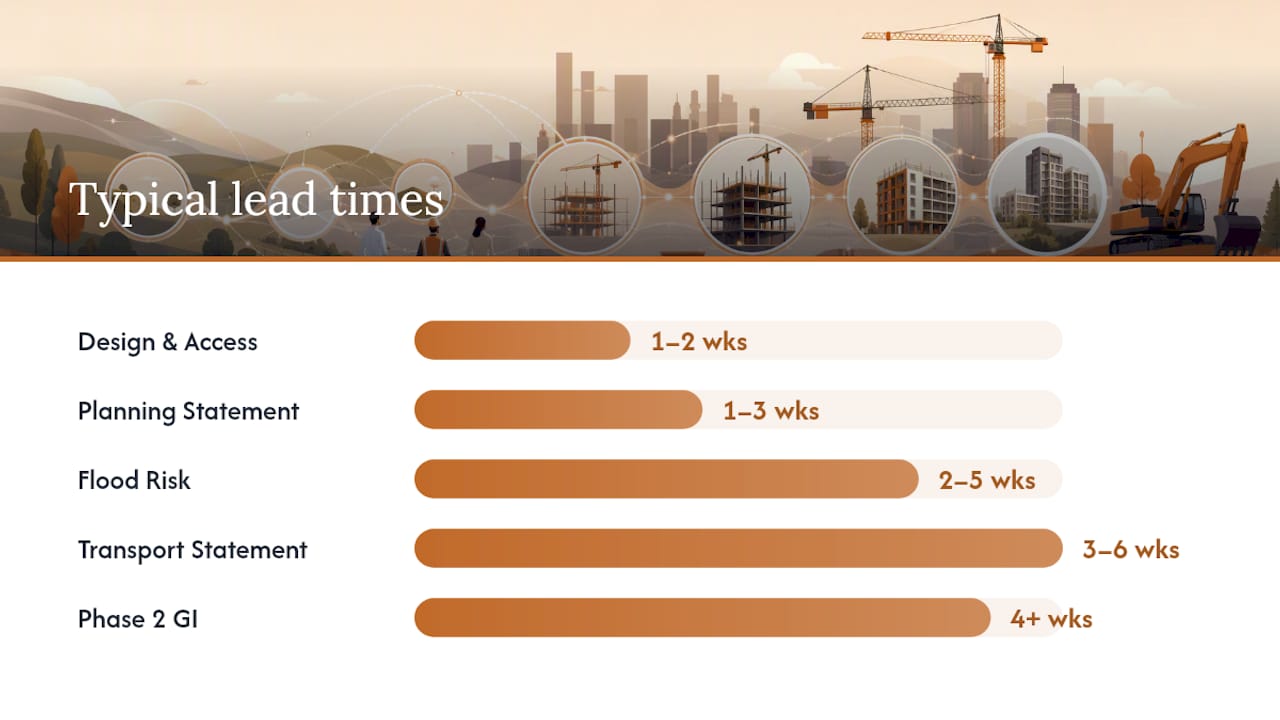
The table below maps each report category to its trigger, typical cost band, and lead time. Costs reflect typical UK consultant fees for a small-to-medium site; complex sites or major applications will sit at the higher end or beyond these ranges.
| Report | Common trigger | Typical cost band | Typical lead time |
|---|---|---|---|
| Planning Statement | Most full, outline, and major applications | - | 1–3 weeks |
| Design & Access Statement | Major developments, listed building consent, and specified developments in designated areas (Article 9, DMPO 2015); not required for most householder applications | - | 1–2 weeks |
| Flood Risk Assessment | Flood Zones 2 or 3, or sites over 1 hectare | - | 2–5 weeks |
| Drainage Strategy | Sites in Flood Zone 2/3, or where surface water management is required | - | 2–4 weeks |
| Ecology Report / BNG Assessment | Habitat present, protected species, or mandatory BNG threshold | - | 4+ weeks (seasonal) |
| Heritage Statement | Conservation area, listed building, or known archaeology | - | 2–4 weeks |
| Transport Statement / Assessment | Traffic-generating use, strategic road proximity, or LPA threshold | - | 3–6 weeks |
| Ground Conditions / Phase 1 Desk Study | Brownfield, former industrial, Coal Mining Risk Area | - | 1–3 weeks |
| Phase 2 Ground Investigation | Phase 1 identifies contamination risk | £15,000+ | 4+ weeks |
| Arboricultural Report (BS 5837) | Trees on or adjacent to site | - | 1–3 weeks |
| Noise Assessment | Proximity to busy roads, railways, or industrial uses | - | 2–4 weeks |
| Air Quality Assessment | AQMAs, major applications, or sensitive receptors | - | 2–4 weeks |
| Daylight & Sunlight Assessment (BRE 2022) | Proposals affecting neighboring amenity, dense urban sites | - | 1–3 weeks |
| Energy Statement | Local policy threshold | - | 1–2 weeks |
| Sustainability Statement | Major applications or local policy requirement | - | 1–2 weeks |
| Construction Management Plan | Major applications, sensitive locations | - | 1–2 weeks |
A few reports deserve more explanation because their triggers are widely misunderstood.
Flood Risk Assessment
The trigger is clear: if your site falls within Flood Zone 2 or 3, or the site is over 1 hectare regardless of flood zone, you need an FRA. The sequential test and exception test requirements under the NPPF add further obligations for higher-risk zones. Check the flood map for planning before anything else - it takes two minutes and immediately tells you whether an FRA is on your list.

Ecology and Biodiversity Net Gain
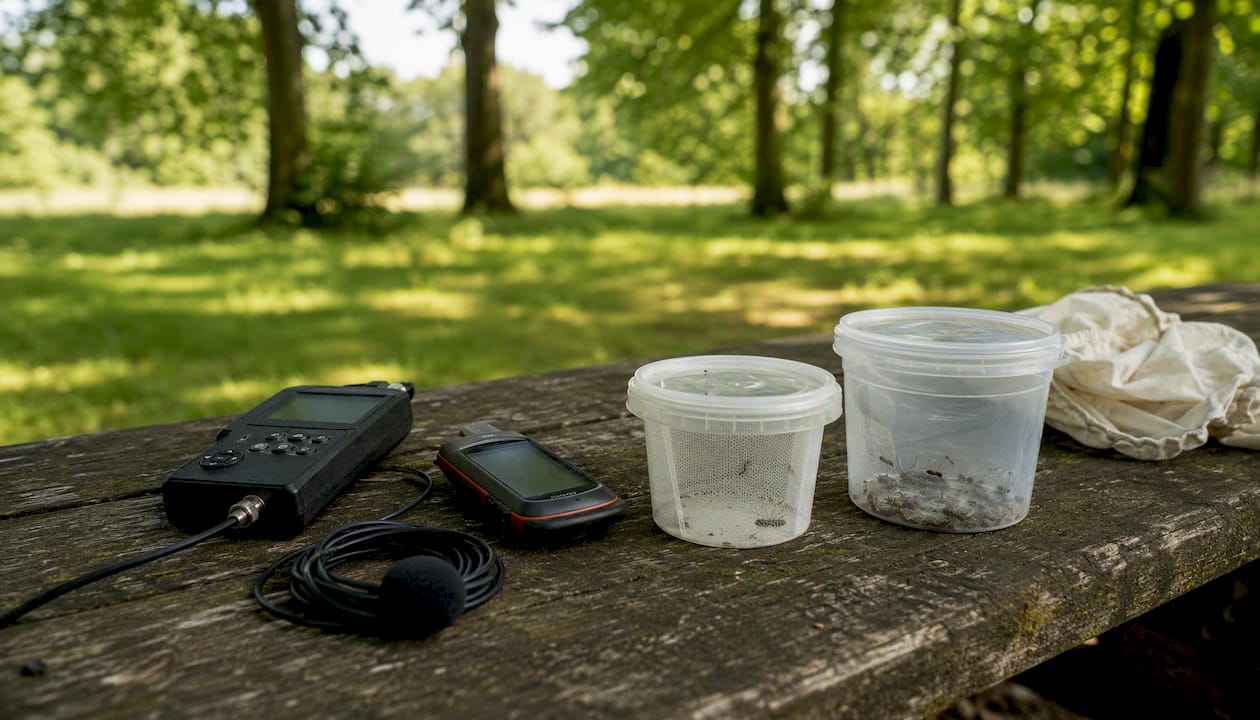
Since mandatory BNG came into force for major sites in 2024, ecology reports have become a near-universal requirement for anything beyond a simple householder extension. The gov.uk BNG guidance sets out when a habitat baseline survey and BNG metric calculation are required. For smaller sites, a Preliminary Ecological Appraisal (PEA) is usually the starting point; if it flags protected species or significant habitat, targeted surveys follow - and those surveys are seasonal, which is where programs go wrong.
Daylight & Sunlight Assessment
BRE 2022 is the current industry standard for these assessments, replacing the earlier 2011 guidance. LPAs reference it explicitly in their validation checklists and officer reports. A BRE 2022-compliant report isn’t just a formatting requirement - the methodology has changed in ways that affect outcomes, particularly for extensions and infill developments in dense urban areas. Local requirements vary, however: Hillingdon, Havering, and Bromley each apply the standard differently, so borough-specific knowledge matters.
Design & Access Statement
Under Article 9 of the DMPO 2015, a DAS is mandatory for major developments, listed building consent applications, and specified developments in designated areas. It is not required for most householder applications. When a DAS is required, it should be proportionate - a short, focused document is sufficient for straightforward schemes.
Ground Conditions and Contamination
A Phase 1 Desk Study is a desktop exercise: it reviews historical maps, site records, and environmental databases to assess contamination risk. It’s relatively quick and inexpensive. If the Phase 1 flags a risk, a Phase 2 intrusive investigation follows - and that’s where costs and timelines jump significantly. Getting the Phase 1 done early avoids the scenario where you’re six weeks from submission and discover you need boreholes.
Which reports do you need by application type and site?
The reports for a householder extension and those for a 50-unit residential scheme share almost nothing in common. Application type and site characteristics together determine your report set.
By application type
| Application type | Typical report set | Typical report count |
|---|---|---|
| Householder (extension, loft, outbuilding) | Location plan, site plan, targeted technical reports where triggered (FRA, arboricultural, ecology) | 2–5 |
| Full / minor (up to 9 dwellings or small commercial) | Planning Statement + constraint-triggered suite | 4–8 |
| Full / major (large developments) | Planning Statement, DAS, full technical suite, BNG Assessment, Energy Statement, CMP | 8–14 |
| Outline application | Screening-level reports (indicative FRA, ecology screen, heritage desk study) | 4–8 |
| Listed Building Consent | Heritage Statement, DAS, structural/fabric reports as required | 3–6 |
| Prior Approval | Targeted technical reports only (flood, contamination, noise as triggered) | 2–4 |
For householder applications specifically, the PD checker is a useful first step to confirm whether permitted development rights apply before you start scoping reports at all.
According to planning consultant guidance, a small site full planning application typically requires 8–14 reports, with traditional consultancy costs ranging from approximately £15,000 to £52,000 and a programme of 8–12 weeks before submission. Householder applications commonly require 2–5 reports and cost considerably less.
By site characteristic
Run through these questions before you finalize your report scope:
- Is any part of the site in Flood Zone 2 or 3, or is the site over 1 hectare? If yes, an FRA is required. Check the flood map for planning first.
- Is the site in or adjacent to a conservation area, or does it involve a listed building? A Heritage Statement is likely required; a DAS may also be triggered.
- Does the site have a history of industrial use, or is it in a Coal Mining Risk Area? Commission a Phase 1 Desk Study before anything else.
- Are there trees on or immediately adjacent to the site? An arboricultural report to BS 5837 will almost certainly be required.
- Is the site near a busy road, railway, or industrial use? Noise and/or air quality assessments are likely, particularly if the development includes residential uses.
- Does the site contain any habitat beyond maintained amenity grassland, or are protected species plausible? A Preliminary Ecological Appraisal is the starting point; BNG obligations apply to most applications above the de minimis threshold.
- Will the proposal affect the daylight or sunlight received by neighboring windows or gardens? A BRE 2022-compliant daylight and sunlight assessment is likely required, especially in urban areas.
Pro Tip: LPA local lists can differ significantly from general assumptions. An authority covering a predominantly brownfield area may require a Phase 1 Desk Study as standard; one covering a rural area may require an ecology screen for almost every application. Always treat the LPA list as the final word, not general guidance.
How should you sequence report commissioning to avoid wasted fees?
The order in which you commission reports matters as much as which reports you commission. Getting the sequence wrong means paying for surveys that need to be redone, or discovering a show-stopping constraint after you’ve spent money on detailed design.
-
Start with desktop screens and the LPA check. Before any consultant is engaged, check the LPA validation list, run the flood map check, and review the site’s planning history and constraints on the Planning Portal. This takes a day and costs nothing.
-
Commission a Phase 1 Desk Study if contamination is plausible. This is a desktop exercise (no site work required) and typically takes 1–3 weeks. It tells you whether a Phase 2 investigation is needed - and if it is, you need to know that before design progresses.
-
Commission a Preliminary Ecological Appraisal (PEA) early. If the PEA flags protected species or significant habitat, you’ll need targeted surveys. Many of those surveys are seasonal: bat surveys run April through October, great crested newt surveys run mid-March through mid-June, and breeding bird surveys run March through August. Missing a survey window can add months to your programme. According to planning consultant guidance, ecology surveys are among the most common causes of programme delays when not planned at pre-application stage.
-
Commission the Flood Risk Assessment and Drainage Strategy once you have a site boundary and indicative layout. These reports need enough design information to assess drainage routes and surface water management options, but they don’t need a fully detailed scheme.
-
Commission design-dependent reports after design freeze. Daylight and sunlight assessments, Transport Statements, and Energy Statements all require a fixed scheme to assess. Commissioning them before design is settled means paying for revisions.
-
Prepare the Planning Statement and DAS last. These are narrative documents that draw on all the technical reports. Writing them before the technical work is complete means rewriting them when the technical work changes the scheme.
Pro Tip: Specify in every consultant brief that the report must be cross-referenced against the LPA’s current validation checklist wording. A report that doesn’t address the specific questions the LPA’s checklist asks - even if technically sound - can still be rejected at validation.
Understanding how planning conditions affect building costs is also worth factoring into your programme: conditions requiring pre-commencement surveys or investigations can extend your overall timeline well beyond the application decision.
How to get your reports accepted first time
Validation rejection is more common than most applicants expect, and it’s almost always avoidable. These steps materially increase the chance that your application is validated and determined without unnecessary queries.
-
Validate against the LPA checklist line by line before submission. Don’t assume your consultant has done this - check it yourself. Every item the LPA lists as required should be present in your submission.
-
Use qualified practitioners. LPAs and planning inspectors check credentials. Ecology reports should be prepared by a chartered ecologist (MCIEEM or equivalent); contamination reports by a suitably qualified person (SQP) under the Environment Agency’s framework; daylight and sunlight reports by a qualified consultant referencing BRE 2022. Using an unqualified or insufficiently experienced consultant is one of the fastest ways to generate a technical objection.
-
Reference the statutory and policy tests explicitly. A Flood Risk Assessment that doesn’t address the sequential test (required under the NPPF for Flood Zone 2 and 3 sites) will be queried. A DAS that doesn’t address the criteria in Article 9 of the DMPO 2015 will be queried. Reports should demonstrate compliance, not just describe the proposal.
-
Cross-reference reports in the Planning Statement. The Planning Statement is the document that ties everything together. It should summarize the conclusions of each technical report and explain how the proposal responds to them.
-
Submit proportionate evidence. The NPPF reinforces that LPAs should only request information that is relevant, necessary, and material to the application. A 200-page ecology report for a two-storey extension on a maintained garden is disproportionate and signals that the consultant hasn’t scoped the work correctly. Proportionate, focused reports are easier to validate and easier for officers to assess.
-
Check that BNG obligations are addressed. Since mandatory BNG requirements came into force, applications that don’t address BNG - even with a statement confirming the de minimis exemption applies - are increasingly being queried at validation. The gov.uk BNG guidance sets out the current thresholds and exemptions.
Fortress Associates validates every report against the current LPA checklist and the relevant statutory standards before delivery. Every report is based on live official data, and the amend-or-refund guarantee means that if a report is rejected on technical grounds, it’s amended or refunded - no argument, no additional fee.
The part of planning reports most developers get wrong
The conventional wisdom on planning reports is that the problem is knowing which ones to commission. In practice, that’s rarely where projects go wrong. Most experienced developers and architects know the broad list. The real failures happen in two places: sequencing and proportionality.
Sequencing failures are expensive. A developer who commissions a daylight and sunlight report before design is frozen, then changes the massing, has paid for a report that needs to be entirely redone. A self-builder who doesn’t commission a PEA until October, then discovers the site has a bat roost, is looking at a six-month delay before the survey window opens again. These aren’t obscure edge cases - they’re the most common reasons planning programmes overrun.
Proportionality failures are subtler but just as damaging. There’s a tendency, particularly among applicants who are nervous about refusal, to over-commission: to get every possible report, cover every conceivable objection, and submit a file that runs to hundreds of pages. This doesn’t help. Planning officers are not more impressed by a larger submission. A report that’s twice as long as it needs to be is harder to assess, more likely to contain internal inconsistencies, and signals that the consultant hasn’t thought carefully about what the application actually needs to demonstrate.
The NPPF is explicit that LPAs should only request information that is relevant, necessary, and material. That principle cuts both ways: applicants who submit proportionate, targeted evidence - reports that directly address the policy tests and nothing else - consistently get faster, cleaner decisions than those who submit everything and hope for the best.
The practical implication is straightforward. Scope each report tightly against the specific policy test it needs to satisfy. Brief your consultants against the LPA’s validation checklist wording, not against a generic scope. And commission reports in the order that the site’s constraints dictate, not in the order that’s most convenient for your programme.
Fortress Associates prepares your planning reports to LPA validation standard
Getting the right reports prepared correctly, in the right order, without paying upfront - that’s what Fortress Associates does for architects, developers, contractors, and self-builders across the UK.
The service covers the full range of specialist planning reports: BRE 2022-compliant daylight and sunlight assessments, flood risk evaluations, air quality studies, energy statements, sustainability assessments, and Building Regulations drawings. Reports are prepared using live official data, validated against the current LPA checklist before delivery, and cross-referenced so your Planning Statement can draw on them directly.
The model is fixed-fee with no upfront payment: you review the completed report before paying. Every report carries an amend-or-refund guarantee - if it’s rejected on technical grounds, it’s amended or refunded. No caveats, no additional fees.
Turnaround on most desktop reports is 1–3 weeks. For a full report bundle, Fortress Associates can scope the package, sequence the commissions, and deliver a coordinated set of documents ready for submission. See the full planning and compliance report services or get in touch directly to discuss your project.
Useful sources and further reading
The sources below are the primary official references for planning report requirements in England. They’re worth bookmarking for any project where you need to verify a trigger or check current guidance.
These sources cover the statutory basis for report requirements, the national validation framework, flood risk and BNG triggers, and examples of how LPAs translate national policy into local validation lists:
- The Town and Country Planning (Development Management Procedure) (England) Order 2015
- What to submit - How to apply - Planning Portal
- Planning permission - GOV.UK
- Planning applications: assessing flood risk - GOV.UK
- Understanding biodiversity net gain - GOV.UK
- Draft Local Validation Checklist for Planning Applications (2026) - OPDC committee report
- What Reports Do You Need for Planning Permission? UK 2026 Mega-Guide | PF & Co Insights
- Planning application validation requirements (PlanningGeek)
Recommended
- UK Planning Reports - Daylight, Flood Risk, Air Quality, Energy | Fortress Associates
- Free UK Planning Tools: Flood Zone, AQMA, Daylight, Carbon, BNG - Fortress Associates
- 21 Free UK Planning Tools - Constraints, Flood, Fees, Daylight | Fortress Associates
- UK Daylight & Sunlight Report - BRE 2022 Compliant for Planning | Fortress Associates
Need help with a UK planning project?
Fixed-fee daylight & sunlight reports and Building Regulations drawings - plus flood risk assessments, air quality assessments, energy statements and sustainability statements for planning applications across the UK.
Request a free quote