Mon–Fri 9–18 · Sat 10–16
FortressAssociates

Overheating Assessments for planning.

Overheating assessments for new UK homes — the Good Homes Alliance early-stage risk score councils ask for at planning, and the Approved Document O simplified method check, with honest signposting where dynamic CIBSE TM59 modelling is the required route.

5.0 Google rated Every UK local authority No advance payment
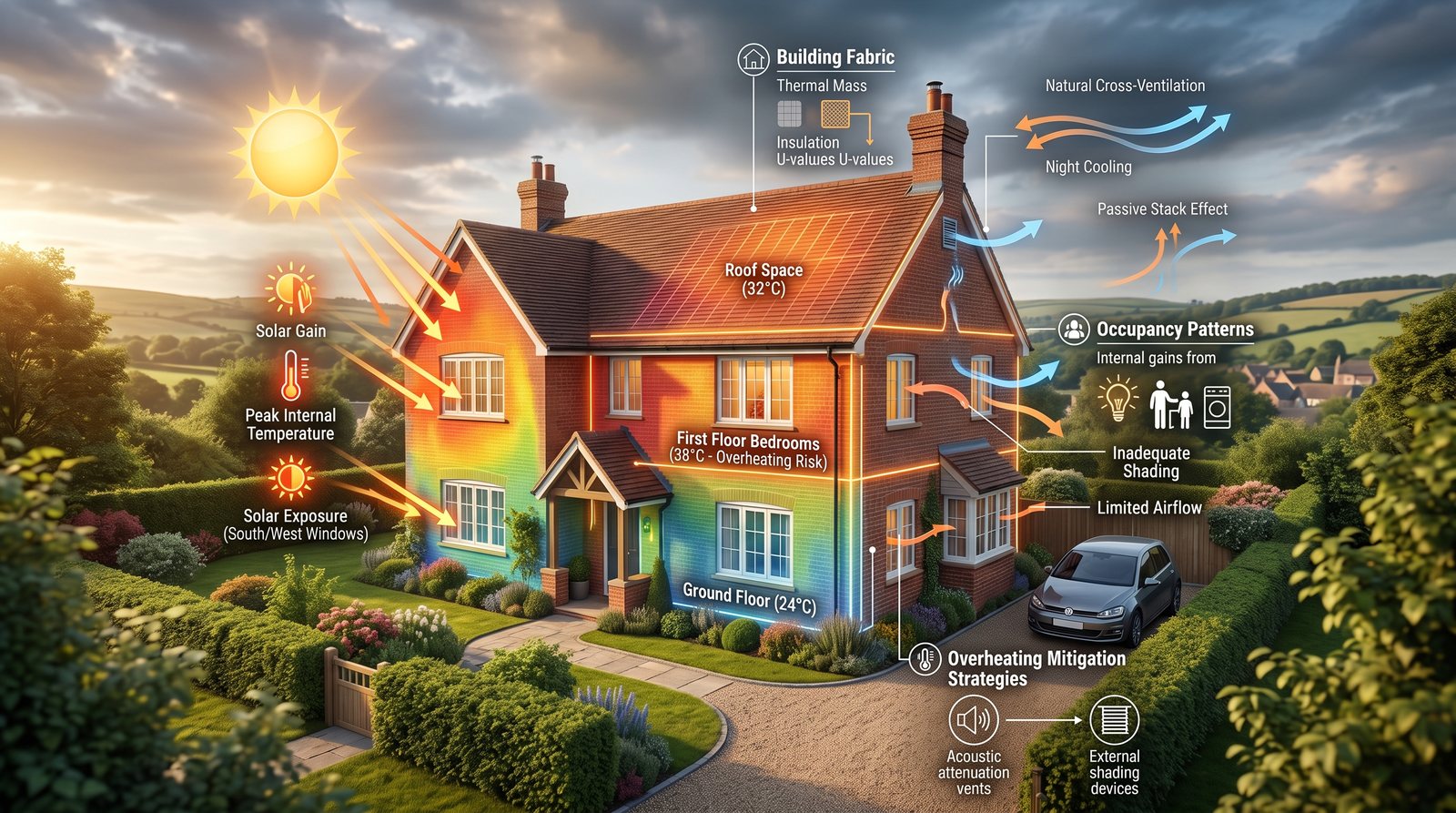
Illustrative overheating assessment: house showing solar gains, glazing orientation, shading and cross-ventilation paths
Approved Document O+ GHA early-stage risk tool
Part O · GHA · TM59
Submission-ready PDF
Part O
2021 Regulation
Applies to new residential
14 Qs
GHA Risk Tool
Planning-stage score
1.1–1.4
AD O Tables
Glazing & free-area checks
UK-wide
Full Coverage
Every local authority

What an overheating assessment shows

Solar gains by orientation, glazing areas against the Approved Document O limits, opening free areas and the shading and ventilation measures that keep bedrooms usable in a heatwave.

Illustrative overheating assessment: house showing solar gains, glazing orientation, shading and cross-ventilation paths
Illustrative visualisation — every report is prepared from your site’s actual details.
Approved Document O & the GHA Tool

The overheating rules your application is judged against.

Since Approved Document O came into force, every new residential building must demonstrate its overheating risk is limited — and many councils, led by the London boroughs, now expect an overheating risk assessment with the planning application itself, before Building Regulations ever see the scheme.

When an overheating assessment is required

The triggers are increasingly standard — an assessment is needed where:

  • New dwellings are proposed — Approved Document O applies to all new residential buildings
  • A London borough determines the scheme — the London Plan expects heat risk addressed through the cooling hierarchy
  • The site is in a high-risk location — parts of London and other postcode areas AD O classifies as higher risk carry extra shading duties
  • Flats with limited ventilation are proposed — single-aspect units are the highest-risk homes and get the closest scrutiny
  • A condition requires it — overheating conditions are now routine on residential consents

What your assessment must demonstrate

A credible assessment runs two recognised checks and reports both:

  • The GHA early-stage risk score — the Good Homes Alliance tool scores the scheme’s risk factors to a published banding — the screening councils ask for at planning stage
  • The AD O simplified method — glazing areas and free areas checked room by room against the Approved Document O tables for your location and ventilation strategy
  • The cooling hierarchy — orientation, shading, glazing specification and ventilation measures, in the order policy expects them
  • An honest route statement — where the simplified method cannot apply, the report says so and scopes the dynamic CIBSE TM59 route
  • Submission-ready PDF — with a unique document reference
What you get

A submission-ready overheating assessment.

Prepared for your exact drawings to the current standards, with everything your case officer looks for.

  • Good Homes Alliance early-stage overheating risk score with banding
  • Approved Document O simplified-method check (glazing and free areas, room by room)
  • High-risk location screening for your exact postcode area
  • Cooling hierarchy and mitigation schedule — shading, glazing, ventilation
  • Clear statement where dynamic TM59 modelling is the required route
  • Submission-ready PDF report with a unique document reference
Illustrative overheating assessment: house showing solar gains, glazing orientation, shading and cross-ventilation paths
Written to the standards your local planning authority expects
Approved Document O (2021) GHA Early Stage Tool CIBSE TM59 (signposted) London Plan Policy SI 4 NPPF & PPG
How it works

From drawings to submission.

1

Send us your drawings

Email your proposed plans and elevations and site address to info@clockfortress.com.

2

Get a fixed quote

We come back within 24 hours with a fixed price and a delivery date. There's no advance payment.

3

We prepare your report

Scored through the GHA tool and checked against the Approved Document O tables for your location — typically 3–5 working days.

4

Submit with confidence

Receive a planning-ready PDF, backed by our amend-or-refund guarantee if the authority rejects it.

Standards

Built on the standards councils check for.

Every overheating assessment follows the recognised national methods.

Approved Document O (2021) GHA Early Stage Overheating Risk Tool v1.0 AD O Simplified Method Tables 1.1–1.4 CIBSE TM59 Dynamic Route (where required) London Plan Policy SI 4 — Managing Heat Risk Part F Ventilation Interaction
FAQ

Overheating assessments — explained.

Quick answers to the questions applicants ask us most.

Ask anything
Do I need an overheating assessment?
If you are building new homes, yes — Approved Document O applies to all new residential buildings, and many councils (led by the London boroughs) now ask for an overheating risk assessment at planning stage too. Conversions are generally outside Part O, but a planning condition can still require an assessment.
What is the GHA early-stage tool?
A recognised screening tool from the Good Homes Alliance that scores a scheme’s overheating risk factors — location, glazing, orientation, ventilation, communal heat — into a published Low, Medium or High banding. It is designed exactly for planning stage, before detailed design is fixed, and is what many validation lists mean by an “overheating risk assessment”.
What is the difference between the simplified method and TM59?
The Approved Document O simplified method is a table-based check on glazing areas and opening free areas — quick, and sufficient for many houses and dual-aspect flats. CIBSE TM59 is full dynamic thermal modelling, required where the simplified method cannot apply (many flats, high glazing, noise-restricted windows). Our report runs the simplified route and tells you honestly if your scheme needs the dynamic one.
What is a “high-risk location”?
Approved Document O classifies certain postcode areas — significant parts of central and inner London — as higher overheating risk. Schemes there face tighter glazing limits and an explicit duty to consider shading. We screen your exact postcode as part of the assessment.
What if my scheme fails the check?
Failing the simplified method is a design prompt, not a dead end: reduced or reoriented glazing, external shading, solar-control glass or improved cross-ventilation usually recover compliance — and are far cheaper on paper than after a refusal. The report sets out the options in the order the cooling hierarchy expects.
Which areas do you cover?
Every UK local authority — the methods are national, with the location classification built in.
Google Reviews

Rated 5.0 by our clients.

5.0★★★★★Based on 500+ Google reviews across our services
DO
Daniel Okafor
a month ago
★★★★★
The borough asked for an overheating risk assessment with our planning application for six flats. The GHA scoring and Part O check came back in four days and validation went straight through.
ST
Sophie Traynor
3 weeks ago
★★★★★
Our single-aspect units were flagged honestly — they told us exactly which two needed attention and the shading that fixed it. Better than finding out at Building Regs.
ME
Mark Ellison
2 months ago
★★★★★
Straightforward Part O check on a pair of new houses. Fixed fee, quick turnaround, clearly written.
AR
Anita Rowe
3 months ago
★★★★★
As an architect I use the early-stage assessment at RIBA Stage 2 now — cheaper to move a window on paper than remodel later. Excellent service.
Get Started

Get your overheating assessment quoted.

Email your proposed plans and elevations and we’ll send a fixed quote and timeframe — usually within 24 hours. No advance payment.

Call Free Quote