Mon–Fri 9–18 · Sat 10–16
FortressAssociates

Urban Greening Factor assessments for planning.

UGF calculations for London planning applications — every surface scored to London Plan Policy G5 and Table 8.2, presented with the colour-coded plan and calculation table the GLA’s guidance requires, against the 0.4 residential and 0.3 commercial targets.

5.0 Google rated Every London borough No advance payment
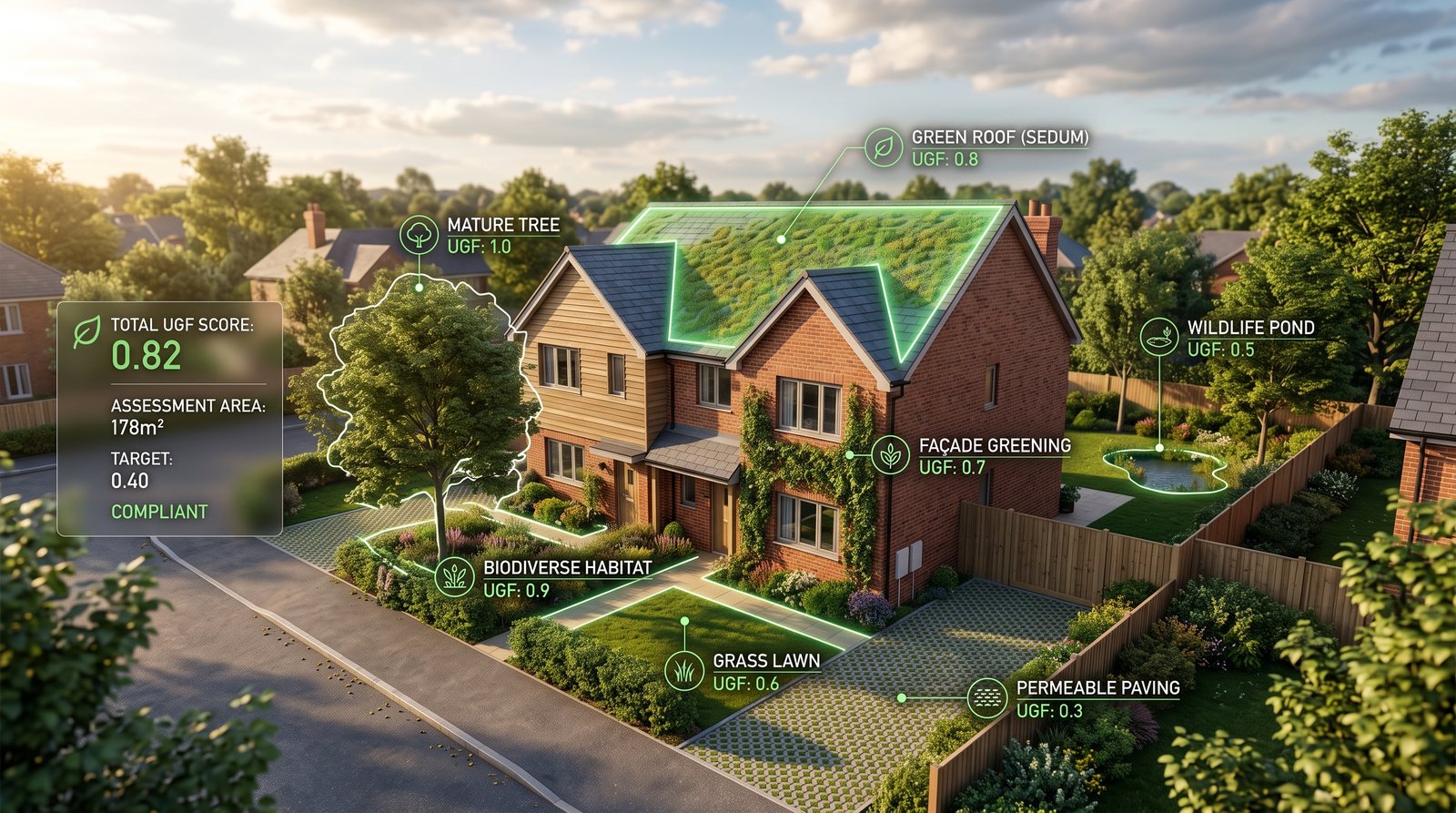
Illustrative Urban Greening Factor assessment: colour-coded site plan with green roofs, trees, planting and permeable surfaces scored to Table 8.2
London Plan Policy G5GLA UGF guidance (Feb 2023)
0.4 res · 0.3 comm
Submission-ready PDF
0.4
Residential Target
London Plan Policy G5
0.3
Commercial Target
Excluding B2/B8 uses
16
Surface Cover Types
Table 8.2 factors
London
Every Borough
Plus UGF-adopting LPAs

What a UGF assessment shows

Every surface on your site — green roofs, trees, planting, permeable paving — scored with its Table 8.2 factor and totalled into the single UGF score your London application is judged on.

Illustrative Urban Greening Factor assessment: colour-coded site plan with green roofs, trees, planting and permeable surfaces scored to Table 8.2
Illustrative visualisation — every report is prepared from your site’s actual details.
London Plan Policy G5 & Table 8.2

The urban greening rules your application is judged against.

The London Plan requires major developments to be designed around urban greening from the start — not greened up at the end. Policy G5 measures that with the Urban Greening Factor: every surface is scored, weighted by its greening value, and totalled against a target your borough will check line by line.

When a UGF calculation is required

The requirement is now firmly established — a UGF calculation is needed where:

  • A major application is made in London — all boroughs apply Policy G5 through the London Plan
  • The scheme is residential — the interim target score is 0.4
  • The scheme is commercial — the target is 0.3 (B2 and B8 uses excluded)
  • A borough sets its own target — several local plans now carry adopted UGF policies and bespoke targets
  • A condition or officer requests it — increasingly asked of minor schemes in greening-priority areas

What your UGF assessment must include

The GLA’s guidance is specific about what a submission-ready UGF package looks like:

  • A colour-coded UGF plan — every surface identified and matched to the calculation
  • The surface schedule — each area scored with its Table 8.2 factor — from intensive green roofs to permeable paving
  • Trees done properly — canopy scored by soil-volume test, and legitimate canopy overlap accounted for
  • The calculation — factor × area totalled and divided by site area, with green walls handled under their special rule
  • A compliance statement — the achieved score against your target, with the design rationale
What you get

A submission-ready UGF assessment.

Prepared from your landscape drawings to the GLA guidance, with everything your borough’s officer looks for.

  • Colour-coded UGF plan cross-referenced to the calculation
  • Full surface schedule scored to London Plan Table 8.2
  • Tree canopy scoring with the soil-volume test applied correctly
  • The complete UGF calculation against your 0.4 or 0.3 target
  • Design advice where the score falls short — the surface swaps that lift it
  • Submission-ready PDF with a unique document reference
Illustrative Urban Greening Factor assessment: colour-coded site plan with green roofs, trees, planting and permeable surfaces scored to Table 8.2
Written to the standards your local planning authority expects
London Plan Policy G5 Table 8.2 Surface Factors GLA UGF Guidance (2023) Urban Greening Plans NPPF & PPG
How it works

From drawings to submission.

1

Send us your drawings

Email your site plan and landscape drawings and site address to info@clockfortress.com.

2

Get a fixed quote

We come back within 24 hours with a fixed price and a delivery date. There's no advance payment.

3

We prepare your report

Every surface scored to Table 8.2 under the GLA’s measurement rules, with the colour-coded plan prepared — typically 3–5 working days.

4

Submit with confidence

Receive a planning-ready PDF, backed by our amend-or-refund guarantee if the authority rejects it.

Standards

Built on the framework boroughs check for.

Every UGF assessment follows the London Plan and the GLA’s published guidance.

London Plan (2021) Policy G5 Table 8.2 Surface Cover Factors GLA London Plan Guidance — UGF (Feb 2023) Policy G1 Green Infrastructure Borough Local Plan UGF Policies NPPF & Planning Practice Guidance
FAQ

Urban Greening Factor — explained.

Quick answers to the questions applicants ask us most.

Ask anything
Who needs a UGF calculation?
Every major planning application in Greater London — Policy G5 applies through all borough local plans. Increasingly, boroughs also ask minor schemes in greening-priority areas for a calculation, and several authorities outside London have begun adopting UGF-style policies of their own.
How is the UGF calculated?
Each surface type is multiplied by a factor from London Plan Table 8.2 — 1.0 for semi-natural vegetation, 0.8 or 0.6 for trees depending on their soil volume, 0.7 for intensive green roofs, down to 0.1 for permeable paving — and the weighted areas are totalled and divided by the site area. The result is a single score compared against your target.
What scores well — and what barely counts?
Trees planted in generous soil volumes, intensive green roofs and rain gardens carry the strongest factors. Permeable paving scores only 0.1 — a common and costly surprise in schemes that assumed it would do the heavy lifting. We flag exactly which swaps raise your score fastest.
Can the score exceed 1.0 — and can green walls help?
Yes. Green walls count in the greened area but not the site area under the guidance’s special rule, and tree canopies may legitimately overlap other scored surfaces — so a well-greened scheme can score above 1.0. Both rules are frequently applied wrongly in submitted calculations; ours follow the GLA measurement rules exactly.
What if my scheme cannot reach 0.4?
The target is applied with judgement, but a shortfall needs design effort first and justification second. We advise on the highest-value changes — tree soil volumes, roof build-ups, surface substitutions — before any justification case, because a strengthened scheme is far more likely to be approved.
Do you cover boroughs with their own UGF policies?
Yes — where your borough has adopted its own target or surface weightings, the calculation is run against the local policy as well as Policy G5, so the officer sees compliance in their own terms.
Google Reviews

Rated 5.0 by our clients.

5.0★★★★★Based on 500+ Google reviews across our services
OF
Oliver Fenwick
a month ago
★★★★★
Our Hackney scheme needed a UGF of 0.4 and we were at 0.31. Their advice on tree pits and the roof build-up got us to 0.42 without losing a parking space. Approved.
LA
Leila Ahmadi
3 weeks ago
★★★★★
Colour-coded plan and calculation matched exactly what the GLA guidance asks for. The officer accepted it without a single query.
RV
Robert Vance
2 months ago
★★★★★
They caught that our permeable paving barely scored and swapped the strategy before submission. Saved the application in my view.
CB
Chloe Barratt
3 months ago
★★★★★
As a landscape architect I now send the UGF number-crunching here — the soil volume and overlap rules are applied properly, which I rarely see.
Get Started

Get your UGF assessment quoted.

Email your site plan and landscape drawings and we’ll send a fixed quote and timeframe — usually within 24 hours. No advance payment.

Call Free Quote