
BREEAM vs LEED: Which Certification Fits U.S. Projects?
For most U.S. projects, LEED (U.S. Green Building Council / USGBC) is the practical default. It dominates domestic portfolios, integrates cleanly with U.S. regulatory expectations, and runs on project-team-led documentation submitted directly to USGBC - no mandatory on-site assessor required. BREEAM (BRE Global) is the stronger call when your project must align with European lifecycle standards, satisfy a UK or EU investor, or pursue dual certification for an international portfolio.
Both systems cover approximately 83% of the same environmental concerns, so the choice is less about sustainability rigor and more about process, market, and risk.
Core differences that affect commissioning decisions:
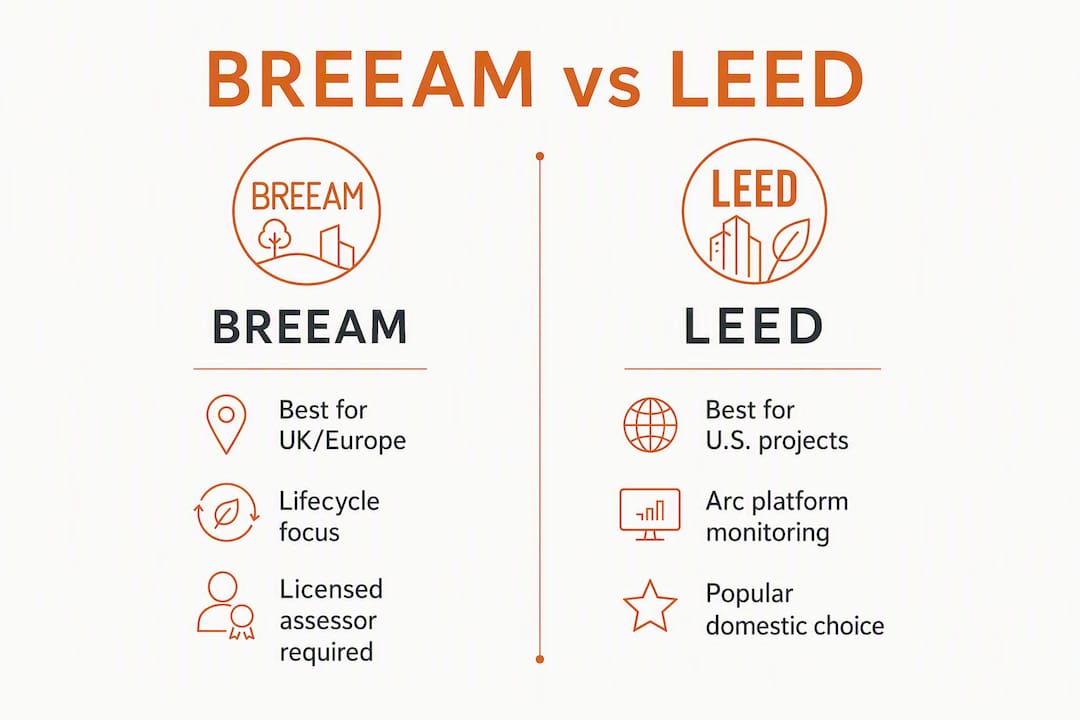
- Market fit: BREEAM leads in UK/Europe; LEED is the dominant standard for U.S. and international portfolios.
- Assessment process: BREEAM requires a licensed third-party assessor on-site; LEED relies on your project team compiling and submitting documentation to USGBC.
- Scoring: BREEAM uses quantitative mandatory standards; LEED uses prerequisites and percentage-based credit thresholds.
- Timeline: BREEAM runs registration → provisional design-stage rating → post-construction verification; LEED follows registration → design review → construction review cycles with USGBC.
- Cost drivers: BREEAM adds assessor professional fees on top of certification costs; LEED costs concentrate in consultant hours and energy modeling.
- Post-occupancy risk: Both systems carry a 15–30% energy performance gap between design projections and actual operation.
Certified buildings routinely consume 15–30% more energy than their design models predict. Neither LEED nor BREEAM certification closes that gap on its own - post-occupancy monitoring written into the contract is the only reliable mitigation.
Pro Tip: Specify post-occupancy monitoring language in your consultant contract before procurement closes, not after handover. By then, the leverage is gone.
Table of Contents
- How do BREEAM and LEED compare side by side?
- What does commissioning a certification actually require?
- How serious is the post-occupancy performance gap?
- How do you choose between BREEAM and LEED for a specific project?
- Clockfortress supports your certification procurement
- Key Takeaways
How do BREEAM and LEED compare side by side?
| Dimension | BREEAM (BRE Global) | LEED (USGBC) |
|---|---|---|
| Best for | UK/Europe-facing portfolios; lifecycle/regulatory alignment | U.S. projects; international portfolios prioritizing energy performance |
| Assessment process | Licensed assessor collects and verifies evidence on-site | Project team compiles documentation; submitted to USGBC for review |
| Scoring structure | Quantitative mandatory standards + weighted credits | Prerequisites + percentage credit thresholds |
| Rating levels | Pass / Good / Very Good / Excellent / Outstanding | Certified / Silver / Gold / Platinum |
| Timeline stages | Registration → provisional design rating → post-construction verification | Registration → design review → construction review |
| Cost drivers | Assessor fees + certification costs + modeling | Consultant hours + energy modeling + USGBC submission fees |
| Post-occupancy verification | Required for final rating under New Construction | Optional; not mandated for certification |
| Market recognition (U.S.) | Limited; growing in institutional/ESG portfolios | Dominant; widely recognized by lenders, tenants, and regulators |

On dual certification: a study of twenty dual-certified buildings found LEED scores consistently ran higher than BREEAM scores, with rating differences typically favoring LEED by one award level. Budget and target each system separately.
What does commissioning a certification actually require?
Credentials to specify in your RFP:
- LEED AP (or LEED Green Associate for smaller scopes)
- Licensed BREEAM Assessor (mandatory for any BREEAM route)
- Energy modeler familiar with the relevant standard’s modeling protocol
- Sustainability statement consultant for documentation and narrative compliance
Contract deliverables to require:
- Design-stage provisional assessment report (BREEAM) or design-phase USGBC submission package (LEED)
- Post-construction verification report
- Post-occupancy monitoring plan with measurable KPIs and data reporting intervals
- Amendment or rework clause if the target rating is not achieved
Procurement checklist:
- Confirm the target certification and rating level before appointing any consultant.
- Verify assessor credentials: LEED AP credential via USGBC; BREEAM Licensed Assessor status via BRE Global.
- Request a fee breakdown separating assessor costs, modeling, and certification fees.
- Build post-occupancy monitoring into the scope from day one.
- Confirm timeline against planning milestones - BREEAM’s provisional rating must precede construction sign-off.
Pro Tip: For BREEAM, appoint the licensed assessor at RIBA Stage 2 or earlier. Waiting until Stage 4 forces expensive redesigns to meet mandatory standards that could have been designed in from the start.
How serious is the post-occupancy performance gap?
The 15–30% energy performance gap documented across certified buildings is not a fringe finding. It shows up consistently in comparative studies of both LEED and BREEAM projects, driven by modeling assumptions that don’t reflect real occupant behavior, commissioning failures, and operational drift after handover.
For U.S. asset owners, that gap translates directly into higher operating costs, weaker ESG reporting, and potential conflicts with portfolio-level sustainability commitments.
Mitigation measures to require:
- Real-time energy and water monitoring with tenant-accessible dashboards
- Formal commissioning and recommissioning schedules written into the building contract
- Measurable KPIs tied to the certified design model, reviewed annually
- Data reporting clauses that survive the initial lease term
BREEAM’s In-Use standard provides a structured post-occupancy framework; LEED’s Arc platform offers a parallel performance-tracking tool. Neither is automatic - both require deliberate procurement.
How do you choose between BREEAM and LEED for a specific project?
Match your project’s primary driver to the system that supports it:
- Regulatory alignment with U.S. authorities → LEED. It maps to domestic energy codes and is the standard most U.S. planners, lenders, and tenants recognize.
- Energy performance as the headline metric → LEED, particularly under v4.1, which tightened energy prerequisites significantly.
- Lifecycle carbon and resilience → BREEAM, which enforces lifecycle-based quantitative standards and covers a broader range of mandatory items including ecology and materials.
- Global or European portfolio consistency → BREEAM, especially for assets that must satisfy EU taxonomy or UK planning requirements alongside U.S. holdings.
Project types that typically favor LEED: U.S. corporate campuses, domestic multifamily, federally funded buildings, and any project where tenant recognition drives leasing value. Project types that favor BREEAM: European-facing logistics portfolios, mixed-use developments with UK or EU institutional investors, and projects where local planning authorities reference BREEAM ratings as a condition of consent.
Dual certification makes sense when an asset must satisfy both a U.S. lender and a European investor simultaneously. Expect rating variance between the two systems and plan procurement targets separately for each.
Clockfortress supports your certification procurement
Commissioning a sustainability certification means stacking multiple technical reports before a single planning condition is discharged. Clockfortress prepares the specialist planning documents that sit alongside BREEAM and LEED submissions: energy statements, sustainability assessments, daylight and sunlight reports, and air quality studies, all validated against current standards with a 100% planning discharge rate.

Every report comes with an amend-or-refund guarantee and no advance payment required. If your project needs a sustainability statement, an energy statement, or a Building Regulations package to support a certification target, get your documents from Clockfortress - reviewed before you pay, backed by live official data, and ready to submit.
Key Takeaways
For most U.S. projects, LEED is the practical default, but BREEAM is the stronger choice when European lifecycle standards, UK planning conditions, or international portfolio consistency are the primary drivers.
| Point | Details |
|---|---|
| LEED leads in the U.S. | USGBC’s LEED dominates domestic portfolios and is recognized by most U.S. lenders, tenants, and regulators. |
| BREEAM requires an on-site assessor | A licensed BREEAM Assessor must collect and verify evidence; budget assessor fees separately from certification costs. |
| Both carry a performance gap | Certified buildings routinely show a 15–30% energy performance gap between design projections and actual operation; post-occupancy monitoring is the mitigation. |
| Dual certification needs separate targets | Studies of dual-certified buildings found LEED scores generally run higher than BREEAM scores by about one award level. |
| Clockfortress delivers the supporting reports | Energy statements, sustainability assessments, and Building Regulations drawings prepared with an amend-or-refund guarantee. |
Recommended
- BREEAM in Planning: When Councils Require It and What the Ratings Mean - Fortress Associates
- Sustainability Statements for Brownfield Sites: BNG, Grey Belt and Greening - Fortress Associates
- Non-Domestic Part L and BRUKL: Energy Statements for Commercial Schemes - Fortress Associates
- Part L 2021 or the Future Homes Standard? Which Applies (2026) - Fortress Associates
Need help with a UK planning project?
Fixed-fee daylight & sunlight reports and Building Regulations drawings - plus flood risk assessments, air quality assessments, energy statements and sustainability statements for planning applications across the UK.
Request a free quote