
Odour Assessment Planning: UK Developer’s Guide
An odour impact assessment is required whenever a planning application either places new sensitive receptors near an existing odour source or proposes a new odour-generating use. Planning authorities expect a minimum of four things: documented baseline conditions (complaints history, existing sources), a receptor map, a justified choice of assessment method (dispersion modelling, monitoring, or both), and mitigation evidence tied directly to manufacturer specifications and site layout. The primary methodological reference is the IAQM Guidance on the Assessment of Odour for Planning, accompanied by Defra’s guidance for local authorities and the Environmental Health Practitioner (EHP) at your Local Planning Authority (LPA).
The single most effective first step: carry out a screening assessment and consult your LPA and EHP before submitting. Pre-application engagement shapes the scope, prevents costly rework, and creates the consultation record that planners expect to see in the final report.
The minimum evidence a planning authority expects:
- Baseline odour conditions: complaints history, existing nearby sources, and any prior monitoring data
- Receptor mapping: location, type, and sensitivity of all receptors within a relevant study area
- Justified assessment method: modelling inputs, monitoring protocol, or empirical observation with stated assumptions
- Mitigation evidence: manufacturer datasheets, ventilation and flue termination drawings, and an Odour Management Plan (OMP) summary
- Modelling or monitoring output: predicted concentrations or odour units, frequency metrics, and a significance statement
Table of Contents
- When does a planning application trigger an odour assessment?
- Screening vs. detailed OIA: which level of assessment do you need?
- What should an OIA report include for a planning submission?
- Which assessment methods do planners and EHPs accept?
- What mitigation evidence do planning authorities actually require?
- How to present results so planners and EHPs can accept them
- How Clockfortress prepares an OIA: steps, timescales, and deliverables
- Key Takeaways
- The failure modes nobody warns you about
- Clockfortress handles your OIA from screening to submission
- Useful sources and primary guidance
When does a planning application trigger an odour assessment?
An Odour Impact Assessment is typically required for planning applications involving new sensitive uses near existing odour sources, or for new developments that themselves generate odour. The triggers fall into two broad categories.
Encroachment is when a sensitive development (housing, schools, hospitals, care homes) is proposed near an existing odour-generating facility. The concern is that future residents or users will experience unacceptable odour from a source that was there first.
New odour-generating use is the reverse: the proposed development itself will produce odour, and nearby existing receptors may be affected. Common examples include commercial kitchens, waste transfer stations, sewage treatment works, intensive livestock units, and certain industrial processes.
Common planning triggers include:
- New residential development within the consultation zone of a sewage treatment works or waste facility
- A commercial kitchen or restaurant extraction system in a mixed-use or residential area
- A new waste transfer station, composting facility, or anaerobic digestion plant
- Intensive animal rearing or agricultural processing near existing settlements
- Change of use to a food production, rendering, or chemical processing operation
- Sensitive development (schools, hospitals) proposed adjacent to an existing industrial odour source
The scale of the assessment varies with risk. A small café extraction system often needs only an OMP and manufacturer specifications for the filtration unit. A new waste transfer station near housing almost always requires dispersion modelling. Local authority validation checklists set out exactly what officers expect at validation stage, so checking the relevant LPA’s checklist before scoping is time well spent.
Pro Tip: Check the LPA’s published validation checklist before scoping your assessment. Many authorities list odour as a required document for specific use classes, which tells you immediately whether a full OIA or a simpler statement will satisfy validation.
Odour is treated as an amenity issue under UK planning policy. Planners are not required to wait for a statutory nuisance to arise; they can and do refuse applications where predicted odour impacts on sensitive receptors are unacceptable.
Screening vs. detailed OIA: which level of assessment do you need?
The distinction matters because commissioning the wrong level wastes time and money, and submitting an under-scoped report is one of the most common reasons for LPA rejection.
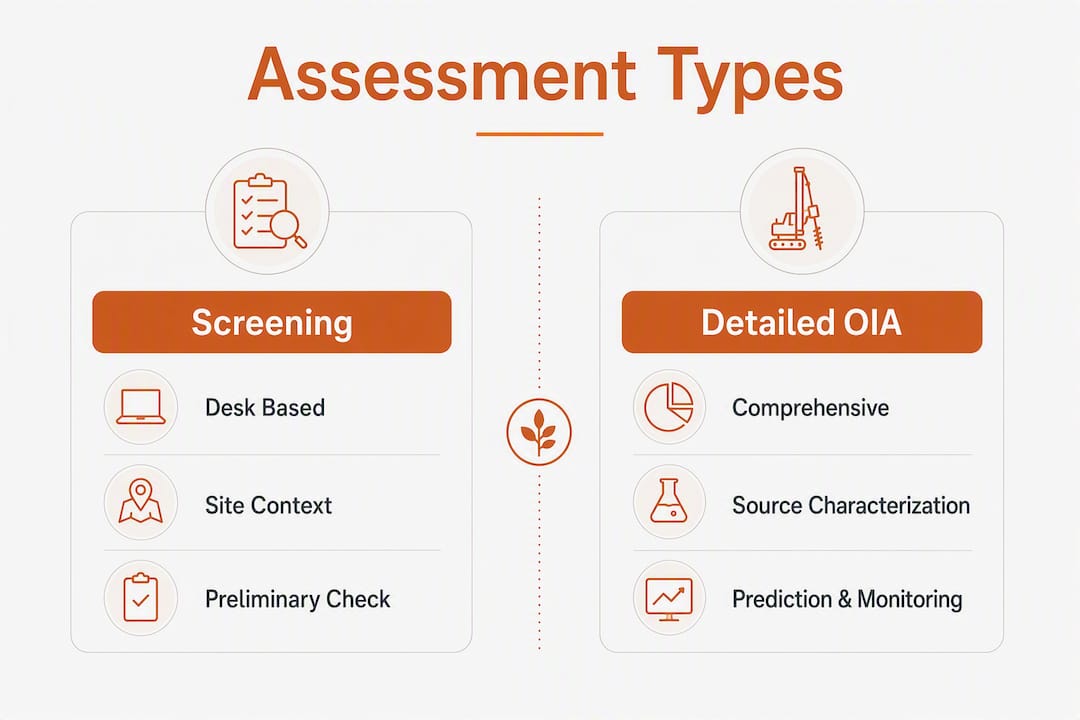
A screening assessment is a desk-based exercise. It uses site context, source characteristics, separation distances, and published look-up criteria to determine whether a full Odour Impact Assessment is necessary. It is appropriate for low-risk scenarios: small sources with good separation from receptors, standard extraction systems with proprietary abatement, or developments where the proposed use is clearly low-odour. The output is typically a short technical note concluding either that no further assessment is needed or that a full OIA is required.
A detailed Odour Impact Assessment is required when the screening identifies a potential for significant impact, when the LPA or EHP specifically requests one, or when the development is of a type that routinely generates odour at scale. It includes source characterization, baseline surveys, dispersion modelling or monitoring, receptor sensitivity analysis, mitigation design, and a significance statement.
| Dimension | Screening assessment | Detailed OIA |
|---|---|---|
| When required | Low-risk sources, good separation, standard abatement | Significant sources, sensitive receptors, complex sites |
| Scope | Desk-based; separation distances, source inventory | Full source characterization, modelling or monitoring, receptor mapping |
| Evidence type | Published criteria, manufacturer specs, site plan | Modelling inputs/outputs, monitoring data, meteorological data |
| Typical deliverables | Short technical note, significance conclusion | Full report, contour maps, OMP draft, appendices |
| Timescale | Days to 1–2 weeks | 6 weeks depending on monitoring requirements |
| Cost implication | Lower; desk-based | Higher; field work, modelling, QA cycle |
The decision path follows a logical sequence:
- Characterize the site context: proximity to sensitive receptors, existing odour sources, and proposed use.
- Assess receptor sensitivity: residential, educational, and healthcare uses carry higher sensitivity than commercial or industrial.
- Estimate source magnitude: throughput, process type, emission rate, and abatement in place.
- Apply screening criteria: if the source is small, well-separated, and well-controlled, a screening note may suffice.
- If any criterion flags a potential impact, escalate to a full OIA with scoped methodology agreed with the LPA/EHP.
Winchester’s odour assessment guidance makes a point that practitioners sometimes miss: an assessment of a new odour source requires a different methodology from an assessment of a sensitive development near an existing source. Applying the wrong approach is a leading cause of rejection.
What should an OIA report include for a planning submission?
A well-structured OIA report gives the LPA and EHP everything they need to make a decision without sending a list of queries. The following checklist reflects what local authority validation requirements and IAQM guidance collectively expect.
Core report sections:
- Executive summary with a clear significance conclusion
- Scope, objectives, and statement of assumptions and uncertainty
- Site description and planning context
- Baseline odour conditions: complaints history, existing sources, any prior monitoring or survey data
- Receptor mapping: location, type, sensitivity classification, and distance from source
- Source characterization: point sources, fugitive emissions, and diffuse area sources; activity descriptions and emission inventories
- Methodology justification: why modelling, monitoring, or empirical observation was selected; FIDOL factors (Frequency, Intensity, Duration, Offensiveness, Location) considered
Predictions and evidence:
- Modelling inputs and outputs, including emission rates, meteorological data, and model choice
- Monitoring results with calibration records and instrument details
- Contour maps and predicted concentrations or odour units at receptor locations
- Frequency metrics (such as C98 where applicable) and a significance statement linked to receptor sensitivity tables
- Cumulative assessment: how the proposed development interacts with existing baseline odour sources
Mitigation section:
- Engineering controls proposed: abatement equipment type, manufacturer, and guaranteed performance
- Ventilation and flue termination drawings at scale
- OMP summary: operational constraints, maintenance schedule, and complaint response procedure
- Evidence that mitigation has been modelled for site-specific conditions, not just quoted from a brochure
Appendices:
- Raw model input files and run options
- Monitoring logs and calibration certificates
- Meteorological data source, period, and processing notes
- Equipment manufacturer datasheets
- Pre-application consultation record with LPA/EHP
The IAQM guidance recommends transparency in modelling inputs and monitoring data throughout. A report that omits raw inputs or fails to document assumptions will draw queries from the EHP and may be treated as incomplete at validation.
Which assessment methods do planners and EHPs accept?
IAQM guidance groups odour assessment tools into predictive and empirical categories and recommends combining them when potential impacts are significant. Each method has a distinct role.

Dispersion modelling provides spatial and temporal coverage across a study area. It is the preferred method when the source is well-characterized, emission rates can be quantified, and the receptor distribution is complex. The key inputs are emission rates, source geometry, meteorological data (typically five years of hourly data from a representative station), and terrain. Outputs are predicted odour concentrations at receptor locations, usually expressed as European Odour Units per cubic metre (ouE/m³) at a defined percentile.
Short-term and continuous monitoring is used when source characterization is uncertain or when modelling alone would not be credible. Olfactometry sampling, electronic nose instruments, and dynamic dilution olfactometry each suit different scenarios. Monitoring is also used to validate model predictions or to establish baseline conditions before a development is built.
Field odour surveys (“sniff surveys”) provide qualitative or semi-quantitative evidence of odour character, intensity, and frequency at receptor locations. They are useful for establishing baseline conditions and for corroborating modelling outputs, but they are not a substitute for quantitative methods on significant sites.
Complaints analysis and observational techniques are empirical tools. A well-documented complaints history from the LPA or operator, combined with site observations, can support a screening assessment or supplement a detailed OIA.
| Method | Evidence type | Typical lead time | Typical deliverables |
|---|---|---|---|
| Dispersion modelling | Predicted concentrations, contour maps | 2–6 weeks (post data collection) | Model files, contour maps, significance statement |
| Short-term monitoring | Measured concentrations, calibration records | 4 weeks (campaign dependent) | Monitoring report, data logs, comparison to model |
| Continuous monitoring | Time-series data, percentile statistics | 3–6 months | Statistical summary, exceedance analysis |
| Field odour survey | Qualitative/semi-quantitative observations | 1–4 weeks | Survey logs, frequency/intensity maps |
| Complaints analysis | Historical frequency and location data | 1–2 weeks | Summary table, spatial plot |
East Riding’s guidance specifies that when modelling is used, reports must contain full modelling inputs and options so a third party can reproduce results. This reproducibility requirement is non-negotiable for most LPAs.
Pro Tip: Combine empirical observations with modelling rather than relying on either alone. A modelled prediction supported by field survey observations that corroborate the predicted odour character and frequency is far more defensible at appeal than either method in isolation.
What mitigation evidence do planning authorities actually require?
Generic manufacturer brochures rarely satisfy EHPs. LPAs expect mitigation measures to be demonstrably fit for purpose against site-specific conditions, which means the evidence must connect the proposed equipment to the modelled emission scenario.
Common mitigation options by source type:
- Point source abatement: carbon adsorption units, thermal or catalytic oxidizers, wet scrubbers, biofilters. Each has a guaranteed odour removal efficiency that must be stated and referenced in the modelling.
- Fugitive and diffuse sources: enclosure, negative pressure buildings, air locks, and extraction to a controlled stack. The stack height and exit velocity affect dispersion and must be modelled.
- Operational controls: delivery and dispatch scheduling to avoid peak receptor occupancy, covering of odorous materials during transfer, and wheel-wash or road-sweeping to prevent tracking.
What EHPs want to see: a direct chain of evidence from the manufacturer’s guaranteed removal efficiency, through the modelled emission rate with abatement applied, to the predicted concentration at the nearest sensitive receptor. If that chain has a gap, the report will come back with queries.
Assessment reports must include manufacturer details for abatement equipment, scale floor plans and elevations showing ventilation and flue locations, and odour dispersion modelling where required. Where the development will also be subject to an Environmental Permit, IAQM guidance notes that planning authorities should assume the permit regime will operate, but residual odour impacts remain relevant to land-use decisions and must still be assessed at the planning stage.
Supporting documents to attach to the planning submission:
- Manufacturer performance datasheets with guaranteed removal efficiencies
- Ventilation and flue termination drawings (scaled, showing heights and distances to receptors)
- Draft OMP covering maintenance schedules, inspection frequency, and complaint response
- Evidence of equipment sizing relative to process throughput
- Modelling run showing predicted concentrations with and without abatement
Pro Tip: When writing the mitigation section, cross-reference the manufacturer’s guaranteed removal efficiency directly to the emission rate used in the model. Label the figures consistently so the EHP can trace the number from the datasheet to the model input without having to ask.
How to present results so planners and EHPs can accept them
The presentation of results is where technically sound OIAs most often fail. A report that buries significance conclusions in appendices, or that presents contour maps without linking them to receptor sensitivity, forces the EHP to do interpretive work they should not have to do.
Model output presentation:
- Contour maps at relevant receptor heights (typically 1.5 m for residential ground floor, 4 m for upper floors) with receptor locations clearly marked
- A table of predicted concentrations or odour units at each receptor, with the assessment metric (e.g., 98th percentile hourly mean) stated
- A significance statement for each receptor, cross-referenced to the sensitivity classification used
Monitoring results:
- Logs with timestamps, instrument calibration records, and placement rationale
- A simple comparison table showing measured values alongside modelled predictions where both methods were used
- Any exceedances of assessment criteria flagged and explained
Reproducibility requirements: LPAs and EHPs routinely request full model input files, run options, and meteorological data so they or their advisors can verify assumptions. Package these as a named appendix with a brief read-me note explaining the software version and run sequence.
| Field | Detail required |
|---|---|
| Receptor ID and location | Grid reference, receptor type, height above ground |
| Predicted concentration metric | ouE/m³ at stated percentile (e.g., C98, 1-hour mean) |
| Receptor sensitivity | Classification used (e.g., IAQM sensitivity table) |
| Significance statement | Negligible / Minor / Moderate / Major adverse |
| Mitigation applied | Yes/No; abatement type and removal efficiency assumed |
The plain-language summary at the front of the report should state the significance conclusion in one or two sentences that a non-technical planning officer can quote directly in a decision notice. Technical detail belongs in appendices; the summary is for the committee report.
How Clockfortress prepares an OIA: steps, timescales, and deliverables
Clockfortress follows a structured delivery workflow that maps directly onto LPA and EHP expectations, with defined client input points at each stage.
- Report drafting and appendices: - the full OIA report is assembled, cross-referenced, and validated against current IAQM guidance and the relevant LPA’s validation checklist.
| Stage | Typical duration | Client input required |
|---|---|---|
| Screening and scoping | 3–5 working days | Site plans, process description |
| Pre-app consultation | 1–3 weeks | Availability for LPA meeting |
| Monitoring campaign | 4 weeks | Site access, process schedule |
| Modelling and QA | 2–4 weeks | Review of draft inputs |
| Report and appendices | 1–2 weeks | Review of draft report |
| Post-submission support | As required | Prompt responses to EHP queries |
Clients receive a full OIA report, georeferenced contour maps, model input files, a compiled manufacturer datasheet pack, the draft OMP, and the pre-application consultation record. Every report is validated against current standards before submission, and Clockfortress’s amend-or-refund guarantee covers any report that does not meet the LPA’s requirements.
Pro Tip: The single biggest cause of programme delay is late site access for monitoring. Book access and agree the process schedule with the site operator before the monitoring campaign starts, not after.
Key Takeaways
A defensible odour impact assessment for planning requires the right assessment type, reproducible methodology, fit-for-purpose mitigation evidence, and a pre-application consultation record with the LPA and EHP.
| Point | Details |
|---|---|
| Screen first, then scope | A screening assessment determines whether a full OIA is needed and shapes the methodology before costly fieldwork begins. |
| Consult LPA/EHP pre-app | Defra guidance recommends early coordination so odour is integral to the planning process, not an afterthought. |
| Match method to scenario | Use dispersion modelling for spatial coverage; add monitoring when source characterization is uncertain; combine both on significant sites. |
| Link mitigation to modelled inputs | Manufacturer removal efficiencies must trace directly to the emission rates used in the model, or EHPs will query the gap. |
| Clockfortress for end-to-end delivery | Clockfortress prepares screening notes, full OIAs, OMP drafts, and post-submission support with an amend-or-refund guarantee. |
Primary guidance to bookmark: IAQM Guidance on the Assessment of Odour for Planning (2018, v1.1, update due Q3 2026) and Defra’s local authority guidance. Check your LPA’s validation checklist to confirm the exact documents required at submission.
The failure modes nobody warns you about
Most OIAs that draw EHP queries or face rejection share one of four problems, and none of them are about the science being wrong.
The most common is applying the wrong assessment type. An odour source assessment and an odour exposure assessment are structurally different exercises. Submitting an exposure-style report for a development that generates odour, or vice versa, signals to the EHP that the practitioner has not understood the planning question. Winchester’s guidance identifies this as the leading cause of rejection, and it is entirely avoidable if the methodology section states clearly which type of assessment is being conducted and why.
The second failure is non-reproducible modelling. If the EHP cannot open the model files, verify the meteorological data, or check the emission rates, the report is effectively unverifiable. This does not mean the modelling is wrong; it means the EHP has no way to confirm it is right. Package every input file, name them clearly, and include a brief note on the software version and run sequence.
Third: ignoring cumulative baseline odour. A single-source assessment that treats the site as if it exists in an odour-free environment will be challenged if there are other nearby sources. IAQM guidance is explicit that cumulative effects and the baseline odour environment must be considered. A report that omits this is not just incomplete; it may be viewed as fundamentally flawed.
Fourth: weak linkage between manufacturer specs and modelled inputs. The EHP will check whether the removal efficiency quoted in the mitigation section matches the emission rate used in the model. If the numbers do not connect, the significance conclusion is unsupported.
The fix for all four is the same: agree the methodology with the LPA/EHP before you start, document every assumption, and build the report so a technically competent third party can follow the chain of evidence from source to receptor without asking a single question.
Clockfortress handles your OIA from screening to submission
Preparing an odour impact assessment that satisfies a UK planning authority takes more than a template report. It requires the right assessment type, a methodology the EHP can verify, and mitigation evidence that connects manufacturer data to site-specific modelled conditions.

Clockfortress prepares the full range of odour assessment work for UK planning applications: initial screening notes, scoped Odour Impact Assessments, dispersion modelling, OMP drafting, and post-submission query responses. Every report is built on live official data, validated against current IAQM guidance and the relevant LPA’s checklist, and covered by an amend-or-refund guarantee. There are no advance payments; you review the completed report before paying.
If you need an air quality mitigation measures strategy alongside your OIA, or a bundled package of planning reports for a larger application, Clockfortress can scope and deliver both. To commission a screening assessment or discuss the scope of a full OIA, get in touch via the Fortress Associates service page.
Useful sources and primary guidance
The documents below are the ones LPAs and EHPs reference when reviewing odour assessment submissions. Keep them in your project file and cite them by name and version in your report.
- IAQM Guidance on the Assessment of Odour for Planning (2018, v1.1): - the primary methodological reference for UK planning odour assessments. Use it to justify tool selection, report structure, significance criteria, and the distinction between source and exposure assessments. An updated version is expected in Q3 2026.
- East Riding Odour Assessment Guidance: - a practical local authority guide covering reproducibility requirements for modelling and the grouping of tools into predictive and empirical categories. Useful as a cross-check even if your LPA is different.
- Winchester Odour Assessment Guidance (2024): - clear on the source vs. exposure distinction and common rejection reasons. Worth reading before scoping any assessment.
Record all pre-application correspondence with the LPA and EHP in a dated log and include it as an appendix. It demonstrates procedural compliance and gives the decision-maker confidence that the methodology was agreed in advance.
Recommended
- WHO Air Quality Guidelines vs UK Objectives: What Planning Uses - Fortress Associates
- EPUK/IAQM Planning for Air Quality Guidance Explained (2026) - Fortress Associates
- Free UK Planning Tools: Flood Zone, AQMA, Daylight, Carbon, BNG - Fortress Associates
- The 2026 EPUK/IAQM Air Quality Planning Guidance Update Explained - Fortress Associates
Need help with a UK planning project?
Fixed-fee daylight & sunlight reports and Building Regulations drawings - plus flood risk assessments, air quality assessments, energy statements and sustainability statements for planning applications across the UK.
Request a free quote