Part L Changes for Architects and Developers: Act Before 2028
Part L has been renamed “Energy and greenhouse gas emissions” and rewritten to implement the Future Homes and Buildings Standard, and two dates now decide whether your project can still build to the old rules. Miss them, and every plot on the site defaults to the tougher 2026 standard regardless of what you designed for.
Here’s the sequence that matters: the Future Homes and Buildings Standard comes into force in 2027 for standard work, with higher-risk building provisions following later that year. Projects that submit their application before the new standard’s in-force date get a grace period, but only if they also commence on site within a specified transitional period. After that, there’s no route back to Part L 2021.
- Check your application date against 24 March 2027 today, not next quarter.
- Confirm you have hard evidence of commencement (not just intent) for every plot you’re relying on.
- Cross-reference your design against Approved Document L (2026 edition), issued by the Department for Levelling Up, Housing and Communities alongside the amendment regulations.
A two-stage transitional period allows applications submitted before 24 March 2027 and construction commenced by 24 March 2028 to remain eligible for the 2021 standards. Miss either date, and the 2026 standards apply in full.
Key Takeaways
Part L’s rename to “Energy and greenhouse gas emissions” and the new L3 renewable requirement mean every live plot needs its transitional status confirmed before 24 March 2028.
| Point | Details |
|---|---|
| Two dates decide everything | FHS applies from 24 March 2027; commencement must happen by 24 March 2028 to keep Part L 2021 eligibility. |
| L3 is new law | On-site renewable electricity generation is now a standalone functional requirement for dwellings, not an optional extra. |
| Commencement means real work | Drainage or foundation work counts; a hoarding and a skip do not, so document evidence carefully. |
| Transitional relief is per plot | Phased sites can end up with some plots on 2021 rules and others on 2026 rules within the same permission. |
| Fortress Associates supports the paperwork | The firm prepares energy statements and Building Regulations drawings with an amend-or-refund guarantee and fixed fees. |
Table of Contents
- What Are the Part L Changes for 2026?
- Which Buildings Does the New Part L Apply To?
- How Do the 2026 Changes Affect Design and Specification?
- What Compliance Tests and Documents Are Required?
- Why Do the Application and Commencement Dates Both Matter?
- What Should Architects and Developers Do Now?
- What Will Part L 2026 Add to Project Costs?
- What We’re Seeing Across Client Pipelines
- Get Your Part L Transition Evidence Right the First Time
- Where to Read the Official Part L Guidance
- Sources
What Are the Part L Changes for 2026?
The rename isn’t cosmetic. Requirement L1 has been rewritten to cover “conservation of fuel and power and minimisation of greenhouse gas emissions,” pulling carbon reduction directly into the legal wording rather than leaving it as a policy aspiration bolted onto an energy-efficiency rule.
The bigger structural change is the insertion of a brand new requirement: L3, covering on-site renewable electricity generation for dwellings and buildings containing dwellings. This didn’t exist in Part L 2021. The definition of “fixed building services” has also been widened, now explicitly capturing lifts and escalators, which pulls vertical transportation into the same energy accounting that used to apply mainly to heating and hot water.
- Part L retitled to reflect energy use and emissions considerations.
- L1 amended to require both conservation of fuel and power and the reduction of greenhouse gas emissions.
- New L3 requirement introduces on-site renewable electricity generation for dwellings.
- Fixed building services definition broadened to include components like lifts and escalators.
The Amendment Regulations introduce a new functional requirement, L3, for on-site renewable electricity generation for dwellings, and modify L1 accordingly.
The full legislative text sits in the amendment regulations, and Approved Document L (2026) is the guidance document that translates it into buildable specifications. The earlier 2021 edition, incorporating 2023 amendments, remains live on GOV.UK for any project that legitimately qualifies for transitional relief.
Which Buildings Does the New Part L Apply To?
Transitional relief operates plot by plot, not site-wide. A phased development with fifteen plots submitted under one outline application could easily end up with some plots on Part L 2021 and others forced onto the 2026 standard, depending on when each plot’s commencement evidence was logged.
Higher-risk buildings (HRBs) follow a slightly later timeline, with provisions starting 24 September 2027 rather than March. Some HRBs also carry practical exemptions around on-site renewable generation, reflecting the reality that roof space and structural loading on tall residential blocks don’t always accommodate the same PV strategy as a semi-detached house.
- Standard dwellings and buildings containing dwellings: Future Homes Standard applies from its in-force date in 2027.
- Higher-risk buildings: separate provisions apply later in the same year, with some practical exemptions regarding renewable generation where photovoltaic solutions might not be feasible.
- Phased or mixed-tenure sites: transitional relief applies on a per-plot basis rather than for the entire planning permission.
- Remediation-only or enabling works: project teams should verify whether such activities meet the official definition of “commencement” before relying on them to protect timelines.
How Do the 2026 Changes Affect Design and Specification?
Fabric performance is moving in one direction: tighter. Expect a notional building uplift that pushes U-values and airtightness targets further than Part L 2021, with the technical detail set out in Approved Document L Volume 1 for dwellings and Volume 2 for non-domestic buildings.
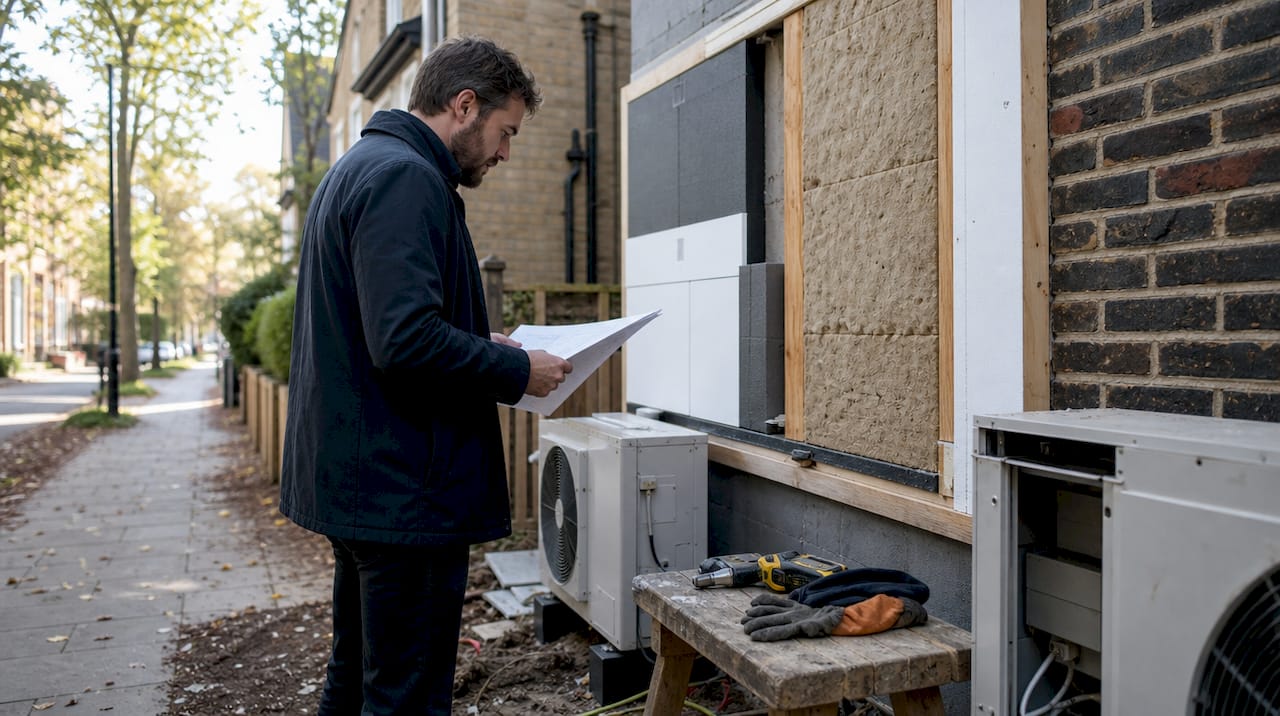
Heating strategy is where most schemes will feel the cost pressure first. Heat pumps and heat networks become the default assumption, which means plant rooms sized for a gas boiler often won’t work without redesign, and commissioning now needs to account for heat pump-specific handover documentation.
L3 changes how renewables get treated in the design programme. Rather than optional roof PV added late, on-site renewable generation now needs to be resolved during schematic design, whether that’s a standard roof array, a courtyard installation on denser schemes, or an alternative arrangement where roof space genuinely can’t take panels.
Pro Tip: Model your renewable strategy before you finalize roof form and massing. Retrofitting PV into a roof designed without it is one of the most common and expensive redesign triggers we see on live schemes.
- Fabric: building specifications require better thermal performance and improved airtightness compared to previous standards.
- Heating: low-carbon systems such as heat pumps and heat networks are expected as standard.
- Renewables: the L3 requirement mandates on-site renewable electricity generation for dwellings, influencing design choices like roof or courtyard solar arrays.
- Services: lifts and escalators are now included within the definition of fixed building services, impacting energy assessments and commissioning.
- Ventilation: design decisions between MVHR and decentralized extraction systems must be resolved earlier due to stricter airtightness and overheating requirements.
A typical three-bed semi under the 2026 rules likely needs an air source heat pump, enhanced fabric, and a resolved PV layout before planning submission. A small commercial unit with a passenger lift now needs that lift’s energy demand factored into the building services calculation, not treated as a separate mechanical afterthought.
What Compliance Tests and Documents Are Required?
At launch, SAP 10.3 remains the operating modeling tool for dwellings, with the Home Energy Model rolling out alongside it, so expect a dual-running period where both outputs may be requested. Non-domestic schemes continue to rely on BRUKL outputs and the associated energy statement.
- Confirm which modeling tool (SAP 10.3 or HEM) your building control body expects for the plot’s transitional status.
- Commission airtightness testing early enough to catch fabric issues before completion, not after.
- Compile commissioning records for heating and ventilation systems, signed off by a competent person.
- Prepare homeowner information under regulation 40C, covering system operation and maintenance.
- For non-domestic buildings, finalize the BRUKL output and energy statement ahead of building control sign-off.
- Design team confirms the target metrics (primary energy, carbon, fabric energy efficiency) at RIBA Stage 3.
- M&E engineer signs off commissioning evidence before practical completion.
- Building control verifies documentation matches the plot’s applicable Part L edition.
Why Do the Application and Commencement Dates Both Matter?
- 24 March 2026: Approved Document L (2026) and the amendment regulations published.
- 24 March 2027: FHS comes into force for standard building work.
- 24 September 2027: HRB-specific provisions come into force.
- 24 March 2028: hard cutoff. Commence by this date on a plot that applied before March 2027, or that plot loses eligibility for Part L 2021.
Industry warnings are consistent on one point: many teams treat the registration deadline as the finish line and overlook the commencement deadline entirely.
The trap is straightforward. A developer submits a building notice in early 2027, celebrates beating the FHS in-force date, and then doesn’t break ground until late 2028 because of a funding delay or contractor mobilization issue. That plot has quietly lost its transitional status. Commencement means substantive work, such as drainage or foundations, not a site hoarding and a skip. Acceptable evidence includes dated site diary entries, photographs of foundation or drainage works, and contractor mobilization records timestamped before 24 March 2028.
What Should Architects and Developers Do Now?
- Audit every live plot against its application date and current commencement status.
- Confirm which Part L edition applies to each plot, not just the overall planning permission.
- Gather and timestamp commencement evidence now, before it becomes a dispute with building control.
- Update house types and specifications to reflect L3 and the tighter fabric targets.
- Engage building control early on any plot with an ambiguous transitional status.
- Check heat pump and MVHR supply chains for lead times that could push commencement past March 2028.
- Reforecast budgets to reflect higher fabric, heating, and renewable generation costs.
- Prioritize plots at greatest risk of missing the cutoff for earliest mobilization.
Architects should lead the house type review, developers should own the plot-by-plot commencement audit, and contractors need to flag any procurement item with a lead time long enough to threaten the March 2028 deadline.
Pro Tip: Order heat pumps and MVHR units for transitional plots before you finalize other trade packages. These are the components most likely to have lead times that quietly eat your commencement window.

What Will Part L 2026 Add to Project Costs?
Heat pump plant, MVHR systems, upgraded fabric and insulation, on-site renewables, and additional commissioning and testing are the five cost drivers that show up on nearly every scheme moving to the 2026 standard. Expect the impact assessment behind the regulations to confirm what most quantity surveyors are already forecasting: a per-dwelling cost uplift concentrated in heating plant and renewable generation, not fabric alone.
- Heat pump plant and distribution redesign.
- MVHR or enhanced ventilation strategy.
- Fabric and insulation uplift to meet the tighter notional specification.
- On-site renewable generation (PV or equivalent).
- Additional commissioning, testing, and documentation time.
Pro Tip: Stage your procurement so long-lead items like heat pumps are ordered against a confirmed commencement date, not a hoped-for one. A cancelled or delayed order is often the real reason a plot misses the March 2028 cutoff.
What We’re Seeing Across Client Pipelines
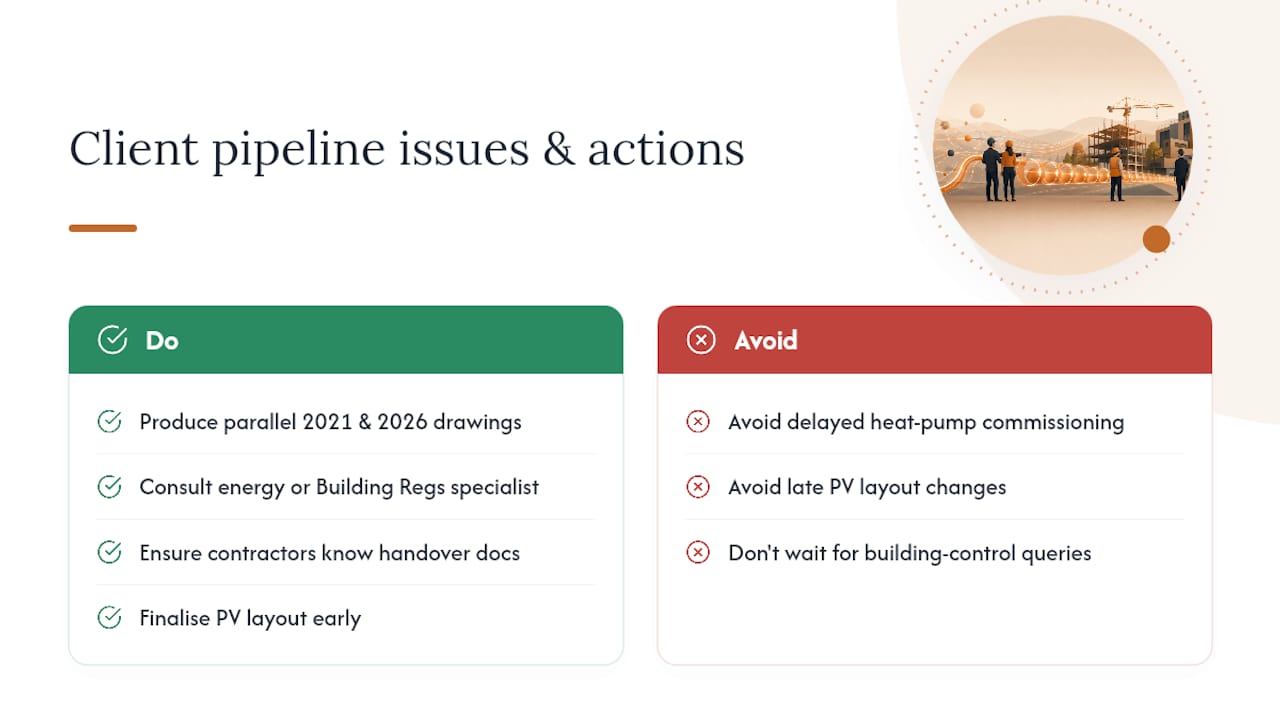
Fortress Associates has watched registrations surge as developers race the March 2027 deadline, often running two parallel sets of house type drawings, one for Part L 2021 eligibility and one already built to the 2026 standard as a fallback.
The most common friction point is commissioning delay on heat pump systems, usually caused by contractors unfamiliar with the handover documentation now expected. A close second is PV layout compromises made too late in the process, forcing awkward roof penetrations or reduced array sizes. If your team is unsure whether a plot’s evidence will hold up, that’s the point to bring in an energy statement or Building Regulations drawings specialist, not after building control raises a query.
Get Your Part L Transition Evidence Right the First Time
Every developer we talk to right now is juggling the same problem: proving commencement, hitting fabric targets, and getting renewable generation designed in before it’s too late to change the roof. Fortress Associates builds the paperwork that carries that proof, energy statements, Building Regulations drawings, and commencement evidence packs, using live official data rather than templated assumptions.
Every report comes on a fixed fee with no advance payment, and if a report gets rejected, Fortress Associates amends or refunds it. That’s a real backstop when a single missed deadline can flip an entire plot onto the 2026 standard. Transitional evidence packs typically turn around fast enough to slot into a tight commencement window, which matters when March 2028 is closer than it looks on a Gantt chart.
If you need Building Regulations drawings that hold up against whichever Part L edition applies to your plot, get a fixed-fee quote before your next commencement deadline.
Where to Read the Official Part L Guidance
- Approved Document L (2026) covers the technical guidance for meeting the updated energy and emissions requirements.
- The Future Homes and Buildings Standards Building Circular explains the transitional timeline and policy intent.
- S.I. 2026/335 is the statutory instrument amending the Building Regulations 2010, showing the exact legal wording behind L1 and L3.
This article is general information, not a substitute for advice from a qualified lawyer. Consult a qualified legal professional about your own circumstances before acting on anything here.
Sources
- The Future Homes and Buildings Standards: Building Circular 01/2026 - letter
- Approved Document L (2026)
- THE BUILDING REGULATIONS ETC. (AMENDMENT) (ENGLAND) REGULATIONS 2026 (FHBS Circular)
- The Building Regulations etc. (Amendment) (England) Regulations 2026 (S.I. 2026/335)
Recommended
- Part L 2021 or the Future Homes Standard? Which Applies (2026) - Fortress Associates
- Future Homes Standard Transitional Arrangements Explained (2027) - Fortress Associates
- The Future Homes Standard 2026: What It Means for Energy Statements - Fortress Associates
- Daylight Reports for Build-to-Rent (BTR) Schemes: A 2026 Guide - Fortress Associates
Need help with a UK planning project?
Fixed-fee daylight & sunlight reports and Building Regulations drawings - plus flood risk assessments, air quality assessments, energy statements and sustainability statements for planning applications across the UK.
Request a free quote