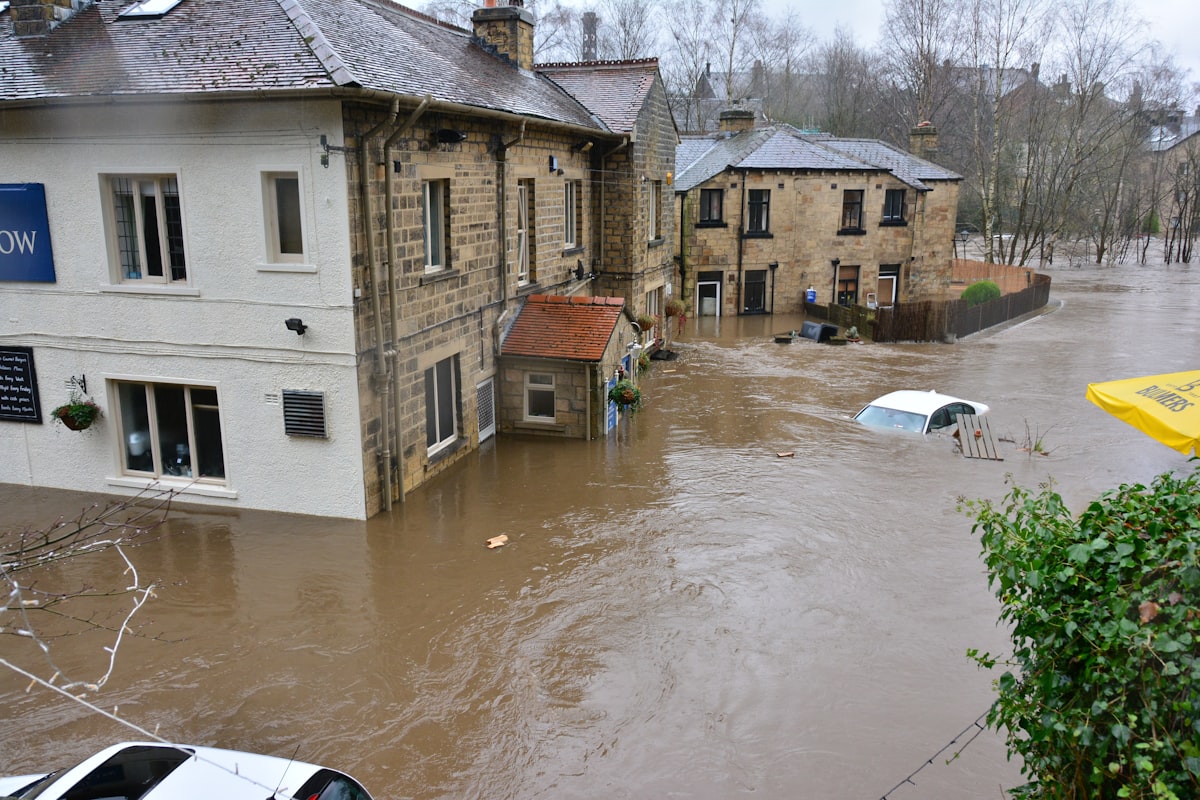
Finding out your site sits in Flood Zone 2 is not the end of your project. Most types of development are considered appropriate in Flood Zone 2 under national policy — but planning permission comes with conditions attached: you will need a site-specific flood risk assessment (FRA) with every application, and for some proposals you must also pass the Sequential Test. Get those two things right and Flood Zone 2 sites are approved routinely across England.
This guide walks through what Flood Zone 2 actually means, when the Sequential Test applies, and what your FRA must demonstrate to satisfy the local planning authority in 2026.
What Flood Zone 2 means
The Environment Agency's Flood Map for Planning divides England into three flood zones based on the annual probability of flooding from rivers and the sea, ignoring existing defences:
- Zone 1 — less than 0.1% annual probability (less than 1 in 1,000). Low risk.
- Zone 2 — between 1 in 100 and 1 in 1,000 annual probability of river flooding (1%–0.1%), or between 1 in 200 and 1 in 1,000 from the sea (0.5%–0.1%). Medium risk.
- Zone 3 — 1 in 100 or greater from rivers, or 1 in 200 or greater from the sea. High risk.
Zone 2 is best understood as the outer margin of the floodplain: land that floods in rarer, more extreme events than the Zone 3 core. Our guide to Flood Zones 1, 2 and 3 covers the definitions in more depth. Note that the flood zones only cover rivers and the sea — surface water is mapped separately, and since the Environment Agency's 2026 update the Flood Map for Planning also shows climate-change extents and depth bands, which councils increasingly expect FRAs to address.
What development is allowed in Flood Zone 2?
National policy classifies development by flood-risk vulnerability, set out in Annex 3 of the National Planning Policy Framework and the Planning Practice Guidance:
- Water-compatible and less vulnerable uses (shops, offices, industry) — appropriate in Zone 2.
- More vulnerable uses (houses, flats, care facilities, drinking establishments) — appropriate in Zone 2, subject to the Sequential Test where it applies.
- Highly vulnerable uses (basement dwellings, caravans and mobile homes intended for permanent residence) — only acceptable in Zone 2 if the Exception Test is also passed.
In short: ordinary housing is acceptable in Flood Zone 2. The one common trap is the self-contained basement flat, which jumps into the "highly vulnerable" class and triggers the much tougher Exception Test.
The Sequential Test in Flood Zone 2
The Sequential Test asks whether the development could reasonably be located on an available site at lower flood risk — i.e. in Zone 1. For sites in Zone 2 the local planning authority must apply it before granting permission, but the Planning Practice Guidance carves out significant exemptions. The Sequential Test is not required for:
- householder development (extensions, outbuildings, alterations to a single dwelling);
- minor development such as small non-residential extensions;
- changes of use (except to caravan/camping sites), and
- sites allocated for that use in an adopted local plan that has already been sequentially tested.
So a rear extension or loft conversion in Zone 2 does not need a Sequential Test at all — it needs a proportionate FRA. For new dwellings on unallocated sites, expect to submit Sequential Test evidence: a search area agreed with the council, a list of reasonably available alternative sites, and reasons why each cannot accommodate the scheme. Done properly this is a paper exercise; done badly it is one of the most common reasons Zone 2 applications stall.
What your flood risk assessment must show
A site-specific FRA is required for all development in Flood Zone 2 — including householder extensions. The Environment Agency publishes standing advice setting out what a proportionate FRA should contain, and since March 2025 a standard FRA template. For a typical Zone 2 application the assessment should:
- Identify all sources of flood risk — not just rivers and sea, but surface water, groundwater, sewers and reservoirs;
- Set finished floor levels — typically a minimum of 300 mm above the estimated flood level, or above surrounding ground where no level is available;
- Specify flood resistance and resilience measures — flood-resistant doors and airbricks, non-return valves, resilient materials and raised electrics up to the design flood level;
- Confirm safe access and egress and, where relevant, a flood plan for occupants;
- Include a drainage strategy — sustainable drainage (SuDS) designed to CIRIA C753 principles, with runoff limited so the development does not increase flood risk elsewhere; and
- Apply climate change allowances appropriate to the development's lifetime and the river basin district — see our guide to climate change allowances in FRAs.
Councils refuse or delay far more Zone 2 applications for a missing or inadequate FRA than for the flood risk itself. An application in Zone 2 submitted without an FRA is invalid — it will not even be registered by most authorities.
A practical playbook for Flood Zone 2 approval
- 1. Confirm your zone and flood sources on the Flood Map for Planning, and check surface water mapping separately — many "Zone 2" refusals are actually surface-water problems.
- 2. Check your vulnerability class. Keep habitable basement accommodation out of the scheme unless you are ready for the Exception Test.
- 3. Deal with the Sequential Test early. If your proposal is not exempt, agree the search area with the council before submission rather than arguing about it afterwards.
- 4. Design in mitigation from the start — raised floor levels, resilient construction and SuDS are cheap on paper and expensive to retrofit after a refusal.
- 5. Submit a compliant, site-specific FRA following the EA template, not a generic desk study. Costs are modest compared to a resubmission — see our guide to flood risk assessment costs.
How Fortress Associates can help
Our flood risk assessment service produces a free, site-specific FRA for planning applications in England, generated in minutes using live Environment Agency data. It screens your flood zone, assesses surface water risk, supports the Sequential Test, and includes a SuDS drainage strategy to CIRIA C753 — following the Environment Agency's FRA template (March 2025) and standing advice on floor levels and resilience. It is designed for householder extensions, new dwellings and small-scale schemes. Contact us if your site is more complex.
Sources & further reading
Need help with a UK planning project?
Fixed-fee daylight & sunlight reports and Building Regulations drawings — delivered in 4–5 working days, no advance payment — plus flood risk assessments, air quality assessments, energy statements and sustainability statements for planning applications across the UK.
Request a free quote